10 min de lectura
Paolo Longinotti (1913-1963)
His career
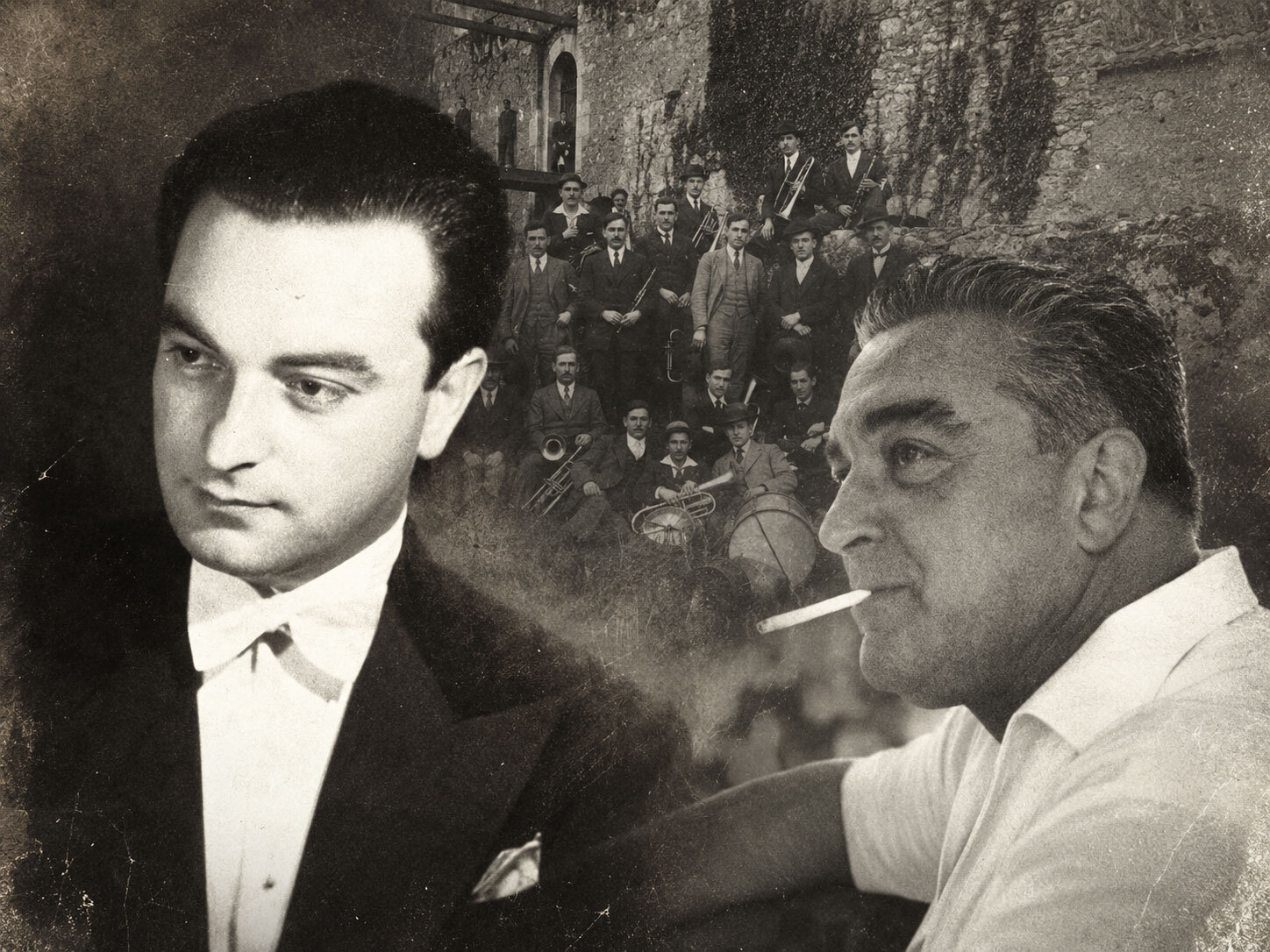
Paolo Longinotti
Paolo Longinotti was one of the most prestigious trumpeters of his age. He belongs to that family of exceptional artists who stand out by virtue of their talent and their personality.
He was the solo trumpet of the Suisse Romande Orchestra (succeeding Francis Bodet in 1949) during that orchestra’s great period of success, one of the unquestionable trump cards in Ernest Ansermet’s orchestral hand.
Paolo Longinotti was the true orchestral solo trumpet and so recorded few concertos as a soloist. On the other hand he can be heard in every one of the great series of recordings made by Ansermet and the Suisse Romande between 1940 and 1960.
He was born in Bellinzona, in the Swiss canton of Ticino, on 6th November 1913. He received his first piano lessons at the age of six from maestro Casagrande. His father Ercole Longinotti (a founder member of the Musica Ferrovieri, the railwaymen’s band, in Bellinzona) taught him the rudiments of music and of the trumpet as well as a love of music. From his twelfth year onwards he continued his study of theory with Professor Fasolis and learned the violin with Professor Bertoni in Lugano. He continued to study the trumpet with Messrs. Mattey and Ombra. After his studies as a dental technician (for which he obtained a diploma in 1933) it was a passion for music that was to determine his destiny. At the Geneva Conservatoire, where he attended few of Professor Dupont’s trumpet lessons, he obtained a virtuoso diploma with special distinction. He studied musical theory with Professors Jules Philippe Godard and Alexandre Dénéréaz in Lausanne.
His first solo trumpet job was from 1st June 1933 to 31st March 1935 at the Orchestra of Radio Lausanne. He then went to the corresponding job at the Suisse Romande Radio Orchestra, which had just been set up and which was disbanded on 30th September 1938. He was then, for the first time, appointed 1st trumpet at Ernest Ansermet’s Suisse Romande Orchestra. In 1942 he left Geneva for Zürich where the Tonhalle Orchestra offered him a better job. At the same time he was solo trumpet at the Lucerne Festival Orchestra for fourteen seasons, playing under the greatest conductors of his time — Toscanini, Furtwängler, Schuricht, Karajan, Bruno Walter, Clemens Krauss, Knappertsbusch, Sabata, Markevich, Dobrowen and many others — all of whom noted and appreciated his playing. He continued to study composition with Professor Müller in Zürich and conducting with Paul Kletzki in Lucerne.
In 1948 Ernest Ansermet asked his administrator to go and fetch Paolo Longinotti from Zürich to lead the section at the Suisse Romande. The horse trading lasted until March 1949, when Longinotti signed a contract as “1st solo 1st trumpet” for “800 francs a month, with four weeks paid leave”. This was success. The orchestra was at its peak.
In 1950 the Berlin Philharmonic, then in its great Furtwängler period, made him a definite offer of 950 marks a month. He would only have to play the concerts, and all sorts of opportunities for additional earnings were pointed out to him. The administrator, Fischer, ended his letter by saying that he hoped its contents would remain confidential. Longinotti declined this offer because “in Berlin there are not enough outdoor cafes where you can sit and drink coffee in the sun!... and it is too far from Ticino!”
At this time (before Adolf Scherbaum arrived on the scene) Longinotti was one of the few great piccolo-trumpet specialists. The shortage of trumpeters capable of playing the 2nd Brandenburg Concerto, for example, could be seen from the occasions when a soprano saxophone or clarinet was booked instead!¹ It was no surprise that people all over Europe were fighting to get hold of Longinotti.² He played the 2nd Brandenburg at least forty times and made a recording as memorable for its musicality as for its technical skill.³
Continue reading
Accede a la edición digital completa.
Brass Bulletin 47, III / 1984 páginas 58–69
Todo el contenido está protegido por derechos de autor © Brass Bulletin 1984–2026