5 min de lectura
Tonguing
Por Louis Davidson
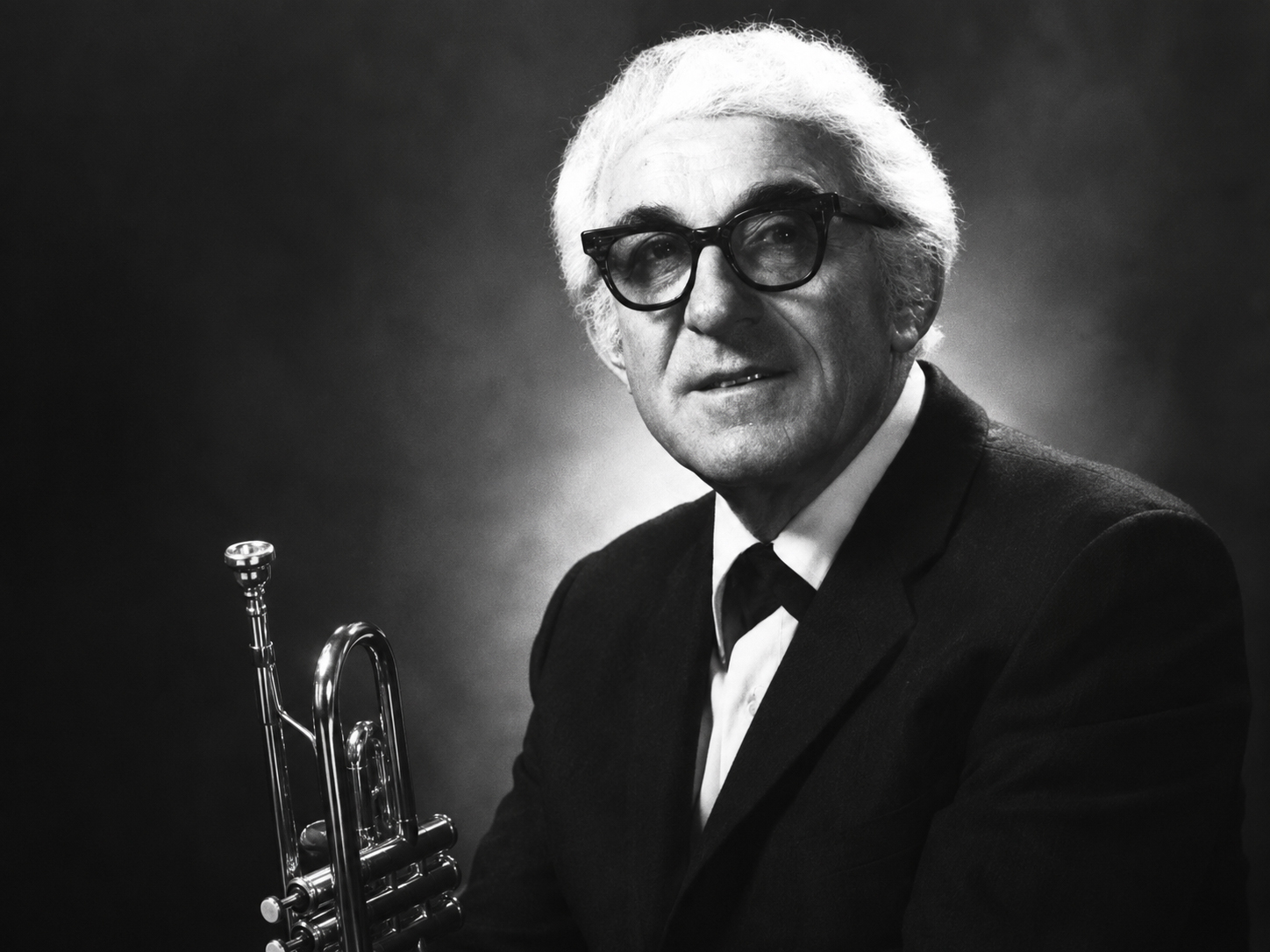
Louis Davidson
Shortening the stroke of the tongue to the smallest degree possible is the most direct means to the achievement of correct tonguing technique, because: 1) The shorter the stroke, the faster the tongue can articulate. It is the long forward and retracting movement that causes sluggish tonguing. 2) The shorter the stroke, the less energy expended, thereby greatly reducing tongue fatigue. 3) The shorter the stroke, the less the possibility of the tongue going “off the track” or out of its groove, thus ensuring greater accuracy.
An extremely important and integral element of this short stroke technique is the constant support of the breath and the sensation of an uninterrupted flow of air — exactly as when holding a long tone — which must underlie all articulated notes.
The physical sensation of the technique may be experienced without using the trumpet by humming a long tone while at the same time articulating a series of “doo’s” — “doo doo doo doo.” (the use of the syllable “doo”, rather than the conventional “too”, at this stage, is most important in developing this technique as the “doo” is best suited for shortening the tongue stroke.) The effect is actually that of a series of articulations superimposed over a long sustained tone. As with the attack, the point of contact in the forward movement of the tongue, with most players, will be in the area of the upper teeth and gum line. Experimenting thus vocally, the tongue, while articulating the series of “doo’s”, will remain very close to the teeth. The tongue movement will be minimal and there will be almost a complete absence of any sensation of movement at the base of the tongue.
Ideally, when the tongue and breath are used in this manner, there should be no more visible sign of any tongue movement inside the mouth than there is any visible sign of movement when holding a long tone. Aurally, the effect should be that of a sustained and flowing sound. Generally, with long strokes of the tongue, facial movements corresponding to each stroke reflect the laboriousness of the tongue’s movements. The player having this problem can deal most effectively with it by practicing in front of the mirror. He can then see, as well as feel, the facial movements and, by shortening the stroke of the tongue as much as possible, these movements can be greatly reduced if not entirely eliminated.
Striving to retain the physical sensation of the vocal experiment, the player should now begin to practice this technique on the trumpet. The tonal and dynamic range, as well as the degree of speed, should be comfortable — not too high or too low, not too loud or too soft and not too fast or too slow. Again, as when vocalizing, only the “doo” syllable should be used; for in addition to keeping the tongue close to the teeth and shortening the stroke, it also greatly encourages sustained breath support.
Once the player has acquired a facility and consistency in this technique, he should begin to develop, by degrees, the harder and more pointed kind of articulation. Actually, this merely involves a slight intensification of the soft “doo” that the player has been practicing to shorten the stroke of the tongue. Now, the “doo” should begin to have a little more definition, a little sharper point (hardness) to each articulation. By a continued and gradual intensification of this syllable, the “doo” articulation will evolve through stages, into a soft “too” then the hard “too” syllable that is by far the most often used. Normally the player should not experience great difficulty in changing from the softer “too” to the harder “too” and in a reasonable time he should be able to play both with equal facility.
As with the soft “too” articulation, spaces between the notes should be just as carefully avoided with the harder “too” articulations. It is this uninterrupted flow of air, plus the sharper point on each articulated note, that gives to this technique the wonderful quality of resonance and clarity in tongued passages, either fast or slow.
Continue reading
Accede a la edición digital completa.
Brass Bulletin 44, IV / 1983 páginas 38–42
Todo el contenido está protegido por derechos de autor © Brass Bulletin 1983–2026