Ofrezca Brass Bulletin en su universidad, conservatorio o biblioteca Descubra el acceso institucional

3 min de lectura

Early trumpet music in Schwerin

Early trumpet music in Schwerin

This article has been inspired by the interesting articles and useful lists by David Whitwell which have appeared in The Instrumentalist over the past ten years. Researchers have done much work to catalog early trumpet music during the past decade, and two important bibliographies emphasizing solo trumpet music have been published (Don Smithers' Music and History of the Baroque Trumpet Before 1721, and Detlef Altenburg's Untersuchungen zur Geschichte der Trompete im Zeitalter der Clarinblaskunst (1500–1800). Although many works have been found and cataloged, some collections have been neglected. Such is the case of the trumpet music in the Mecklenburgische Landesbibliothek at Schwerin.

All of the works in the following list are manuscript (unless otherwise noted), and the majority are from the mid-eighteenth to early nineteenth century in origin. Many of the works are clearly among the early compositions for wind band. The use of the trumpet runs the full gamut, from virtuoso solo parts to simple parts stressing rhythms and cadences. The trumpet had reached its greatest performance technique by 1760 but, on the other hand, was suffering from what historians popularly call a “decline” in performance technique. This “decline” may be attributed to several factors including the equal temperament tuning with the new possibility to modulate frequently to various keys within a given work. Perhaps the main reason for the “decline” was the changing social hierarchy of eighteenth century Europe and with it the changing socio-musical climate in which trumpeters performed.

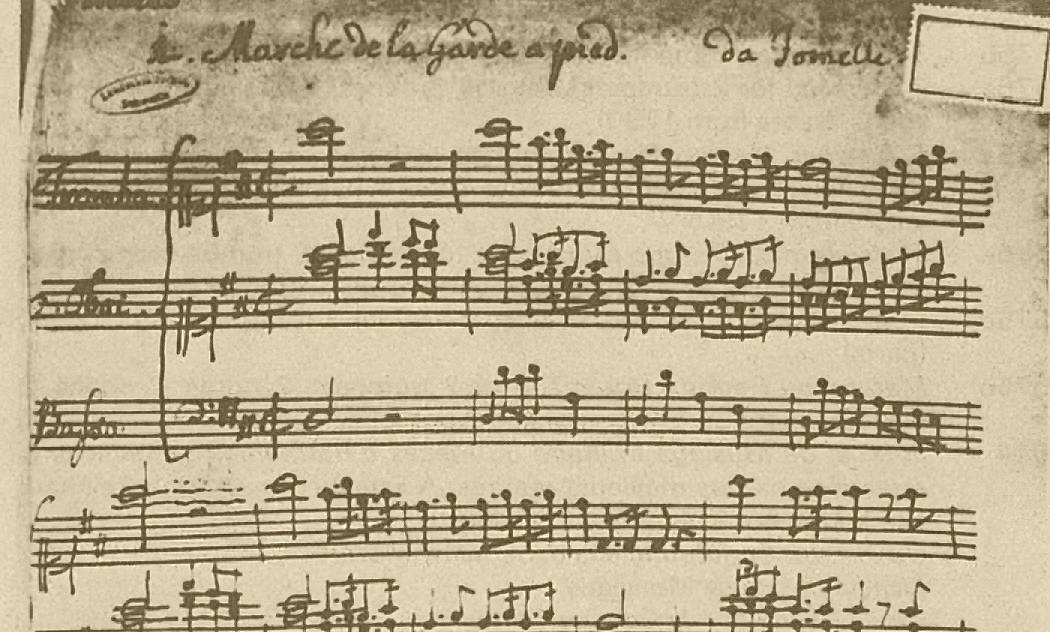
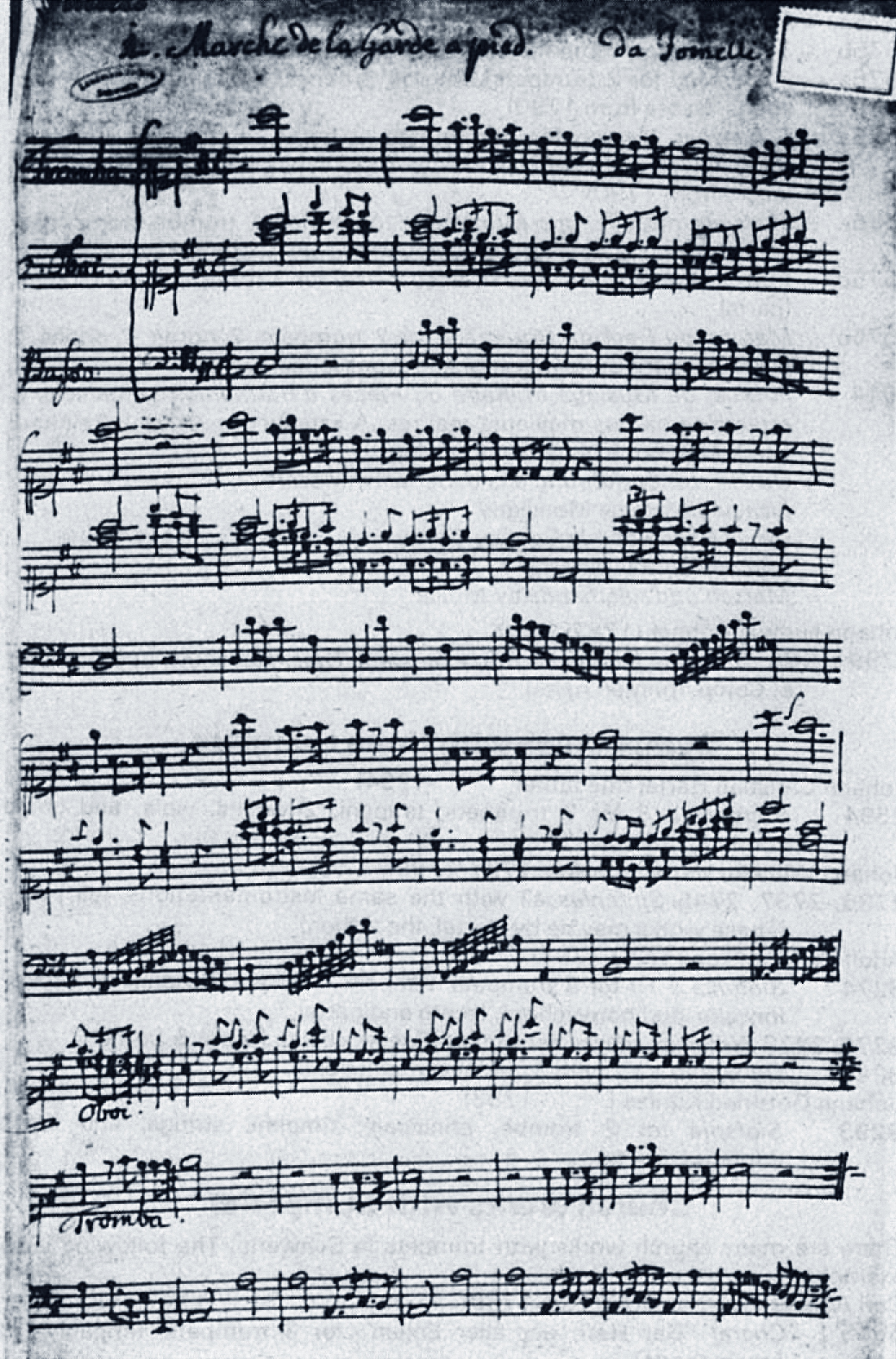
Marche de la Garde à pied by Jomelli (Schwerin 3009)

Marche de la Garde à pied by Jomelli (Schwerin 3009)

Modern scholars have concentrated their study on solo and orchestral works with trumpets, and for this reason, the list which follows may be something of a surprise. It is apparent that trumpets and horns were frequently used with other woodwind instruments. Wind bands did exist before, in England and France. It seems that the English wind players who were part of the King’s Musick (including 16 trumpets, kettledrums, shawms, cornetts and sackbuts) did not perform as a single unit. It also appears that Louis XIV supported perhaps the first organized “wind band” in the last few decades of the seventeenth century. Denner “invented” what we know today as the modern clarinet in 1690 and this led the way for the numerous instrumental combinations found in the present list of early wind band manuscripts.

In 1763 Frederick the Great fixed the Prussian army band at 2 oboes, 2 clarinets, 2 horns, and 2 bassoons. David Whitwell has already called attention to the Haydn and Mozart works written for ensembles of mixed winds. (See: A New History of Wind Music, published by The Instrumentalist, 1972.) What eventually was to happen in the early nineteenth century and which would culminate in the standardization of our own contemporary band instrumentation may be seen in three basic elements. It is true that each was happening at the same time and over a period of years. First, the high brass were made chromatic—finally and successfully—by use of the piston and rotary valves. Second, the “industrial revolution” came to music instrument manufacturing with many new models designed and complete families of homogeneous instruments developed. Third, the doubling of parts once the wind instrument families had been developed allowed band leaders to promote their personal concepts of instrumentation and influence the standardizing of what we call the modern concert band. (Certainly one must perceive this in general terms, as there is continuous change still going on.)
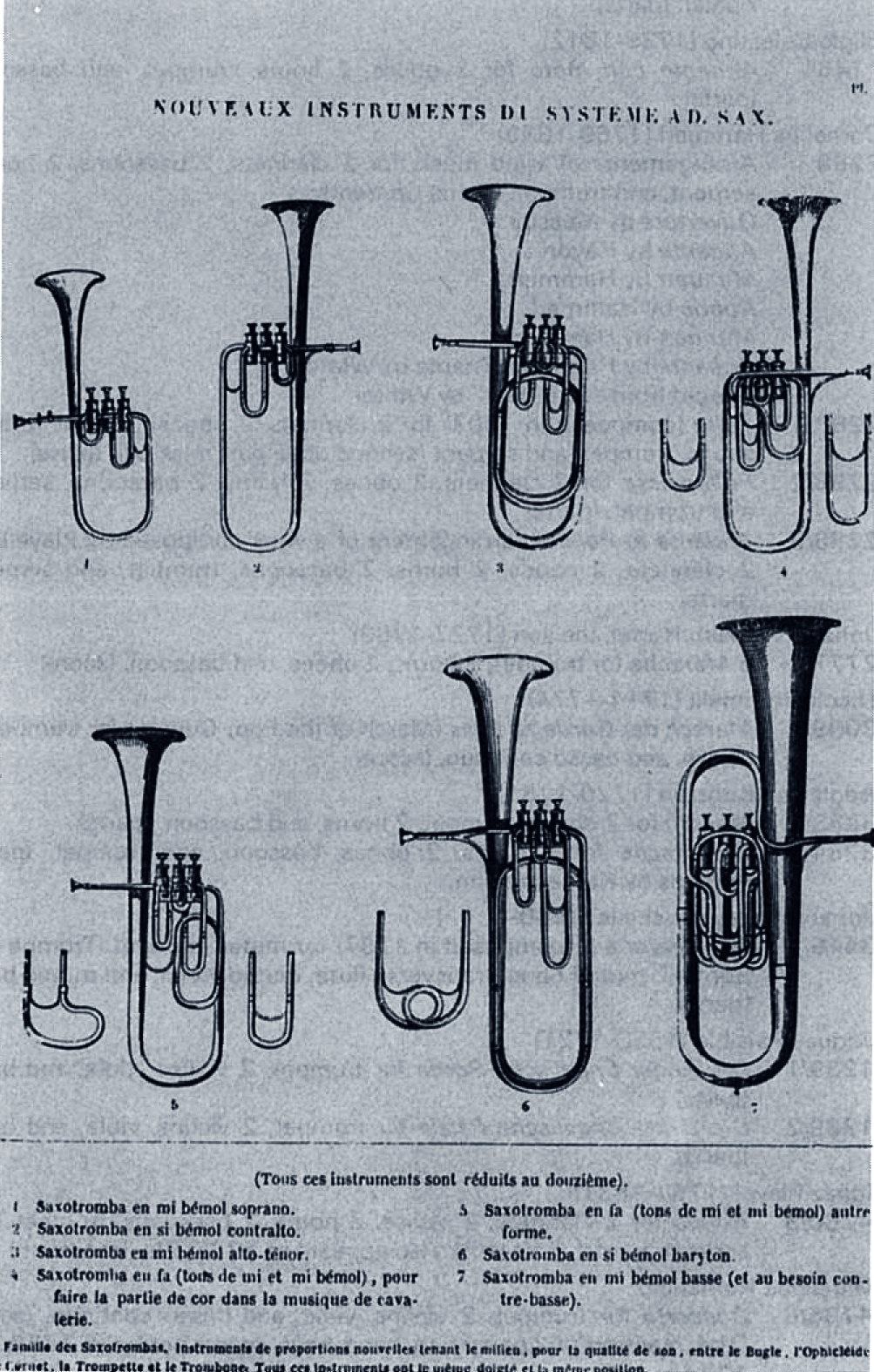
A plate from Georges Kastner’s Manuel Général de Musique Militaire (Paris, 1848) showing the development of families of...

A plate from Georges Kastner’s Manuel Général de Musique Militaire (Paris, 1848) showing the development of families of homogeneous brass instruments. This made possible new (and larger) scorings for wind bands and a new style of playing which differed from the traditional trumpet style.

With its ability to play chromatically and with great volume, the soprano brass (ultimately the cornet) became the “concertmaster” instrument of the band. The concept of orchestral trumpet scoring, with its limited tonal resources, was to continue in the tradition firmly established by Haydn and Mozart. This trumpet style was to become more daring only slowly, while the “cornet” style took over its new function more quickly.

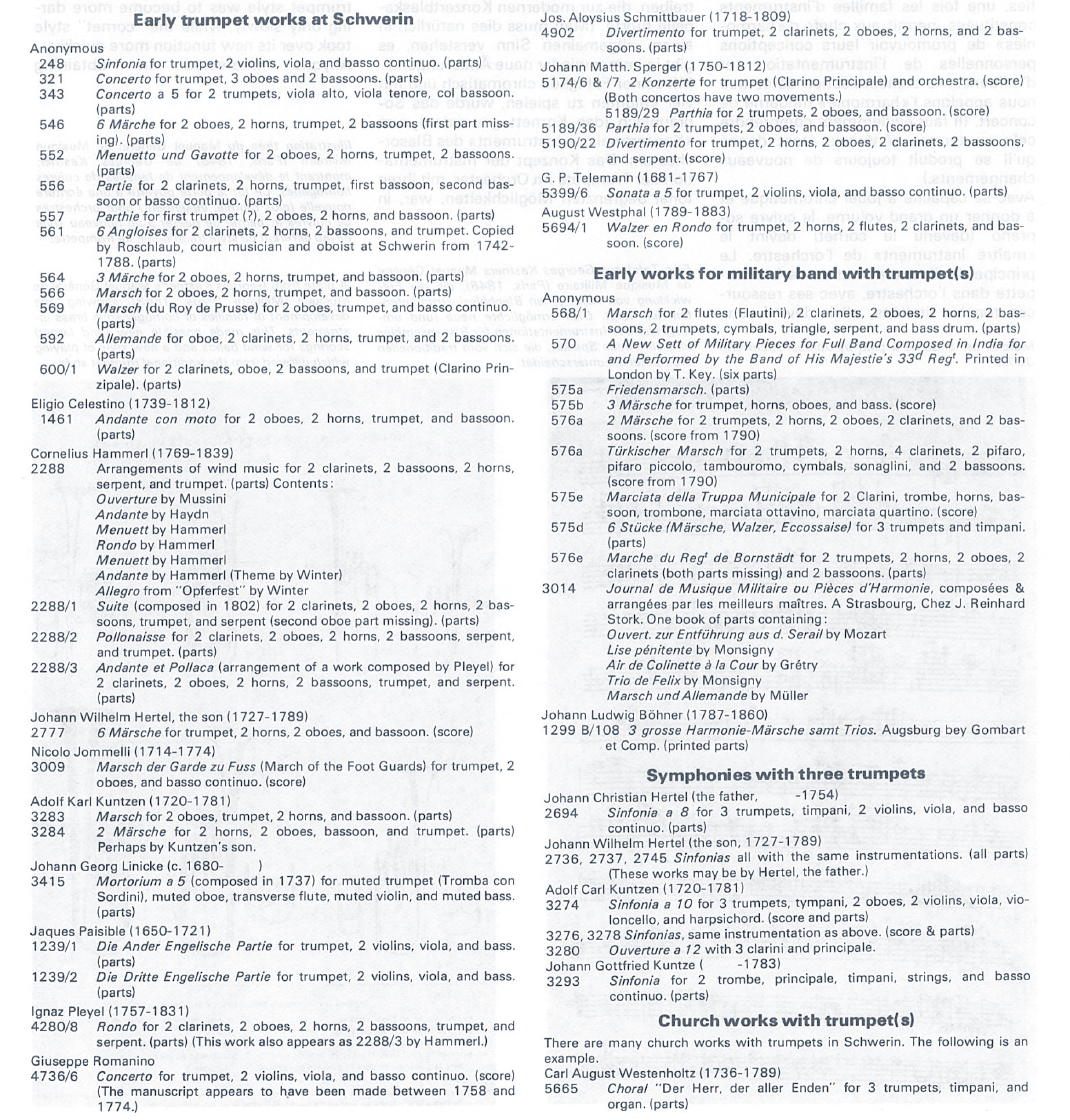
Anyone interested in obtaining microfilms of works listed should write to: Mecklenburgische Landesbibliothek, Musikabteilung, Am Dom 2, DDR-27 Schwerin. In the following lists, the library call number is given first, followed by the original title, and then, the instrumentation (which has been given in English).
Brass Bulletin image

Brass Bulletin 23, III / 1978 páginas 35–40

Todo el contenido está protegido por derechos de autor © Brass Bulletin 1978–2026

Compartir este artículo

Facebook LinkedIn
Cargando…

Preguntas y respuestas

Cómo funciona la edición digital

¿Qué incluye la edición digital?

La edición digital reúne los artículos ya digitalizados como textos legibles y consultables en línea —no simplemente como escaneos o archivos PDF— junto con sus ilustraciones originales, notas, autoría, información del número y traducciones disponibles. Las sugerencias de artículos relacionados incluyen actualmente solo este material digitalizado.

¿Los artículos digitales son idénticos a los originales?

Conservamos con la mayor fidelidad posible el texto original, el idioma, las ilustraciones, los pies de imagen, las notas y el contexto editorial. La presentación se adapta para facilitar la lectura en línea y pueden corregirse errores evidentes de transcripción o escaneado. El contenido y el carácter del artículo publicado permanecen inalterados.

¿Qué idiomas están disponibles?

Brass Bulletin se publicó en inglés, francés y alemán a lo largo de toda su historia. Las traducciones al italiano y al español se añadieron a partir del número 60. Por este motivo, en los sitios italiano y español los artículos de los números 1 a 59 se muestran en inglés de forma predeterminada.

¿Con qué frecuencia se añaden nuevos artículos?

Se añaden nuevos artículos casi a diario, con aproximadamente un número completo digitalizado cada semana. El ritmo puede variar según el trabajo de preparación, tratamiento de imágenes y revisión editorial necesario.

¿Por qué no están disponibles todos los artículos en formato digital?

La colección completa de Brass Bulletin contiene 1.246 artículos publicados entre 1971 y 2003. El índice completo ya está disponible en línea y permite descubrir todos los artículos de la colección, incluidos aquellos cuyo texto íntegro todavía no ha sido digitalizado.

La digitalización comenzó en febrero de 2026. Cada artículo se prepara cuidadosamente para la lectura en línea, se revisa y se vincula con su número, sus autores, sus temas y sus ilustraciones. Al ritmo actual de digitalización, se prevé que la colección completa esté disponible en línea en febrero de 2028.

¿Por qué algunas referencias mencionan artículos que todavía no están disponibles?

Las referencias de los artículos originales se conservan aunque el material al que remiten aún no haya sido digitalizado. De este modo se mantiene intacto el contexto histórico y editorial. A medida que se incorporen más números a la edición digital, un número creciente de estas referencias conducirá a artículos que podrán leerse en línea.

¿Puedo sugerir un artículo o informar de un error de transcripción?

Sí. Si hay algún artículo que le gustaría especialmente ver digitalizado, o si detecta un posible error de transcripción o algún dato que falta, póngase en contacto con nosotros. Los comentarios de los lectores nos ayudan a mejorar la edición digital y a establecer prioridades útiles dentro del archivo.

¿Cómo puedo apoyar a Brass Bulletin?

Su apoyo ayuda a financiar la preparación, verificación y publicación en línea de la colección completa.

Suscríbase a la Edición Digital

¿Prefiere apoyarnos sin suscribirse?

Haga una donación

¿Cómo avanza la digitalización?

Estamos poniendo Brass Bulletin a disposición de los lectores en línea, artículo por artículo. Pueden leer los artículos recién digitalizados en cuanto estén listos, incluso antes de que se complete un número entero.

Consulten nuestro calendario de digitalización para descubrir las últimas novedades y las fechas estimadas de disponibilidad de los próximos números. Estas estimaciones se basan en nuestro ritmo reciente y pueden cambiar.

Busca en Brass Bulletin.