Rendete Brass Bulletin disponibile nella vostra università, nel vostro conservatorio o nella vostra biblioteca Scoprite l’accesso istituzionale

3 min di lettura

Early trumpet music in Schwerin

Early trumpet music in Schwerin

This article has been inspired by the interesting articles and useful lists by David Whitwell which have appeared in The Instrumentalist over the past ten years. Researchers have done much work to catalog early trumpet music during the past decade, and two important bibliographies emphasizing solo trumpet music have been published (Don Smithers' Music and History of the Baroque Trumpet Before 1721, and Detlef Altenburg's Untersuchungen zur Geschichte der Trompete im Zeitalter der Clarinblaskunst (1500–1800). Although many works have been found and cataloged, some collections have been neglected. Such is the case of the trumpet music in the Mecklenburgische Landesbibliothek at Schwerin.

All of the works in the following list are manuscript (unless otherwise noted), and the majority are from the mid-eighteenth to early nineteenth century in origin. Many of the works are clearly among the early compositions for wind band. The use of the trumpet runs the full gamut, from virtuoso solo parts to simple parts stressing rhythms and cadences. The trumpet had reached its greatest performance technique by 1760 but, on the other hand, was suffering from what historians popularly call a “decline” in performance technique. This “decline” may be attributed to several factors including the equal temperament tuning with the new possibility to modulate frequently to various keys within a given work. Perhaps the main reason for the “decline” was the changing social hierarchy of eighteenth century Europe and with it the changing socio-musical climate in which trumpeters performed.

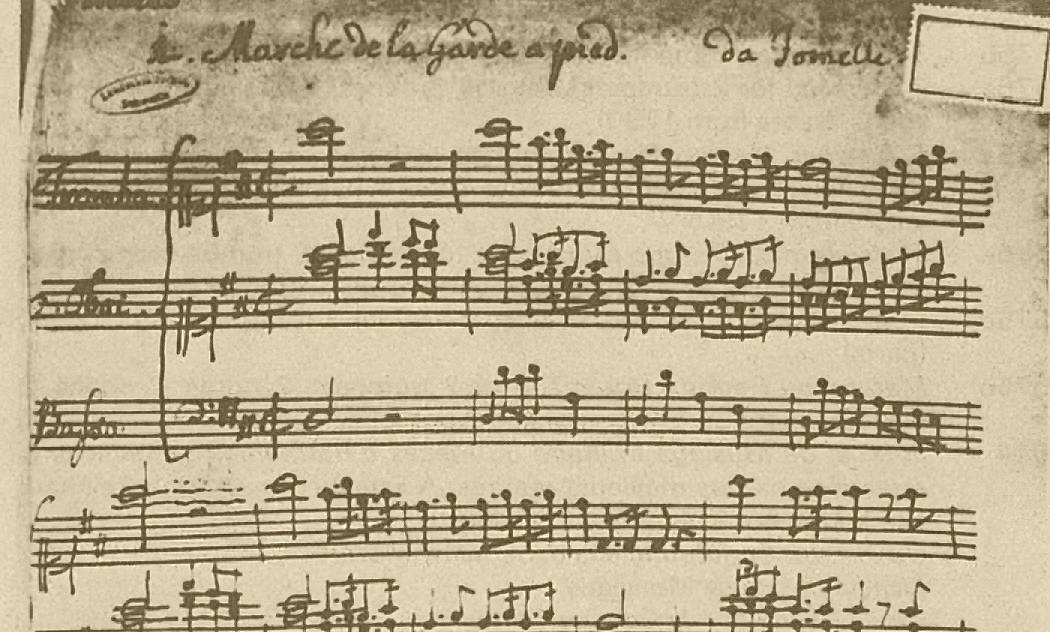
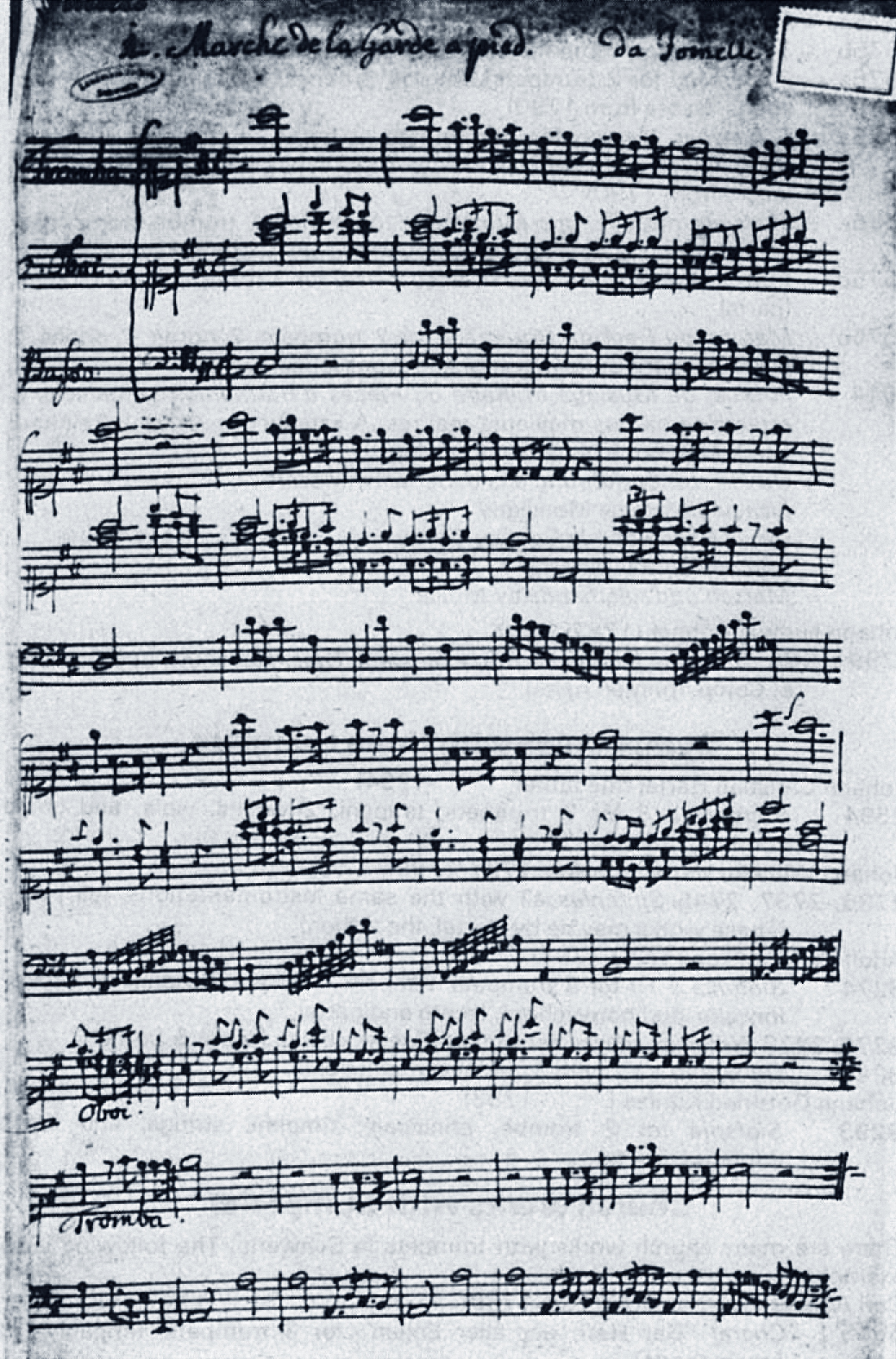
Marche de la Garde à pied by Jomelli (Schwerin 3009)

Marche de la Garde à pied by Jomelli (Schwerin 3009)

Modern scholars have concentrated their study on solo and orchestral works with trumpets, and for this reason, the list which follows may be something of a surprise. It is apparent that trumpets and horns were frequently used with other woodwind instruments. Wind bands did exist before, in England and France. It seems that the English wind players who were part of the King’s Musick (including 16 trumpets, kettledrums, shawms, cornetts and sackbuts) did not perform as a single unit. It also appears that Louis XIV supported perhaps the first organized “wind band” in the last few decades of the seventeenth century. Denner “invented” what we know today as the modern clarinet in 1690 and this led the way for the numerous instrumental combinations found in the present list of early wind band manuscripts.

In 1763 Frederick the Great fixed the Prussian army band at 2 oboes, 2 clarinets, 2 horns, and 2 bassoons. David Whitwell has already called attention to the Haydn and Mozart works written for ensembles of mixed winds. (See: A New History of Wind Music, published by The Instrumentalist, 1972.) What eventually was to happen in the early nineteenth century and which would culminate in the standardization of our own contemporary band instrumentation may be seen in three basic elements. It is true that each was happening at the same time and over a period of years. First, the high brass were made chromatic—finally and successfully—by use of the piston and rotary valves. Second, the “industrial revolution” came to music instrument manufacturing with many new models designed and complete families of homogeneous instruments developed. Third, the doubling of parts once the wind instrument families had been developed allowed band leaders to promote their personal concepts of instrumentation and influence the standardizing of what we call the modern concert band. (Certainly one must perceive this in general terms, as there is continuous change still going on.)
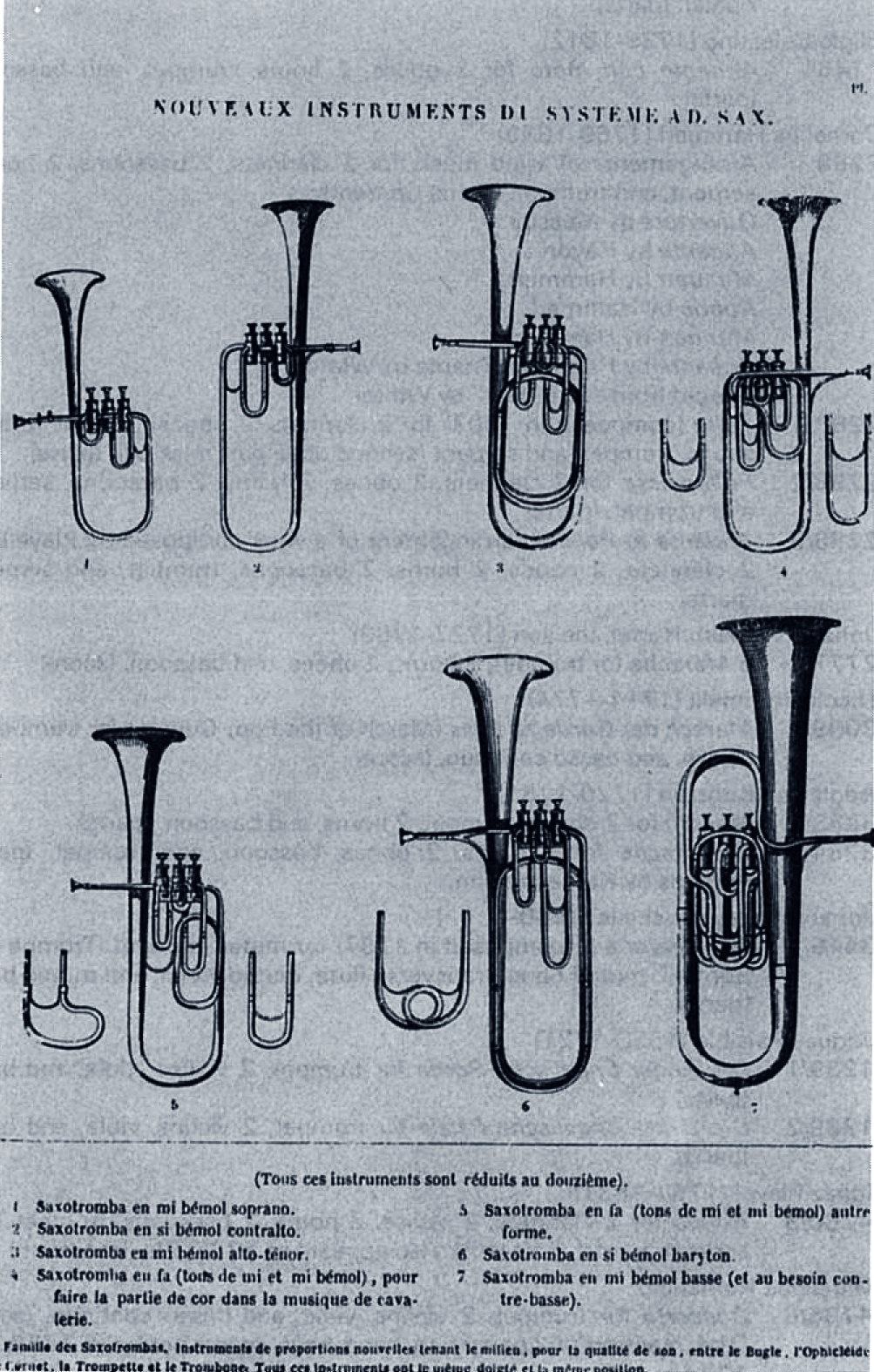
A plate from Georges Kastner’s Manuel Général de Musique Militaire (Paris, 1848) showing the development of families of...

A plate from Georges Kastner’s Manuel Général de Musique Militaire (Paris, 1848) showing the development of families of homogeneous brass instruments. This made possible new (and larger) scorings for wind bands and a new style of playing which differed from the traditional trumpet style.

With its ability to play chromatically and with great volume, the soprano brass (ultimately the cornet) became the “concertmaster” instrument of the band. The concept of orchestral trumpet scoring, with its limited tonal resources, was to continue in the tradition firmly established by Haydn and Mozart. This trumpet style was to become more daring only slowly, while the “cornet” style took over its new function more quickly.

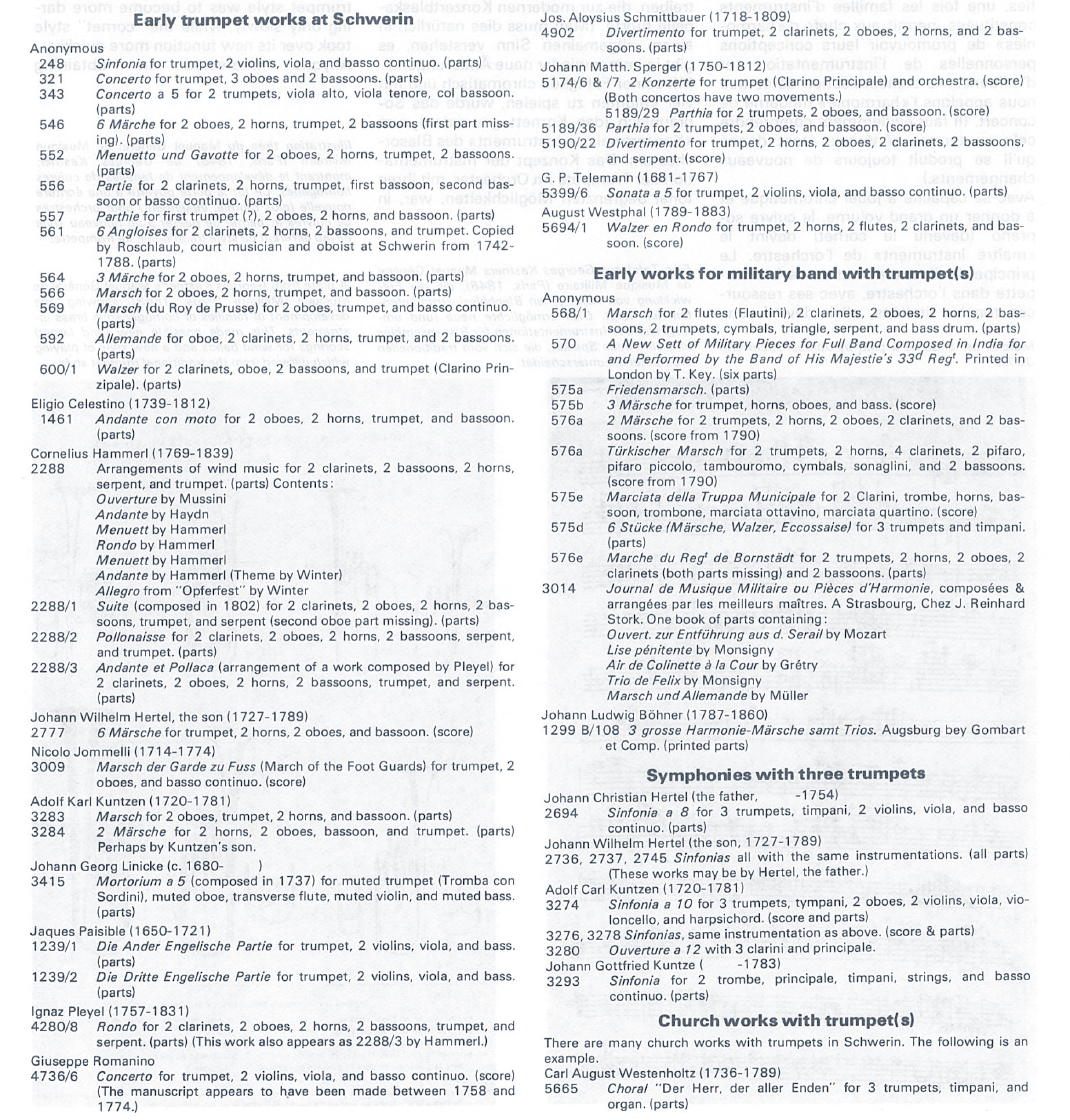
Anyone interested in obtaining microfilms of works listed should write to: Mecklenburgische Landesbibliothek, Musikabteilung, Am Dom 2, DDR-27 Schwerin. In the following lists, the library call number is given first, followed by the original title, and then, the instrumentation (which has been given in English).
Brass Bulletin image

Brass Bulletin 23, III / 1978 pagine 35–40

Tutti i contenuti sono protetti dal diritto d’autore © Brass Bulletin 1978–2026

Condividi questo articolo

Facebook LinkedIn
Loading…

Domande e risposte

Come funziona l’edizione digitale

Che cosa comprende l’edizione digitale?

L’edizione digitale riunisce gli articoli già digitalizzati sotto forma di testi leggibili e ricercabili online — non semplicemente come scansioni o file PDF — insieme alle illustrazioni originali, alle note, agli autori, alle informazioni sul numero della rivista e alle traduzioni disponibili. I suggerimenti di articoli correlati comprendono attualmente solo questo materiale digitalizzato.

Gli articoli digitali sono identici agli originali?

Conserviamo il più fedelmente possibile il testo originale, la lingua, le illustrazioni, le didascalie, le note e il contesto editoriale. La presentazione viene adattata per una lettura confortevole online e gli evidenti errori di trascrizione o scansione possono essere corretti. Il contenuto e il carattere dell’articolo pubblicato rimangono invariati.

Quali lingue sono disponibili?

Brass Bulletin è stato pubblicato in inglese, francese e tedesco nel corso di tutta la sua storia. Le traduzioni italiane e spagnole sono state aggiunte a partire dal numero 60. Sui siti italiano e spagnolo, gli articoli dei numeri da 1 a 59 vengono quindi mostrati in inglese per impostazione predefinita.

Con quale frequenza vengono aggiunti nuovi articoli?

Nuovi articoli vengono aggiunti quasi ogni giorno, con circa un numero completo digitalizzato ogni settimana. Il ritmo può variare in base al lavoro di preparazione, elaborazione delle immagini e verifica editoriale necessario.

Perché non tutti gli articoli sono disponibili in formato digitale?

La collezione completa di Brass Bulletin comprende 1.246 articoli pubblicati tra il 1971 e il 2003. L’indice completo è già disponibile online e consente di scoprire tutti gli articoli della collezione, compresi quelli il cui testo integrale non è ancora stato digitalizzato.

La digitalizzazione è iniziata nel febbraio 2026. Ogni articolo viene accuratamente preparato per la lettura online, verificato e collegato al relativo numero, agli autori, agli argomenti e alle illustrazioni. Al ritmo attuale di digitalizzazione, la collezione completa dovrebbe essere disponibile online entro febbraio 2028.

Perché alcuni riferimenti citano articoli che non sono ancora disponibili?

I riferimenti presenti negli articoli originali vengono conservati anche quando il materiale a cui rimandano non è ancora stato digitalizzato. In questo modo si preserva l’integrità storica ed editoriale della rivista. Man mano che nuovi numeri vengono aggiunti all’edizione digitale, un numero crescente di questi riferimenti condurrà ad articoli leggibili online.

Posso suggerire un articolo o segnalare un errore di trascrizione?

Sì. Se desiderate che un determinato articolo venga digitalizzato, oppure se notate un possibile errore di trascrizione o un’informazione mancante, contattateci. I riscontri dei lettori ci aiutano a migliorare l’edizione digitale e a stabilire priorità utili all’interno dell’archivio.

Come posso sostenere Brass Bulletin?

Il vostro sostegno contribuisce a finanziare la preparazione, la verifica e la pubblicazione online dell’intera collezione.

Abbonati all’Edizione digitale

Preferite sostenerci senza abbonarvi?

Fate una donazione

Come procede la digitalizzazione?

Stiamo rendendo Brass Bulletin disponibile online gradualmente, articolo per articolo. Potete leggere gli articoli appena digitalizzati non appena sono pronti, anche prima che un intero numero sia completato.

Consultate il nostro calendario di digitalizzazione per scoprire le ultime aggiunte e le date di disponibilità stimate dei prossimi numeri. Le stime si basano sul nostro ritmo recente e possono cambiare.

Cerca in Brass Bulletin.