Ofrezca Brass Bulletin en su universidad, conservatorio o biblioteca Descubra el acceso institucional

7 min de lectura

A scientific study of pulmonary function

As applied to wind instrument playing, with emphasis on the study of lung function in trumpet playing

Do trumpet players breathe differently? William W. Bing shows not really—except for greater lung capacity tied to endurance, with no harmful effects.
A scientific study of pulmonary function

Processes and research

When I first began this study, it was my intention to show the various aspects of breathing, and the mechanics of breathing, as applied to wind instrument playing, and in particular, to trumpet playing. Also, I hoped to determine if trumpet players breathe any differently than non-trumpet players.

As a result of these studies, I have come to the conclusion that playing a wind instrument requires three important processes:

  1. Inhalation
  2. Exhalation
  3. Lots of practice.

I feel that, although these may seem like obvious steps to playing well, it was not without a great deal of scientific study that I finally came to these conclusions.

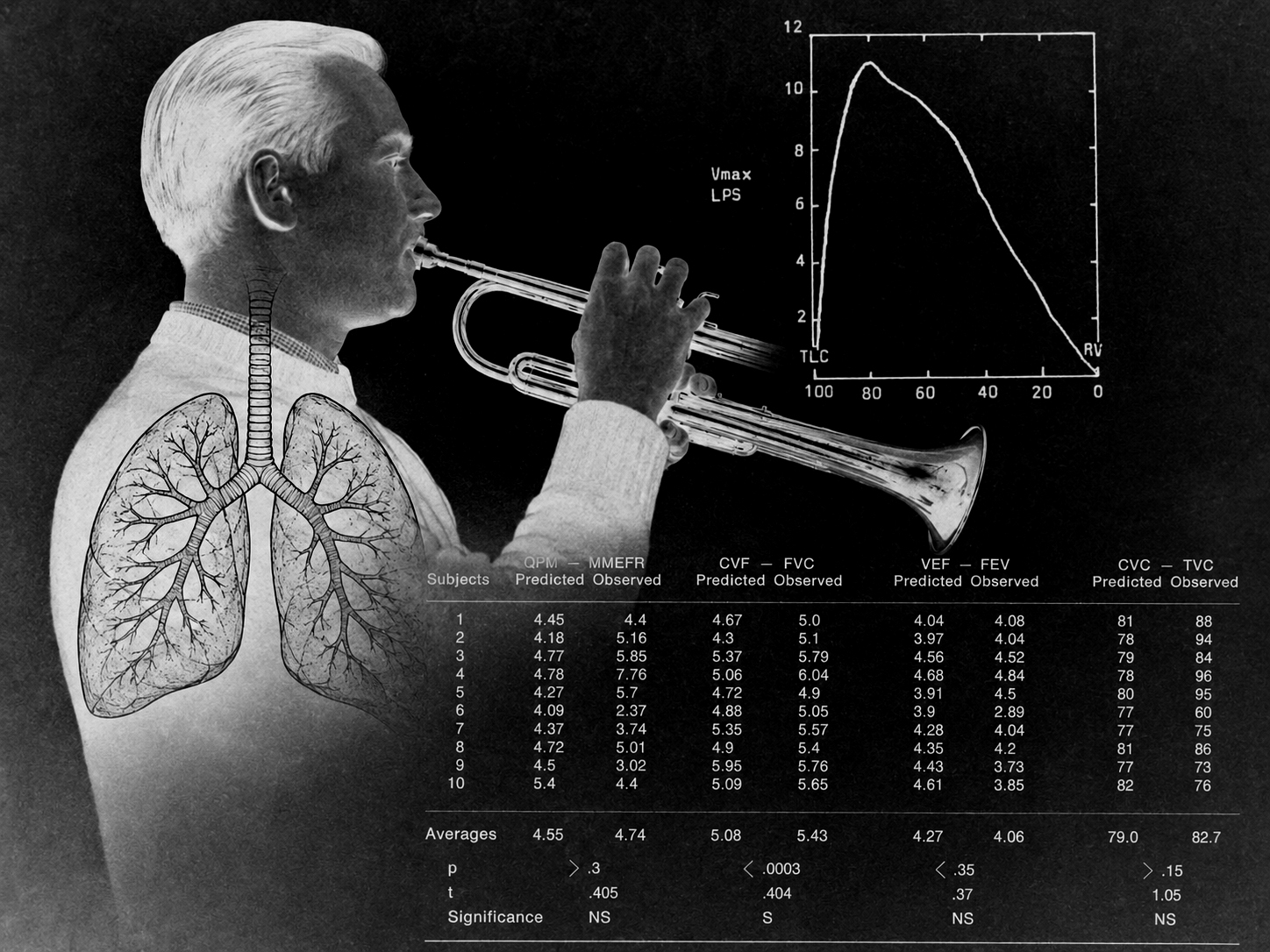
Included in this test are many of the finest symphony and studio musicians in Los Angeles.* The musicians were asked to fill out a two-page form which revealed various aspects of their playing and medical history. They were then told about the test and given instructions on how to breathe into the respirometer. The Collins respirometer is the simplest and most practical answer to the problem of measuring and recording respiratory excursions, lung volumes and oxygen uptake.

Essentially, the system involves rebreathing into an inverted, counterweighted, water-sealed container with a pen arranged to record its movements. The musicians were asked to take as large a breath as possible, and then to exhale as quickly and completely as possible. There were at least two tests taken of each individual, and the test with the best score was used.

Each test would reveal four measurements as measured on the graph paper. The four tests computed were:

  1. Forced vital capacity (FVC) — The greatest volume of gas that can be expelled by voluntary effort after a maximal inspiration.
  2. Forced expiratory volume (FEV) — The volume of air expelled in the first second of exhalation.
  3. Timed vital capacity (TVC) — The percentage of vital capacity removed in the first second of exhalation compared to the total exhalation.
  4. Maximum midexpiratory flow rate (MMEFR) — Calculated from the volume of air expired during the middle 50% of expiration. As expressed in litres per second, this is a flow measurement rather than a volume measurement.

All of the above measurements were made with the adjustments necessary because of different air temperatures, air pressures, and bell factors. It should be noted that the mouthpiece used with the respirometer is the same one used by pulmonary technicians in hospitals, and is larger in diameter than a trumpet mouthpiece. Therefore, it offers much less resistance. For the purposes of this test, and to make the experiment scientifically valid, I used the mouthpiece which fits the respirometer.

Continue reading

Accede a la edición digital completa.

Brass Bulletin 13, I / 1976 páginas 15–26

Todo el contenido está protegido por derechos de autor © Brass Bulletin 1976–2026

Compartir este artículo

Facebook LinkedIn
Cargando…

Preguntas y respuestas

Cómo funciona la edición digital

¿Qué incluye la edición digital?

La edición digital reúne los artículos ya digitalizados como textos legibles y consultables en línea —no simplemente como escaneos o archivos PDF— junto con sus ilustraciones originales, notas, autoría, información del número y traducciones disponibles. Las sugerencias de artículos relacionados incluyen actualmente solo este material digitalizado.

¿Los artículos digitales son idénticos a los originales?

Conservamos con la mayor fidelidad posible el texto original, el idioma, las ilustraciones, los pies de imagen, las notas y el contexto editorial. La presentación se adapta para facilitar la lectura en línea y pueden corregirse errores evidentes de transcripción o escaneado. El contenido y el carácter del artículo publicado permanecen inalterados.

¿Qué idiomas están disponibles?

Brass Bulletin se publicó en inglés, francés y alemán a lo largo de toda su historia. Las traducciones al italiano y al español se añadieron a partir del número 60. Por este motivo, en los sitios italiano y español los artículos de los números 1 a 59 se muestran en inglés de forma predeterminada.

¿Con qué frecuencia se añaden nuevos artículos?

Se añaden nuevos artículos casi a diario, con aproximadamente un número completo digitalizado cada semana. El ritmo puede variar según el trabajo de preparación, tratamiento de imágenes y revisión editorial necesario.

¿Por qué no están disponibles todos los artículos en formato digital?

La colección completa de Brass Bulletin contiene 1.246 artículos publicados entre 1971 y 2003. El índice completo ya está disponible en línea y permite descubrir todos los artículos de la colección, incluidos aquellos cuyo texto íntegro todavía no ha sido digitalizado.

La digitalización comenzó en febrero de 2026. Cada artículo se prepara cuidadosamente para la lectura en línea, se revisa y se vincula con su número, sus autores, sus temas y sus ilustraciones. Al ritmo actual de digitalización, se prevé que la colección completa esté disponible en línea en febrero de 2028.

¿Por qué algunas referencias mencionan artículos que todavía no están disponibles?

Las referencias de los artículos originales se conservan aunque el material al que remiten aún no haya sido digitalizado. De este modo se mantiene intacto el contexto histórico y editorial. A medida que se incorporen más números a la edición digital, un número creciente de estas referencias conducirá a artículos que podrán leerse en línea.

¿Puedo sugerir un artículo o informar de un error de transcripción?

Sí. Si hay algún artículo que le gustaría especialmente ver digitalizado, o si detecta un posible error de transcripción o algún dato que falta, póngase en contacto con nosotros. Los comentarios de los lectores nos ayudan a mejorar la edición digital y a establecer prioridades útiles dentro del archivo.

¿Cómo puedo apoyar a Brass Bulletin?

Su apoyo ayuda a financiar la preparación, verificación y publicación en línea de la colección completa.

Suscríbase a la Edición Digital

¿Prefiere apoyarnos sin suscribirse?

Haga una donación

¿Cómo avanza la digitalización?

Estamos poniendo Brass Bulletin a disposición de los lectores en línea, artículo por artículo. Pueden leer los artículos recién digitalizados en cuanto estén listos, incluso antes de que se complete un número entero.

Consulten nuestro calendario de digitalización para descubrir las últimas novedades y las fechas estimadas de disponibilidad de los próximos números. Estas estimaciones se basan en nuestro ritmo reciente y pueden cambiar.

Busca en Brass Bulletin.