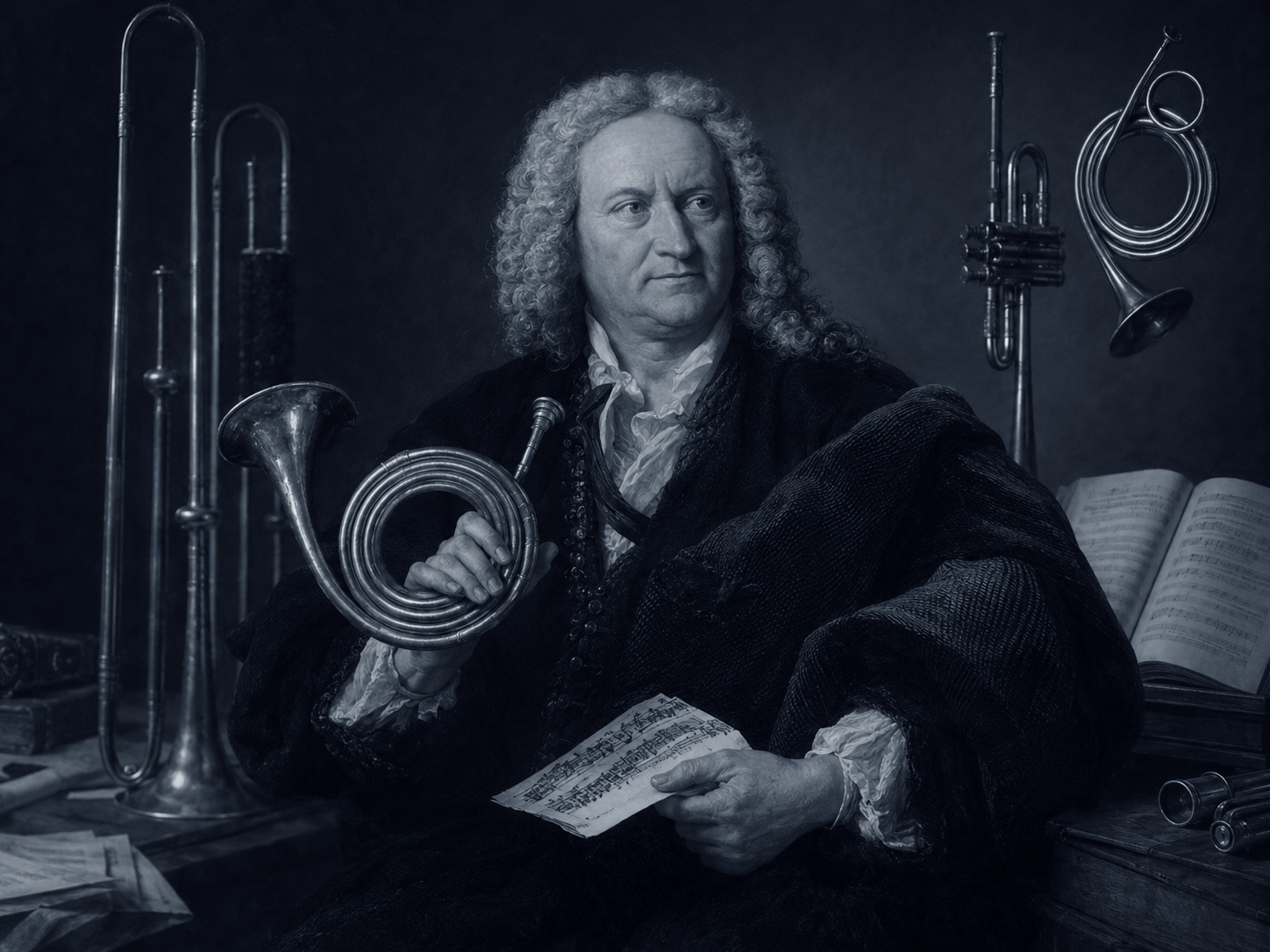
What kind of an instrument is the “Bach trumpet”? The trumpet of Bach’s time? In 1960, such an instrument was reconstructed for the Cappella Coloniensis, the Baroque orchestra of the West German Radio in Cologne. At that time, the following lines appeared:
On January 8, 1961, … on the AM station of the West German Radio, Cologne, original Bach trumpets — so-called clarins — were sounded again for the first time in one and a half centuries. The reconstruction of these instruments, which were thought to be extinct, … should cause something like a … sensation in the international music world².
If we are speaking of the key to a mystery, all the elements of mystery are present in these newspaper lines. The “original Bach trumpets”, which for good measure are also named “clarins”, were thought to be “extinct”, even for “centuries”, so that their rediscovery, after all this time, is sure to cause a “sensation”.
Had this instrument really disappeared, and for such a long period of time? Let us turn to another newspaper article:
For the first time since the revival of the (B Minor) Mass, all three trumpet parts were played on instruments copied from the trumpet of Bach and Handel’s day — an instrument the recovery of which is among the most curious incidents in recent musical history³.
Here we have the same situation: for the first time trumpets are played which were “copied from the trumpet of Bach and Handel’s day”. This second newspaper report, however, neither refers to the Cappella Coloniensis, nor does it even date from our century. It appeared in the Saturday Review in 1892, referring to a performance in the Leeds Festival.
Both of these reports cannot be correct at the same time. If a Baroque instrument was reconstructed as early as 1892, the same claim could not be made any more in 1961.
We must therefore get to the bottom of the matter and discover what kind of instruments are referred to in the two reports. First, let us consider the trumpet of the Baroque period.
1. The trumpet of the Baroque era
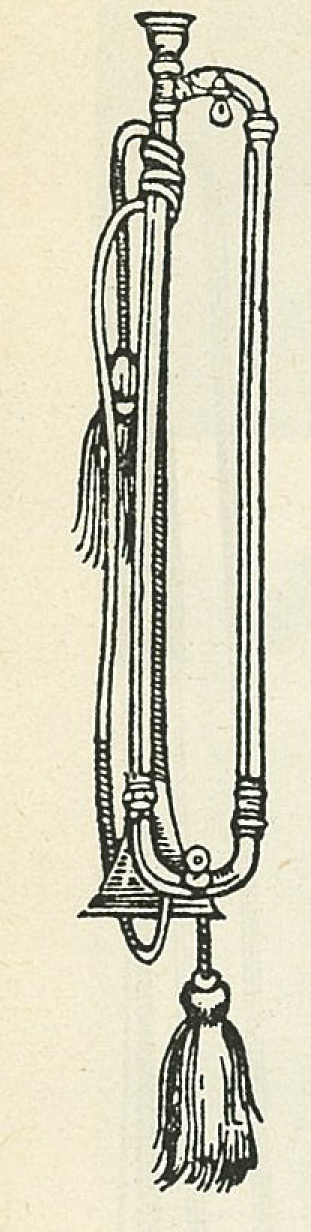
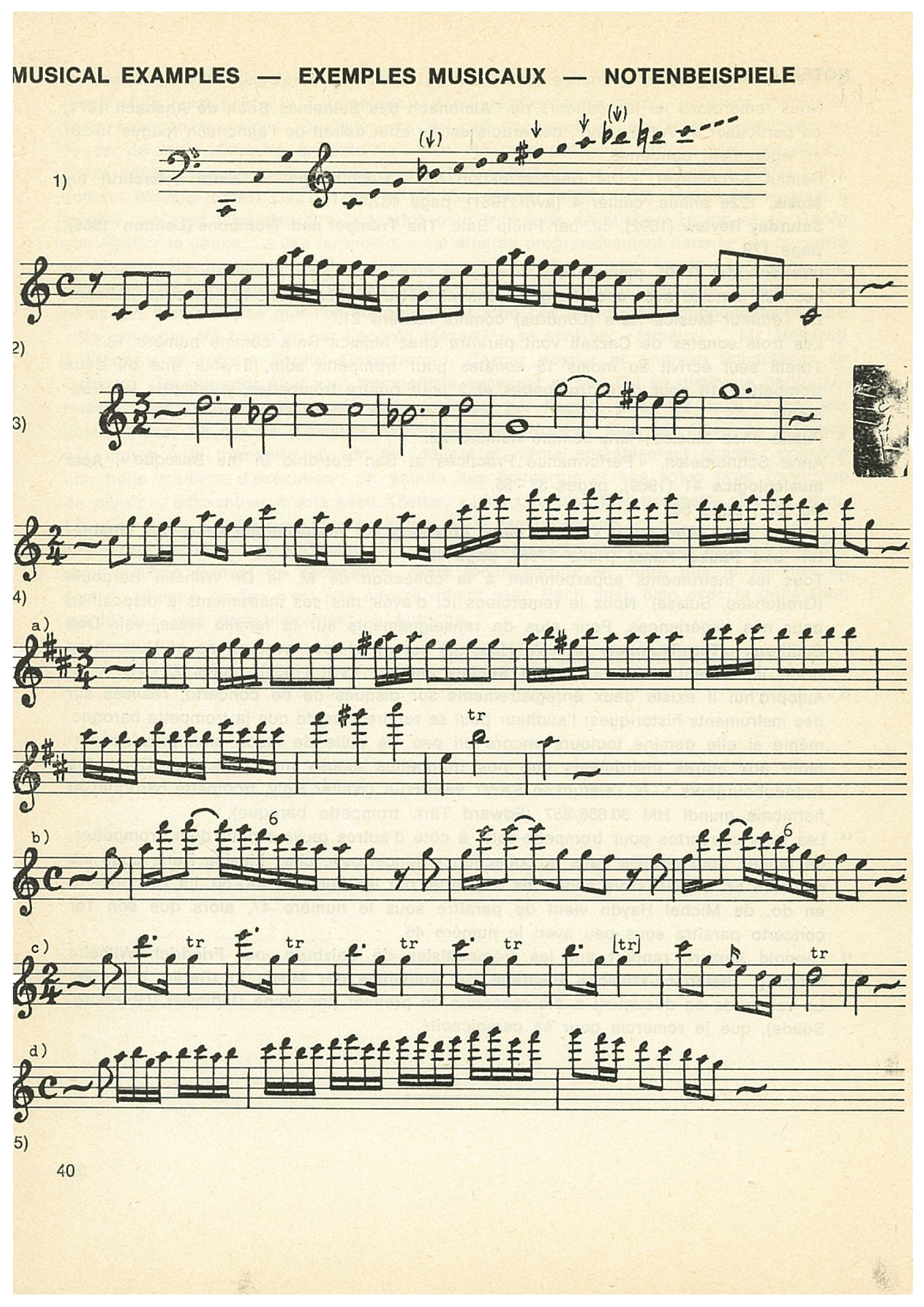
At the beginning of the Baroque period around 1600, trumpeters and timpanists did not yet play art music, but instead improvised among themselves in fixed trumpet ensembles on valveless instruments (see Illustration 1, a trumpet from Michael Praetorius’ Theatrum Instrumentorum)⁴. These instruments produce only the notes of the harmonic series (see Music Example 1). Such instruments are referred to as “natural trumpets”, or in the case of trumpets from the Baroque period, “Baroque trumpets”. Each trumpeter of the ensemble improvised in a particular register of his instrument.
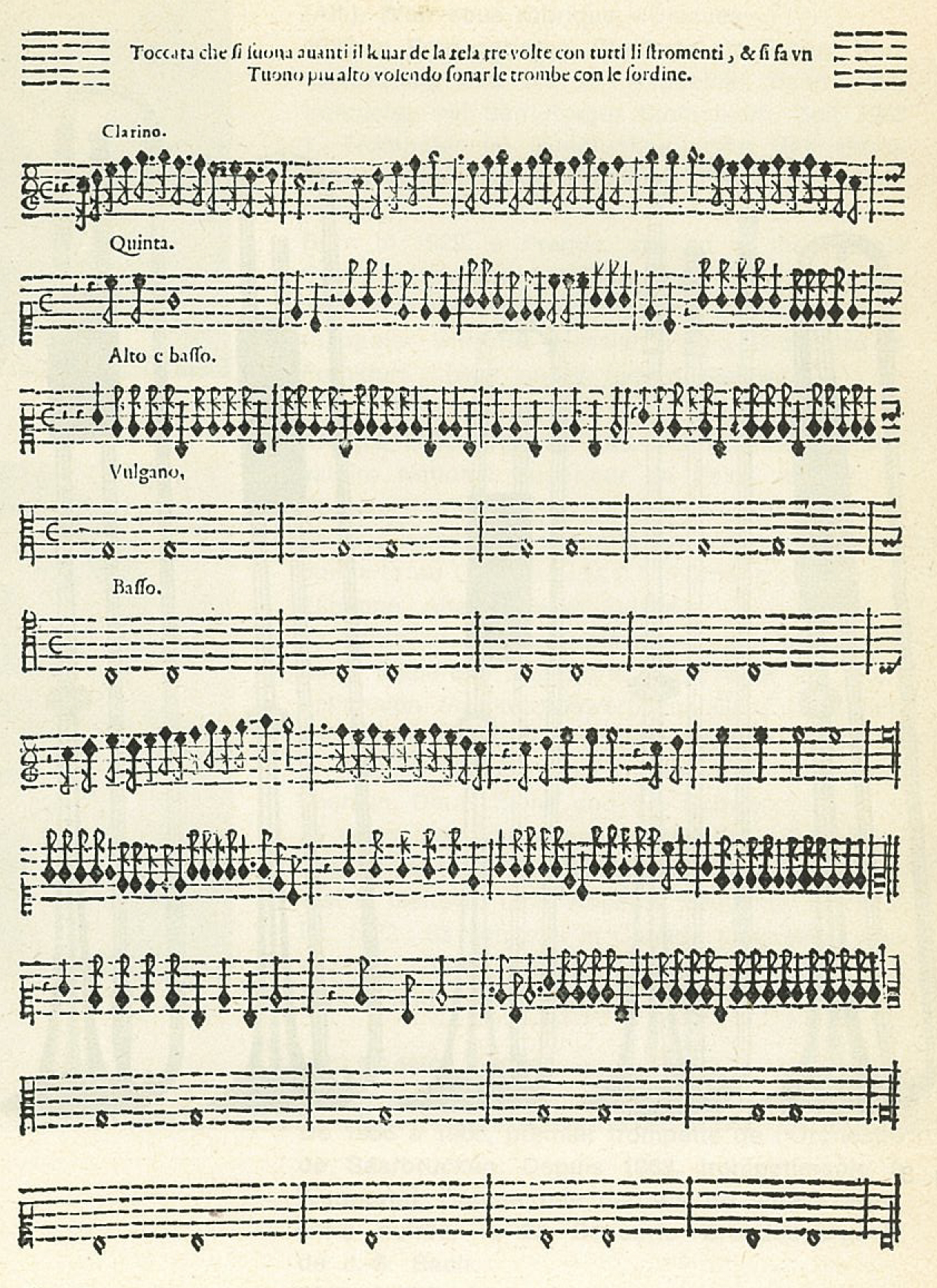
In the “Toccata” at the beginning of Monteverdi’s opera L’Orfeo (1607) we find all the trumpet parts written out for the first time (see Illustration 2). From top to bottom, they are called “Clarino”, derived from the Latin word clarus, meaning “clear” (c" to a''), “Quinta” or sometimes with other composers “Principal” (c', e', g', c"), “Alto e basso” (g, c', e'), “Vulgano” (g), and “Basso” (c). All the parts of a given piece, high and low, were played on the same-sized instrument, as opposed to the various other families of instruments developed in various sizes during the Renaissance, such as recorders or viols, the smaller instruments playing the higher parts, the larger ones playing the lower. The player of the “Basso” part thus used the same type of instrument as the player of the “Clarino” part. For this reason, early trumpet music remained bound to one chord, C or D depending on the key of the instruments, since the low notes of the harmonic series from C to c" allow no other possibility.
The first solo sonatas for trumpet were written in 1638 by Girolamo Fantini, chief court trumpeter for the Grand Duke of Tuscany. Some require harpsichord, others call for organ accompaniment⁵. The first solo sonatas for trumpet with string accompaniment were only written in 1665 by the Bolognese composer Maurizio Cazzati⁶. Cazzati ushered in an important era for the trumpet, for during the next 30 to 50 years, virtually every Italian composer wrote at least one trumpet sonata. Torelli alone wrote at least 15 for solo trumpet and another 16 for two trumpets⁷; other important composers for trumpet were Corelli, Stradella, Albinoni, and Vivaldi, to name just a few.
From then on, the solo trumpeter in art music had to master not only the so-called clarino register, but also the former quinta or principal register. The toccata-like beginning of Cazzati’s second trumpet sonata, La Bianchina, demonstrates the new range of the solo trumpet around 1665 (see Music Example 2).
The next datable composition was written in 1680 by Petronio Franceschini, who like Cazzati was active in the Basilica di S. Petronio in Bologna. In his Sonata a 7 for two trumpets, the lyric possibilities of the instrument are explored more fully, the upper register is extended to concert d''', and — a very rare occurrence in the Baroque trumpet literature — the trumpet sounds in some passages in a minor key. Franceschini makes use of the 7th and 14th notes of the harmonic series (b' and b''), which are by nature too flat, as the third of a minor triad on g'. Music Example 3 shows a representative passage from the third movement of Franceschini’s sonata⁸.
Thanks to a brilliant study by Anne Schnoebelen⁹, we now know who may have performed the trumpet parts of this and other Bolognese works. One Giovanni Pellegrino Brandi is listed as a trumpeter in the records of payment of musicians on the Feast of S. Petronio, beginning with the year 1679. “Brandi’s name appears through 1699, and it is probably he for whom the trumpet sonatas by Franceschini, Torelli, and Perti were written¹⁰.” One “sig. Vincenzo” was listed as second trumpeter in 1680, receiving the same wage as Brandi. That, of course, is the date of Franceschini’s sonata for two trumpets, and it is very tempting to link them with this work: probably they were, in fact, the solo trumpeters in Franceschini’s sonata.
Further technical progress in trumpet playing took place during the 18th century in Germany. Here in particular the high register was cultivated. Obviously, trumpeters were becoming particularly proficient in the extreme clarin register.
Simultaneously with the new demands made by composers on the trumpet’s high register, instrument makers came to the player’s rescue. The most renowned center of brass instrument making in the 17th and 18th centuries was Nürnberg. Trumpets, trombones, and horns made by such famous Nürnberg families of instrument makers as Schnitzer, Heinlein, Haas, Ehe, and many others are to be found today in important instrument collections all over the world. The trumpets of the Haas family were particularly well known. The trumpeter and theorist Johann Ernst Altenburg wrote in 1795: “The (trumpets) made in Nürnberg and provided with angels’ heads by W. Haas are … generally considered to be the best”¹¹. Illustration 3 shows six trumpets made by three generations of the Haas family: from left to right, the first three are by Johann Wilhelm Haas (1649–1743), the next two by Wolf Wilhelm Haas (1681–1760), and the last by Ernst Johann Conrad Haas (1723–1792)¹².
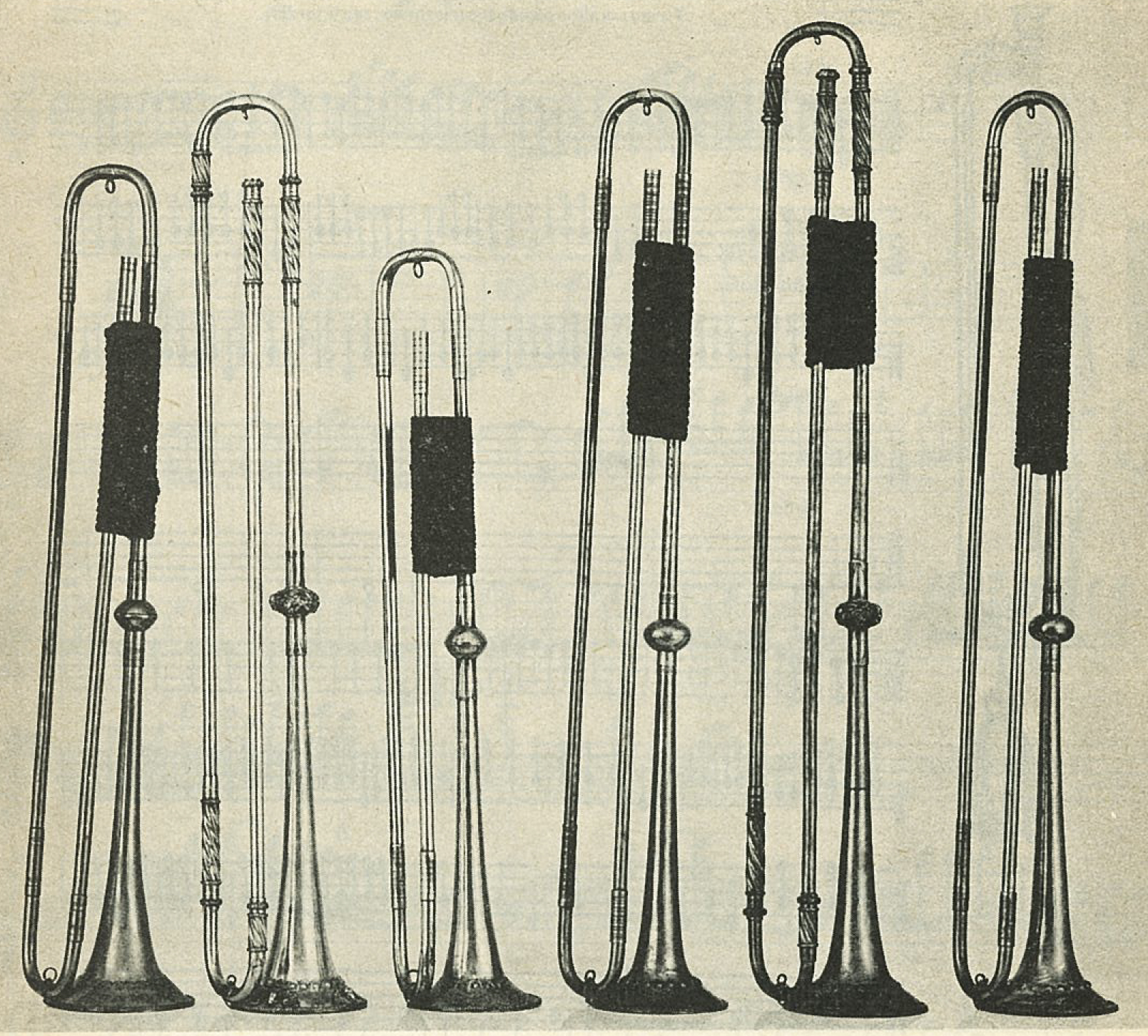
The early trumpet, like the one in Praetorius’ woodcut (Illustration 1), had a simple funnel-shaped bell; during the course of the 17th and early 18th centuries the throat of the bell was tightened somewhat, resolving itself at the end in a rapid flare. The narrower bell with the sharp terminal flare, in particular the way it was built by the Haas family, favored the higher vibrations of the harmonic series and thus helped trumpeters to ascend still further into the upper clarin register.
When we think of composers making use of the new technical possibilities offered by the clarin register of the trumpet, Bach is the first name to come to mind. His use of the clarin register of the small Baroque trumpet in F in his Second Brandenburg Concerto poses severe threats for performers even today (Music Example 4 shows part of the third movement). The combination of high trumpet with three other solo instruments—oboe, violin, and especially recorder—is difficult to balance properly. But when we remember that the Baroque trumpet had a less piercing sound than its modern-day replacement, we begin to understand that this combination of instruments must actually have made musical sense in Bach’s day¹³.
In the first movement of the Second Brandenburg Concerto, Bach wrote the 18th note of the harmonic series, a sounding g''' on the F trumpet, three times. He often wrote the 18th harmonic of the D trumpet, an e''', for example in the B Minor Mass and numerous cantatas. Until recently, Bach’s works have been considered to form the culmination of clarin playing.
In the last few years, however, musicologists have discovered a number of works written by composers of the generation after Bach, demonstrating the use of the highest clarin register to an extent unknown before. The trumpet parts in these works sometimes ascend as high as the 24th harmonic and represent the highest and final flowering of the so-called clarin technique. Some of these concertos, which because of their extreme technical difficulty are only beginning to be published¹⁴, were written by Johann Melchior Molter (1695–1765), Georg von Reutter d. J. (1708–1772), Franz Xaver Richter (1709–1789), Johann Wilhelm Hertel (1727–1789), and Michael Haydn (1737–1806).
Music Example 5 shows some representative passages from trumpet concertos by Michael Haydn and Georg von Reutter d. J. The awe-inspiring 24th harmonic is reached by stepwise motion in Michael Haydn’s first concerto and in Reutter’s work, whereas the 21st or 22nd harmonic is reached in Michael Haydn’s second concerto by adventuresome leaps.
The names of the trumpeters who presumably executed these uniquely difficult works have been transmitted to us by Leopold Mozart¹⁵: they are “the famous … Mr. Heinisch in Vienna” and Johann Baptist Gesenberger, Caspar Kestler, and Andreas Schachtner from Salzburg. Gesenberger, a “fine trumpeter”, “achieved particularly great fame in the high register through his exceptionally fine intonation, through his speed in runs and through his good trills”. Kestler was a pupil of Heinisch and “gives the trumpet a delicate, very pleasant singing tone, has a good manner of playing, and his concertos and solos are heard with great pleasure”. Schachtner studied with Kestler, “plays a quite good trumpet and with good taste”; he was, moreover, an intimate friend of the Mozart family.
The historian sees in this extreme use of the highest register of the trumpet the symptoms of decadence and eventual decline, and we realize that the actual culmination of natural trumpet playing did not occur with Bach, but rather during the succeeding generation, probably in Austria.