7 min di lettura
The Haydn Trumpet Concerto
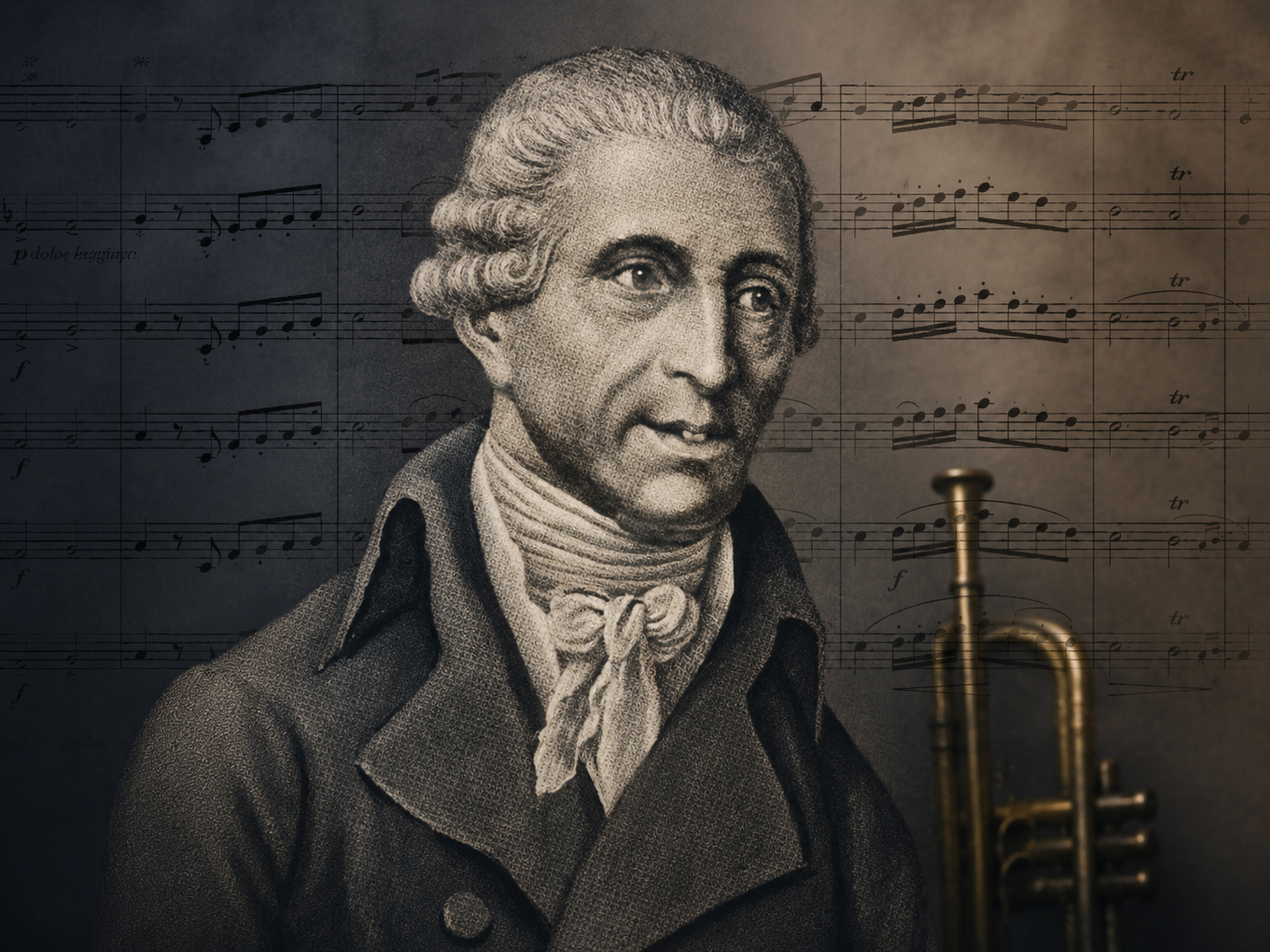
Haydn the World Over with reference to the concerto in Eb for trumpet
Starting in this issue Brass Bulletin is publishing a series of three articles in which Fred Willener, a sociologist of music, will examine:
— the scores,
— musicians' intentions,
— interpretations on record,
— criticisms,
with a view to bringing brass musicians to reflect among themselves on the key problems revealed by an international comparison centred on this work.
Brass Bulletin invites readers to send in:
published criticisms (of concerts or recordings); thoughts and experiences concerning the work; or simply their address if they wish to be contacted.
Part I
The trumpet repertoire contains so few concertos by great composers that it is hardly surprising that «everybody» studies or even teaches this classic, interprets or even edits it, in private or even in public — and that it has become a «test-piece». Indeed some orchestras audition candidates for a trumpet job on the basis of an interpretation of the work.
We in turn, therefore, will take this test-piece as our starting point in exploring the rôle of the musical interpreter, and this we will do by means of comparing the different scores and recordings of the work which we have been able to assemble. A comparative analysis of them leads one to the question — a difficult one, but one we must at least try to answer — on criteria of excellence (cf. Thomas Stevens' questions in this respect, Brass Bulletin no. 27, p. 7.): how much is there, in the appraisal of an instrumentalist's work, that is "objective" (universal); and how much that is "subjective" (not only differences between one individual and another but "cultural" differences between one tradition, one country, one school and another)?
The following is a rough outline. Later, with your help, I will try to answer the questions which I am asking now. I am a professional researcher (in the sociology of music, but not in musicology) and an amateur trumpeter (who can play this concerto, but in private).
I. The Text
In the theatre the playwright determines in principle the story the actors will play out, its meaning, and in a frequently approximate degree its detail (props, gestures, diction, speed, lighting etc.). In general people seem to think that the composer strictly determines the playing details for the musicians, but feel that the meaning of the text is left to their discretion.
Thus arises the first, embarrassing, question: Which are the details of the text that determine the meaning of the work? And even before that: is there one meaning, and must it be respected? (If so, how can this be achieved, given the concert situation?)
An understanding of the age in which Haydn lived and the ability to place his work in musical as well as European history would of course be desirable. Is it enough that conductors and critics should concern themselves with acquiring and disseminating such knowledge?
I shall limit myself at this point to a few notes designed mainly to explain the conditions under which the text was produced. And I have chosen a portrait in which I think Haydn appears, rather than in the usual aristocratic ones, for what he is: a workman maintained by a prince, a sort of luxury proletarian.
Joseph Haydn had to know how to play several instruments, compose, conduct, organise concerts and teach, but also look after the maintenance of the instruments, copy music, rehearse the singers, keep discipline among the musicians etc. The extent of his duties was formidable, and led to considerable overwork, but also to very great competence.
He was certainly not a composer in the Romantic style: surrounded by Muses and looking for inspiration; like Bach and Mozart he generally composed to order and not "for posterity" (Hughes, pp. 34–39).
Haydn was privileged in having a secure job with a single employer and yet at the same time had to accept many inconveniences and limitations on his life and his writing. He had financial worries, though less than other people; at his death his fortune amounted to 40,000 florins (Mozart's amounted to 60 florins, with 3,000 florins' worth of debts — a freelance musician who died in poverty; Engel, p. 10).
The Trompetenkonzert was his last concerto (or one of his last — see Landon, p. 226). It belongs to his final great mature period; Haydn had just returned to Vienna after his second stay in London where he composed 277 works in three years, representing 768 large pages. England firmly established his reputation. During his first stay there he had been made Doctor of Music at Oxford, an honour which even Handel had not received. He said, "I became famous in Germany only after England" (ibid., p. 10).
Brass Bulletin 35, III / 1981 pagine 33–40
Tutti i contenuti sono protetti dal diritto d’autore © Brass Bulletin 1981–2026