Ofrezca Brass Bulletin en su universidad, conservatorio o biblioteca Descubra el acceso institucional

6 min de lectura

Melvyn Poore

Tuba britannica

Melvyn Poore

Melvyn Poore

The greatest heavyweights are frequently very sensitive. We laugh about them because they do not correspond to our slender ideals and we misjudge thereby their true nature and beauty. So it is with one of the most sensitive of orchestral instruments, the tuba. (The Tagespost, Graz, Austria, after a performance by Melvyn Poore).

…the atmospheric performance of the magician Poore… (New Rotterdam Courant)

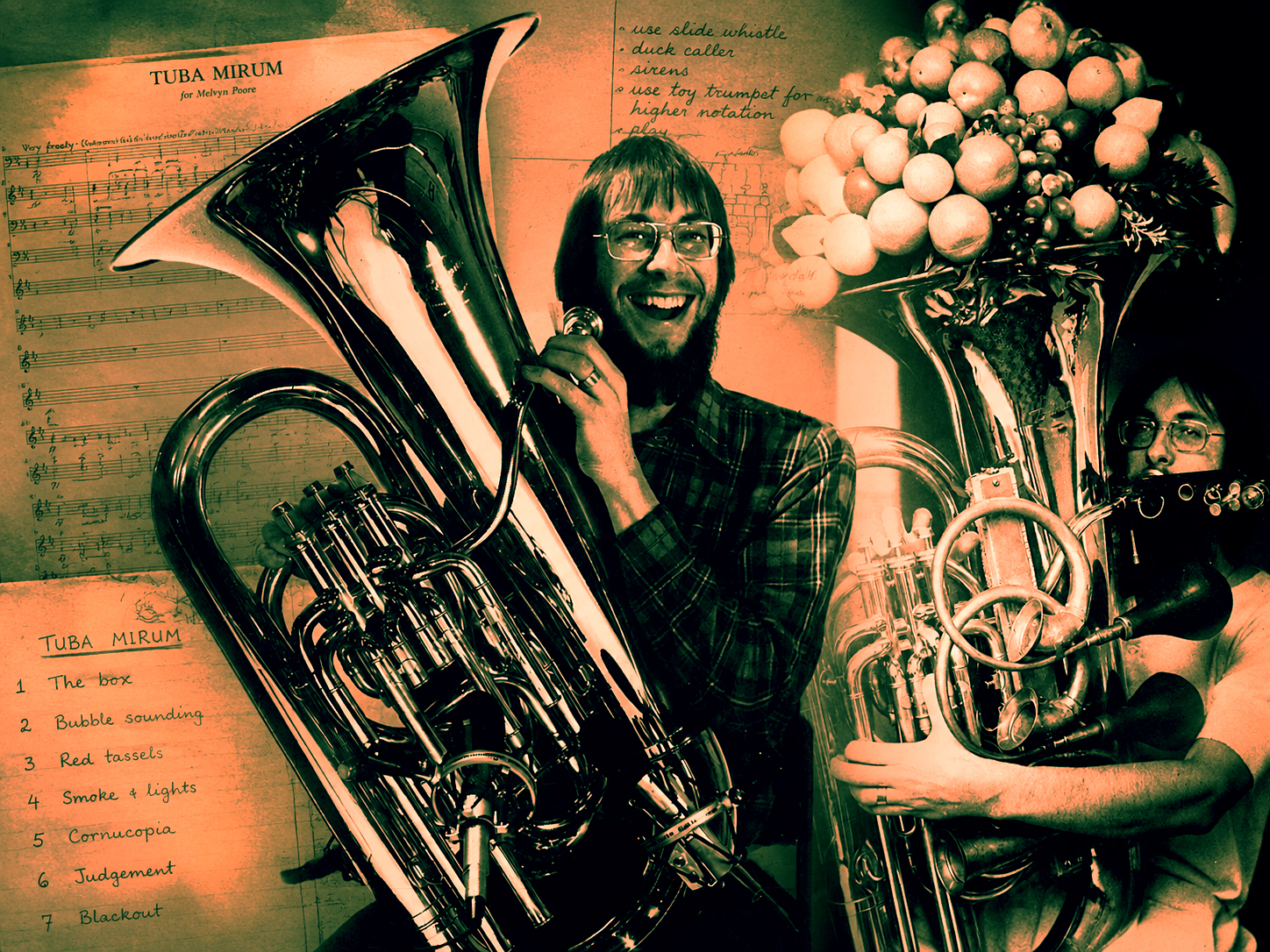
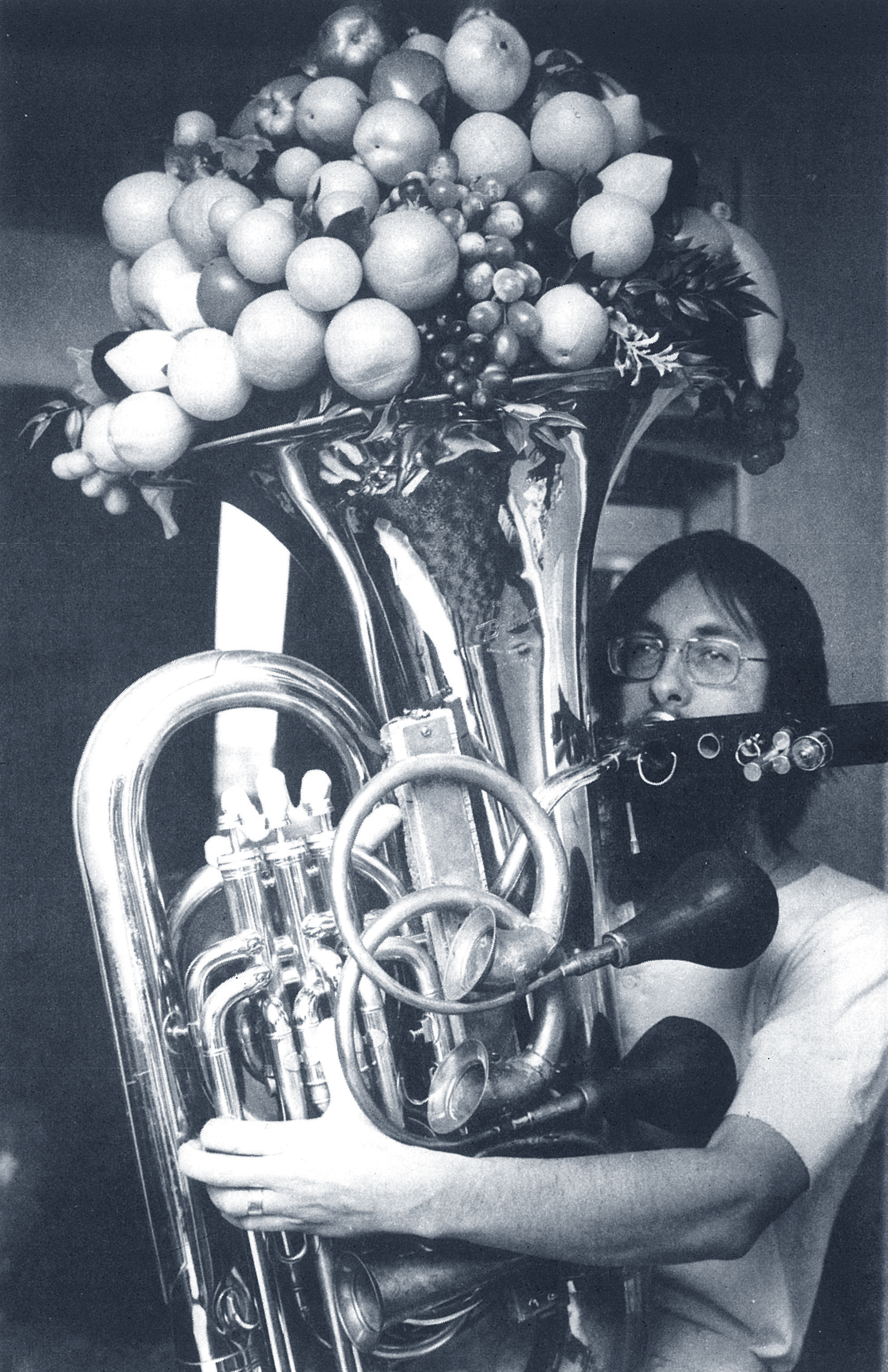
English tuba player Melvyn Poore conducts his professional life under the trade name Tube o’ Sweets. The single work he is most often asked to play, Trevor Wishart’s Tuba Mirum, reaches its climax with the instrument wearing an outsize mute, the fruit bowl decorations of which suggest one of Carmen Miranda’s least restrained carnival headdresses.

From these two facts you might conclude that Mr. Poore is a humorist — someone who sees the tuba as a vehicle only for comedy and bizarrerie. But, while there is plenty of both those things in his performances, he is a deeply serious (yet far from solemn) performer and composer.

I asked him if he was something of a crusader, and his answer — “You could say that, I suppose, although I didn’t set out to be” — combined the modesty of someone who doesn’t like to use melodramatic language about himself with clear awareness that his career demonstrates a remarkably single-minded pursuit of the new and the out-of-the-ordinary.

The life of an orchestral tubist does not appeal to him. “I couldn’t face the prospect of having very few notes to play and a great deal of time to spend sitting round without being able to concentrate on something else. I’d rather commit myself to what I’m doing now.” Yet, despite his rejection of the conventional, he says, “I tend to accept things as they are rather than trying to change them…” He is greatly influenced by Buddhist ideas.

This is perhaps the more striking in that he grew up with the dogmatic evangelical certainties of the Salvation Army. However, “I was always able to be independent. My parents didn’t keep me under their thumb, for which I’m very grateful. This has helped me develop my own musicality without being afraid of what’s going to happen or what people will say.”

Melvyn began playing the euphonium when he was four, taught by his father, a euphonium player in the Salvation Army in Alton, Hampshire. He played later in the Mid-Hants Youth Band (National Youth Champions in 1968) and with the County Youth Orchestra (where he played bass trombone parts on the euphonium until the orchestra acquired a tuba).

As a schoolboy he studied art to Advanced Level. “I was primed with a lot of ideas from the plastic arts in this century which I was ready to transform into musical terms”. He was gradually rejecting the values and way of life he had grown up with. “Not totally, but I gathered other things, and integrated them into my philosophy and way of life. As soon as I got to university (in Birmingham) I joined a modern music group called Embarkation which played a lot of John Cage, Morton Feldman, Stockhausen and the English experimental school, including Cornelius Cardew.

At first I found very little music that was written specifically for the tuba, so I played a lot of things written for variable instrumentation, text pieces and music theatre pieces.” These text pieces, often by Stockhausen, avoided notated music. The directions were poetically expressed indications of a mental outlook which could be translated into music only by intuition. “They were biased towards Eastern philosophy: ‘Listen to the vibrations of your molecules and play the sounds that you hear’. I would find that difficult now.”

Melvyn Poore

Melvyn Poore

He spent a lot of time developing his own solo repertoire and techniques. “Not entirely new techniques, because they’d all been used before on other instruments. Things like using reeds instead of a mouthpiece. Taking the instrument apart. Different kinds of mutes. Circular breathing. Using the voice at the same time as playing.

The things I was trying to play seemed to require, for example, continuous sound, so I developed circular breathing. Some required extremes of pitch, so I had to think about getting higher notes than you can obtain with a regular mouthpiece. You can use falsetto voice, or reeds. Reeds mean you have to break to change mouthpieces and you have to sacrifice some of your control over pitch — the instrument just doesn’t behave in the same way. With voice there’s no gap, but there’s not much power either.

I use both single (a tenor saxophone mouthpiece) and double (bassoon) reeds. On the saxophone mouthpiece in the low register you get something that doesn’t sound like a reed at all — it’s more like flutter tonguing a pedal note. The middle range sounds rather like a saxophone, but less grainy. In the upper register you can do all your squeaks and glissandi.”

After university he worked at Birmingham Arts Lab. for four years, on electronic music (building up the equipment from scratch), a new music workshop, organising concerts and a music publishing venture.

His interest in music theatre (by which he means neither opera nor drama with songs, but pieces in which music and theatrical action work hand in hand) grew. In 1978 he commissioned Tuba Mirum from Trevor Wishart, and this is now one of his most requested performances.

Lasting about 20 minutes, it is set in the basement of a psychiatric hospital. The central figure, played by Melvyn, is there as a political prisoner.

“I’m brought onto the stage by two bureaucrats and a surgeon, who put me into a bed, then sit at a desk which should ideally be fairly high up. They switch on a red light and sit there for most of the rest of the action looking through files and papers.”
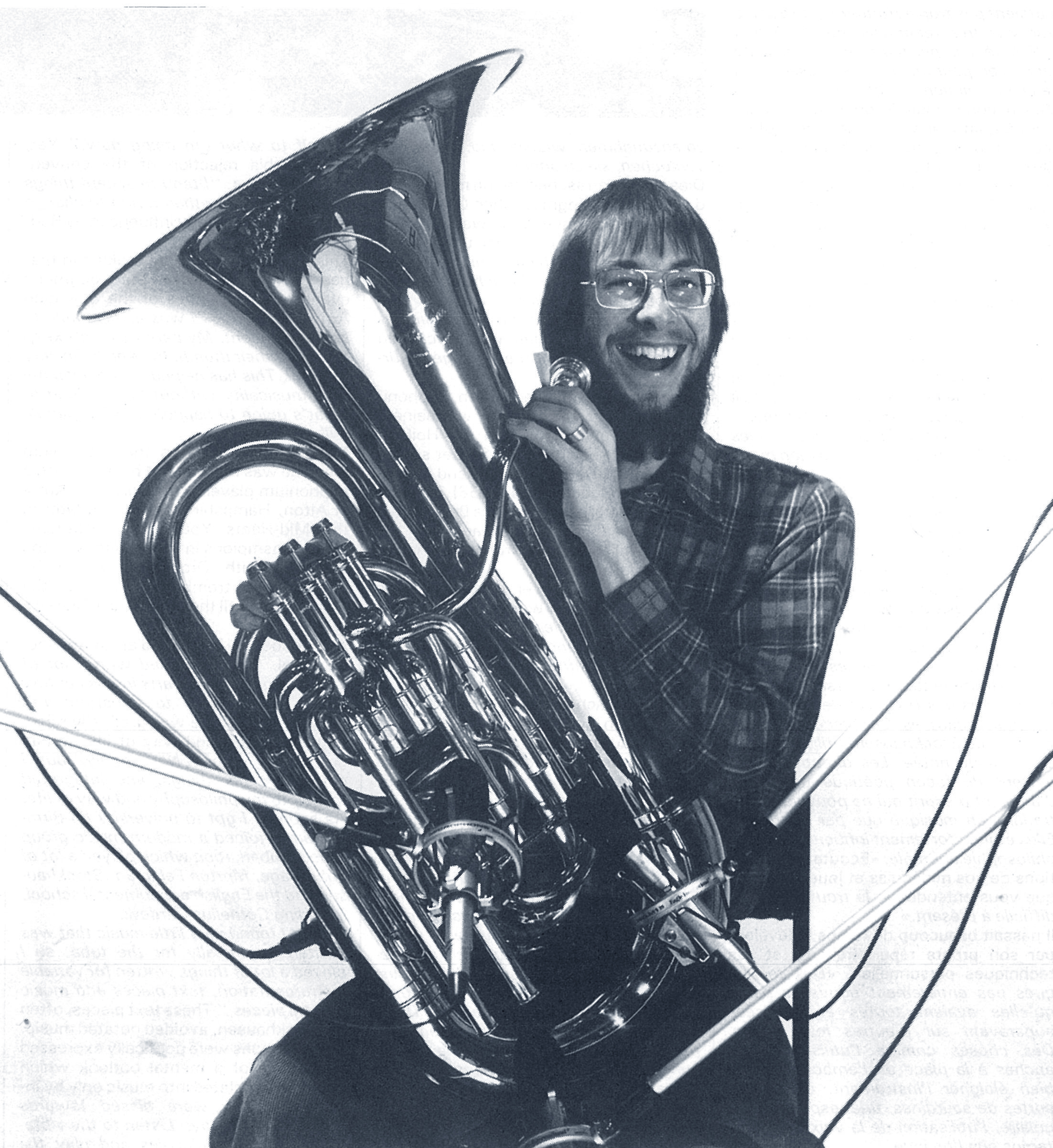
Melvyn Poore, equipped to play Tuba Mirum.

Melvyn Poore, equipped to play Tuba Mirum.

They are his judges. Politically and medically they are deciding what to do with him, and on the level of the mass for the dead, from which the piece’s title is drawn, they suggest the Trinity looking through the Book of Judgement in which all is written, preparatory to the sounding of the Last Trumpet, or Tuba Mirum.

“I get out of bed and cross to a big box which has something leaning on it covered in a sack. I reveal the tuba, which has three motor klaxons attached to it and, on the side of the mouth pipe, a little rack with a duck caller, a train whistle, a toy trumpet, a siren and a cuckoo call.

When I begin to play it’s full of water so we just get bubbling sounds. I empty it and go through various other non-normal tuba sounds.

When I actually play for the first time we hear a motive from the tuba mirum plainsong which develops through the piece: Music example 1

I’m always trying to play this motive, but I’m always looking over my shoulder to see if I’m being watched and I use a series of ever more bizarre mutes to disguise it: one with a tambourine inside which rattles when I play in certain registers; one of black felt with red tassels which has an alarm bell inside it which rings at a climatic point. (This and other things are controlled by foot pedals which make the piece even more difficult to play!)

When the bell rings I take out the slides of the instrument to find out where the noise is coming from. I also switch to a bassoon reed and a section follows in which the sounds have nothing to do with normal tuba sound at all. This ends with an explosion inside the bell and clouds of smoke through which lights shine.

The final mute is the cornucopia — the horn of plenty with all the fruit. Things are quite happy now. I cast all care to the winds and play the motive, which develops into a big tune. The tuba mirum — the wonderful tuba, as we might punningly call it — plays its last trick. By means of a loudspeaker hidden inside the mute, it replicates its own sound several times. Animal sounds are heard on tape, starting with low growls and grunts, but finally turning to birdsong — a symbol of freedom.

The other three have now decided what to do with me. They take the instrument from me and lead me towards the bed. There is a blackout.

When the lights come back up there’s a single spotlight on the tuba and one on me, sitting in bed totally drugged. The tuba, on its own, repeats two sounds from earlier in the piece: the bubbling sound and one rather like a dog whining. Then there’s the final blackout.”

Another piece from his repertoire is Tom Johnson’s “Monologue” in which he both plays the tuba and speaks to it. It’s “very humorous and not that easy to play. I like it because it lightens up a programme. I like to be entertaining as well as serious”

When I asked him what sort of living he made out of his work, he replied dryly, “A very precarious one. But in many ways it’s not a lot worse than any other free-lance musician. The problem is that, although the market is there, you have to do a lot more work to seek it out, at least initially.”

As well as his solo work, he plays with the European Tuba Quartet, which plays improvisation based music, the Grubenklang Orchester (“basically a jazz band but playing in a great variety of styles”) and the Interface Europe Quartet which plays very melodic jazz. “I have to cover a lot of miles. The jazz gigs get fixed two to three months in advance. The new music ones are fixed much further in advance. When there’s a clash we manage somehow.

I suppose I do between 50 and 60 gigs in a year.”

Talking to Melvin Poore, one can begin to accept the idea of a tuba as the symbol of mankind’s longing for freedom. That seems something of an achievement.

Brass Bulletin 46, II / 1984 páginas 16–22

Todo el contenido está protegido por derechos de autor © Brass Bulletin 1984–2026

Compartir este artículo

Facebook LinkedIn
Cargando…

Preguntas y respuestas

Cómo funciona la edición digital

¿Qué incluye la edición digital?

La edición digital reúne los artículos ya digitalizados como textos legibles y consultables en línea —no simplemente como escaneos o archivos PDF— junto con sus ilustraciones originales, notas, autoría, información del número y traducciones disponibles. Las sugerencias de artículos relacionados incluyen actualmente solo este material digitalizado.

¿Los artículos digitales son idénticos a los originales?

Conservamos con la mayor fidelidad posible el texto original, el idioma, las ilustraciones, los pies de imagen, las notas y el contexto editorial. La presentación se adapta para facilitar la lectura en línea y pueden corregirse errores evidentes de transcripción o escaneado. El contenido y el carácter del artículo publicado permanecen inalterados.

¿Qué idiomas están disponibles?

Brass Bulletin se publicó en inglés, francés y alemán a lo largo de toda su historia. Las traducciones al italiano y al español se añadieron a partir del número 60. Por este motivo, en los sitios italiano y español los artículos de los números 1 a 59 se muestran en inglés de forma predeterminada.

¿Con qué frecuencia se añaden nuevos artículos?

Se añaden nuevos artículos casi a diario, con aproximadamente un número completo digitalizado cada semana. El ritmo puede variar según el trabajo de preparación, tratamiento de imágenes y revisión editorial necesario.

¿Por qué no están disponibles todos los artículos en formato digital?

La colección completa de Brass Bulletin contiene 1.246 artículos publicados entre 1971 y 2003. El índice completo ya está disponible en línea y permite descubrir todos los artículos de la colección, incluidos aquellos cuyo texto íntegro todavía no ha sido digitalizado.

La digitalización comenzó en febrero de 2026. Cada artículo se prepara cuidadosamente para la lectura en línea, se revisa y se vincula con su número, sus autores, sus temas y sus ilustraciones. Al ritmo actual de digitalización, se prevé que la colección completa esté disponible en línea en febrero de 2028.

¿Por qué algunas referencias mencionan artículos que todavía no están disponibles?

Las referencias de los artículos originales se conservan aunque el material al que remiten aún no haya sido digitalizado. De este modo se mantiene intacto el contexto histórico y editorial. A medida que se incorporen más números a la edición digital, un número creciente de estas referencias conducirá a artículos que podrán leerse en línea.

¿Puedo sugerir un artículo o informar de un error de transcripción?

Sí. Si hay algún artículo que le gustaría especialmente ver digitalizado, o si detecta un posible error de transcripción o algún dato que falta, póngase en contacto con nosotros. Los comentarios de los lectores nos ayudan a mejorar la edición digital y a establecer prioridades útiles dentro del archivo.

¿Cómo puedo apoyar a Brass Bulletin?

Su apoyo ayuda a financiar la preparación, verificación y publicación en línea de la colección completa.

Suscríbase a la Edición Digital

¿Prefiere apoyarnos sin suscribirse?

Haga una donación

¿Cómo avanza la digitalización?

Estamos poniendo Brass Bulletin a disposición de los lectores en línea, artículo por artículo. Pueden leer los artículos recién digitalizados en cuanto estén listos, incluso antes de que se complete un número entero.

Consulten nuestro calendario de digitalización para descubrir las últimas novedades y las fechas estimadas de disponibilidad de los próximos números. Estas estimaciones se basan en nuestro ritmo reciente y pueden cambiar.

Busca en Brass Bulletin.