Ofrezca Brass Bulletin en su universidad, conservatorio o biblioteca Descubra el acceso institucional

4 min de lectura

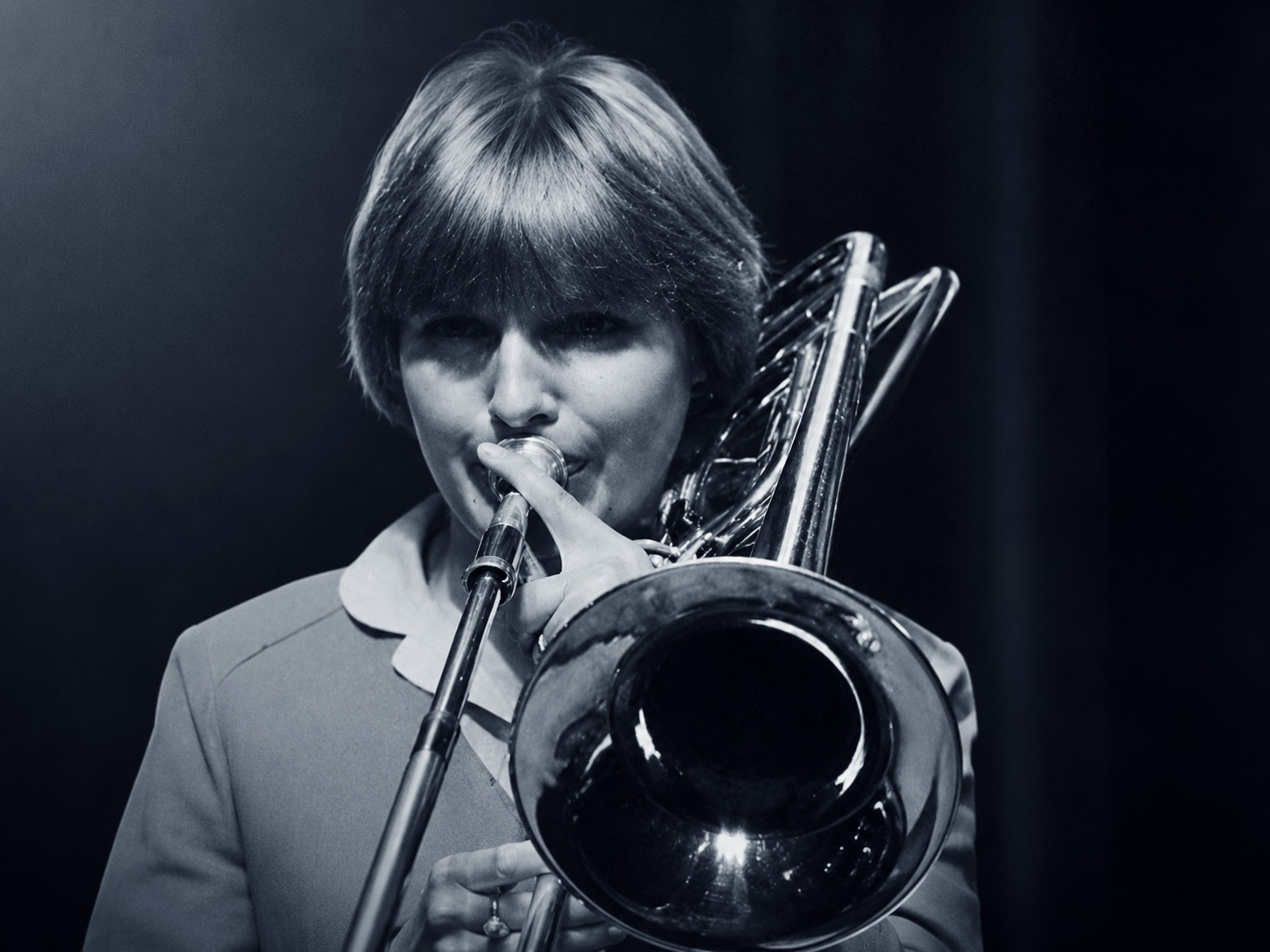
A woman trombonist, Yvelise Girard

Women and Brass

A woman trombonist, Yvelise Girard

A section under the heading "Women and Brass" is here devoted to a professional woman trombone player. She is the first woman in France to be appointed to an official post by means of a competition and I thought it would be interesting to introduce her to Brass Bulletin readers.

Yvelise Girard, 22, was born into a family of musicians. At the age of eight she happened to attend a concert given by an American military band and it was there that she discovered the trombone. Fascinated by the instrument, she immediately decided to learn to play it and was given a valve trombone.

Although they were surprised by her choice of instrument, her parents enrolled her on a course given by Monsieur Launay, professor at Conservatoire du Mans. He was a very kindly man who came to treat the little girl as his own daughter.

Although Yvelise was joining a group which had until then been exclusively male, this did not appear to pose any problems; indeed, she recalls that the atmosphere was pleasant and relaxed.

Monsieur Ferran, Monsieur Launay’s successor, encouraged her to try for the Paris Conservatoire.

"I was 17 at the time and the second girl to join the trombone class. It may be that at the beginning my classmates were surprised at my being there but we very soon began to work as a team since we found ourselves faced with the same problems."

Two years later Yvelise won her first prize. It was then that she really began to discover music; she went to concerts and listened to records, and from then on her music studies were centred more and more on musicality.

The chamber music class in which she also won a first prize was a great help to her in this.

After going round the large Paris symphony orchestras, she deputised several times in the orchestras in Nantes and Limoges. She obviously did not pass unnoticed. There are advantages as well as disadvantages in this; as for example when competitions are involved.

The main advantage is that people listen to her carefully and, if she plays well, her name will be more readily remembered from among the mass of applicants. On the other hand her performance is closely scrutinised, criticised and analysed.

One day Yvelise heard that the National Police Band was holding a competition for two trombonists. The competition was open to women, so she applied and her application was favourably received by Monsieur Bigot, the band's conductor.

Monsieur Bigot made all the necessary approaches to the various ministries. Despite the reservations expressed by some of the musicians, Yvelise was appointed.

The first few months were nevertheless difficult. Dressed in a smart uniform, a charming hat and elegant shoes she forced herself to play at concerts and parades, refusing to accept preferential treatment.

One very cold day she was taken ill during an open-air ceremony but would not accept any assistance until she heard that two of her colleagues had already received treatment (and her honour was satisfied).

Things will no doubt be easier for female musicians who follow her but Yvelise is the first woman trombone player to play in a police band and her path is littered with obstacles.

When they play away from home Monsieur Bigot reserves a hotel room for her so that she does not have to stay in the barracks.

Yvelise was recently successful in another competition held by the Paris Police Band but she is very reluctant to accept the post as she would then be in the same section as her bass-trombonist husband.

She rightly thinks that it is sometimes preferable, for the smooth running of the household, to keep professional and private life separate.

She has found that at work men are more touchy — a remark which may be "pertinent" uttered by a man becomes "unpleasant" when uttered by a woman.

Since she is still new to the business, Yvelise is ruffled by the lack of honesty shown by certain musicians to "the girl trombone player"; her isolation within an orchestra consisting entirely of men disturbs her in spite of everything and she is eager to be joined by a female colleague.

Meanwhile she works extremely hard to prove her worth; she has entered all the international competitions, especially the one in Prague, where she reached the semi-final.

She finds some consolation in the fact that the harshest criticism always comes from rather mediocre musicians. (With a little more experience I think she will come to realise that jealousy and gossip arise without regard to sex...)

Comparing herself to men Yvelise has found that she has the advantage of flexibility and musicality over them; on the other hand she had to force herself to solve the problem of power (unconscious fear of appearing vulgar?...).

Yvelise dreams of joining a large Paris symphony orchestra; she would also like to have a baby. It would make a good story, beginning, "The alto trombone, whose parents the tenor trombone and the bass trombone..."

Yvelise's career will probably take a new turn when she takes up teaching; she will then no longer have to accompany the National Police Band on its numerous trips and will thus be able to give more attention to her home while continuing to play the trombone at the same time.

Through Brass Bulletin she would very much like to get in touch with other female brass players in order to correspond with them and, ultimately, organise some meetings.

The call has been made... I am sure it will be heard.

Brass Bulletin 29, I / 1980 páginas 49–52

Todo el contenido está protegido por derechos de autor © Brass Bulletin 1980–2026

Compartir este artículo

Facebook LinkedIn
Cargando…

Preguntas y respuestas

Cómo funciona la edición digital

¿Qué incluye la edición digital?

La edición digital reúne los artículos ya digitalizados como textos legibles y consultables en línea —no simplemente como escaneos o archivos PDF— junto con sus ilustraciones originales, notas, autoría, información del número y traducciones disponibles. Las sugerencias de artículos relacionados incluyen actualmente solo este material digitalizado.

¿Los artículos digitales son idénticos a los originales?

Conservamos con la mayor fidelidad posible el texto original, el idioma, las ilustraciones, los pies de imagen, las notas y el contexto editorial. La presentación se adapta para facilitar la lectura en línea y pueden corregirse errores evidentes de transcripción o escaneado. El contenido y el carácter del artículo publicado permanecen inalterados.

¿Qué idiomas están disponibles?

Brass Bulletin se publicó en inglés, francés y alemán a lo largo de toda su historia. Las traducciones al italiano y al español se añadieron a partir del número 60. Por este motivo, en los sitios italiano y español los artículos de los números 1 a 59 se muestran en inglés de forma predeterminada.

¿Con qué frecuencia se añaden nuevos artículos?

Se añaden nuevos artículos casi a diario, con aproximadamente un número completo digitalizado cada semana. El ritmo puede variar según el trabajo de preparación, tratamiento de imágenes y revisión editorial necesario.

¿Por qué no están disponibles todos los artículos en formato digital?

La colección completa de Brass Bulletin contiene 1.246 artículos publicados entre 1971 y 2003. El índice completo ya está disponible en línea y permite descubrir todos los artículos de la colección, incluidos aquellos cuyo texto íntegro todavía no ha sido digitalizado.

La digitalización comenzó en febrero de 2026. Cada artículo se prepara cuidadosamente para la lectura en línea, se revisa y se vincula con su número, sus autores, sus temas y sus ilustraciones. Al ritmo actual de digitalización, se prevé que la colección completa esté disponible en línea en febrero de 2028.

¿Por qué algunas referencias mencionan artículos que todavía no están disponibles?

Las referencias de los artículos originales se conservan aunque el material al que remiten aún no haya sido digitalizado. De este modo se mantiene intacto el contexto histórico y editorial. A medida que se incorporen más números a la edición digital, un número creciente de estas referencias conducirá a artículos que podrán leerse en línea.

¿Puedo sugerir un artículo o informar de un error de transcripción?

Sí. Si hay algún artículo que le gustaría especialmente ver digitalizado, o si detecta un posible error de transcripción o algún dato que falta, póngase en contacto con nosotros. Los comentarios de los lectores nos ayudan a mejorar la edición digital y a establecer prioridades útiles dentro del archivo.

¿Cómo puedo apoyar a Brass Bulletin?

Su apoyo ayuda a financiar la preparación, verificación y publicación en línea de la colección completa.

Suscríbase a la Edición Digital

¿Prefiere apoyarnos sin suscribirse?

Haga una donación

¿Cómo avanza la digitalización?

Estamos poniendo Brass Bulletin a disposición de los lectores en línea, artículo por artículo. Pueden leer los artículos recién digitalizados en cuanto estén listos, incluso antes de que se complete un número entero.

Consulten nuestro calendario de digitalización para descubrir las últimas novedades y las fechas estimadas de disponibilidad de los próximos números. Estas estimaciones se basan en nuestro ritmo reciente y pueden cambiar.

Busca en Brass Bulletin.