Rendete Brass Bulletin disponibile nella vostra università, nel vostro conservatorio o nella vostra biblioteca Scoprite l’accesso istituzionale

2 min di lettura

Drollery in the medieval representation of musical subjects

Drollery in the medieval representation of musical subjects

The following text and pictures are taken from a publication by Prof. Dr. Franzgeorg von Glasenapp: Varia / Rara / Curiosa (ed. 1971 by the Joachim-Jungius-Gesellschaft der Wissenschaften, Hamburg; Vandenhoeck & Ruprecht, publ., Göttingen), which is part of a large work on the subject to be published at a later date.

The « grand siècle » of the drolleries was the Gothic era, i.e. 12th till 15th century. During that period many pictures and sculptures showed an outspoken humorous trait. Formerly they were called « caricatures » or « satires », but nowadays one generally speaks of « drolleries », thus expressing their jesting, playful character. The artist makes full use of his imagination and gets his ideas from many different sources: everyday objects and creatures are modified in a jocular way, fairy or fable figures of all kinds added. But also religion and superstition are a source of inspiration for drolleries as well as criticism of contemporaries, of the clergy and last not least of the « Spielmann » (— minstrel and juggler).

The Spielmann, being agile and versatile, could influence practically every scope of public life in the middle ages, be it on cultural, economical, political or social grounds. These quite indispensable artists were the « all-round-men » of their era, forerunners so to speak of the elusive and agile Figaro. At first the Church had a very poor view of the Spielmann: he was considered to be the devil incarnate or at least his « minister ». But gradually the artists succeeded in gaining the clergy's favor, at least those who behaved according to the moral laws and who served church and high dignitaries with their art.

It is an interesting fact that many images of minstrels and jugglers decorate Gothic churches. Why this should be, we do not know for sure. It could be that the Spielmann, as a symbol of frivolous « vanitas », was used as a warning image for all to see, yet it could also be that the image underlined the fact that the Church of God represents the entire cosmos, embracing even people like jugglers and minstrels. It is also presumed that the Gothic sense of drollery played a certain role in the conception of these works of art (ill. nr. 2).

The medieval images of minstrels and jugglers (Spielleute) are generally simple and speak for themselves. Since much material on the subject has become accessible during the last century, study and comparison have led to the conclusion that the artist of the middle ages knew every detail of the instruments, yet would represent them « correctly » only when he wanted to do so, i.e. if he did not have a special reason for making them look different. Therefore we shall always find stylised pictures (ill. nr. 3) or instruments that are typically an attribute to the player, like the straight trumpets of the angels of the Last Judgment. Or — drolleries (ill. 7–10).

Brass instruments are mostly clearly recognizable on pictures or sculptures of the middle ages (not so wind instruments of other material), even if they are « curiosities ». Looking at the following pictures it should be kept in mind that the rule is: an instrument with a narrow and (2/3rd of total length) cylindrical tube belongs to the trumpet-family, whereas the conical form will be counted to the horn instruments.

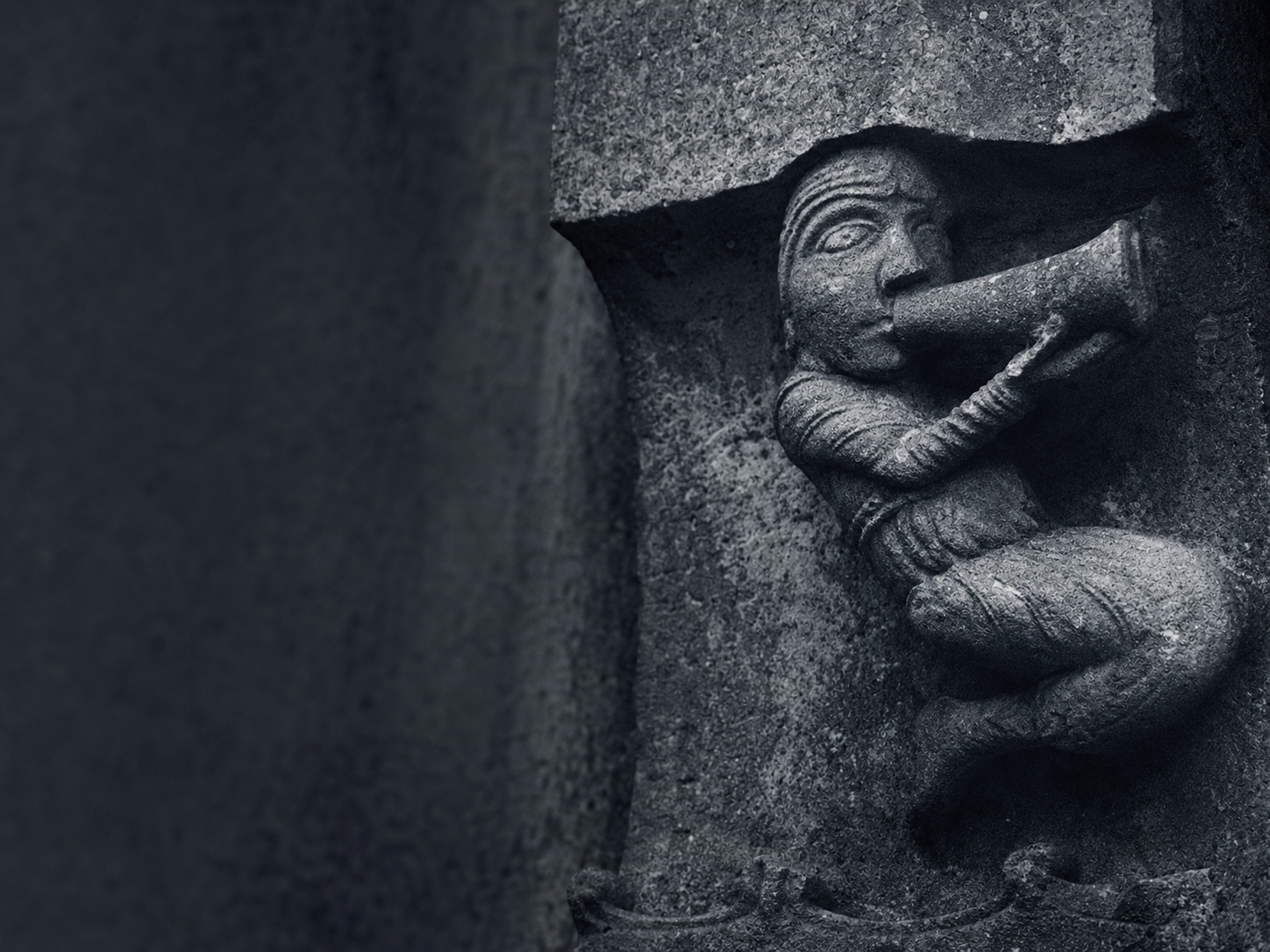
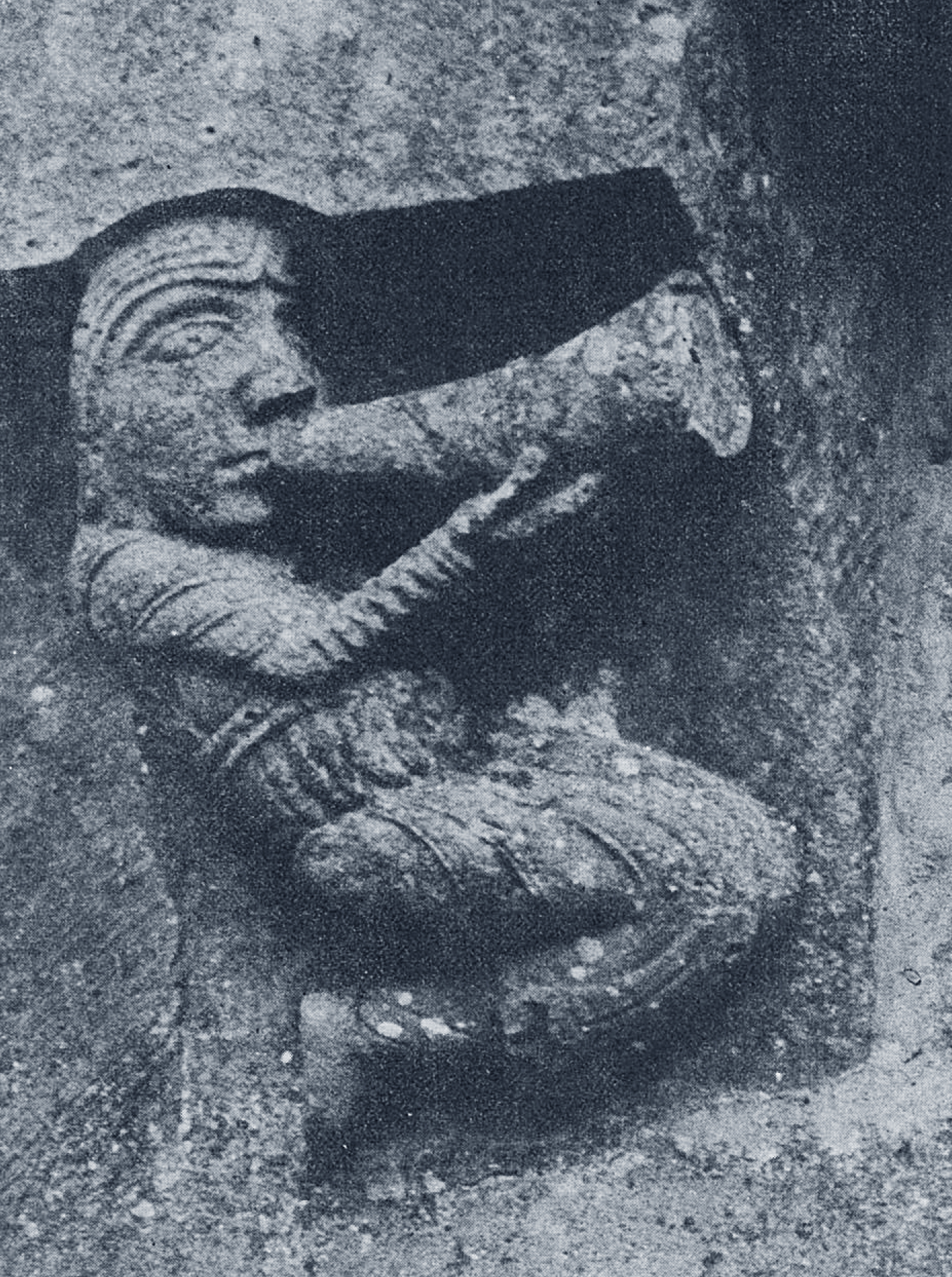
1. A horn player, St. Pierre Church of Aulnay (Charente marit.), 12th cent.
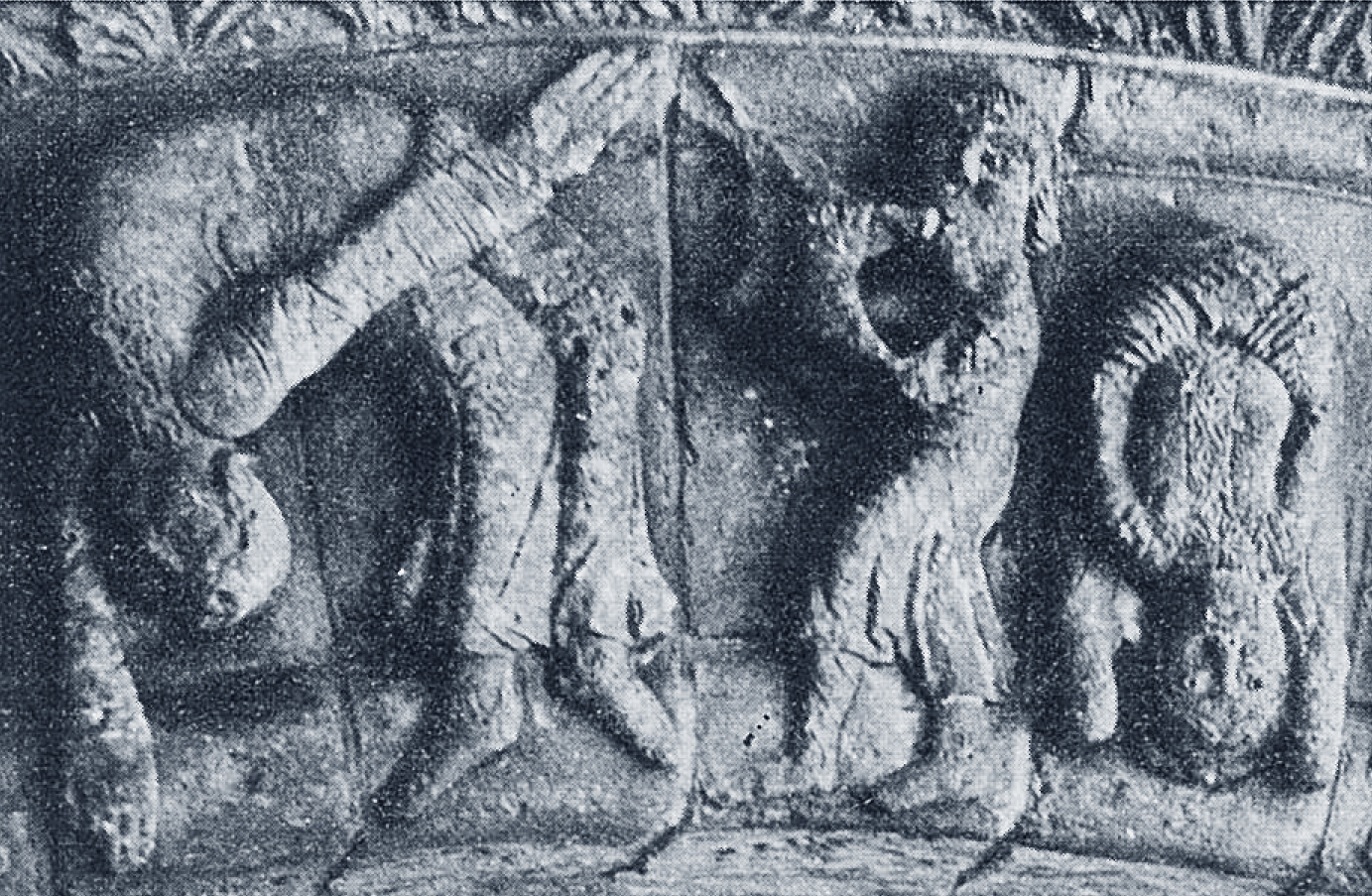
2. Musician and two acrobats. The wind instrument in the middle is destroyed except for the cupped mouthpiece. The two j...
2. Musician and two acrobats. The wind instrument in the middle is destroyed except for the cupped mouthpiece. The two jugglers bend backwards: the one on the right is seen from behind, the other from the side. First half 12th cent. Foussais (Vendée), église extérieure, façade ouest, portail. Première moitié du XIIe siècle.
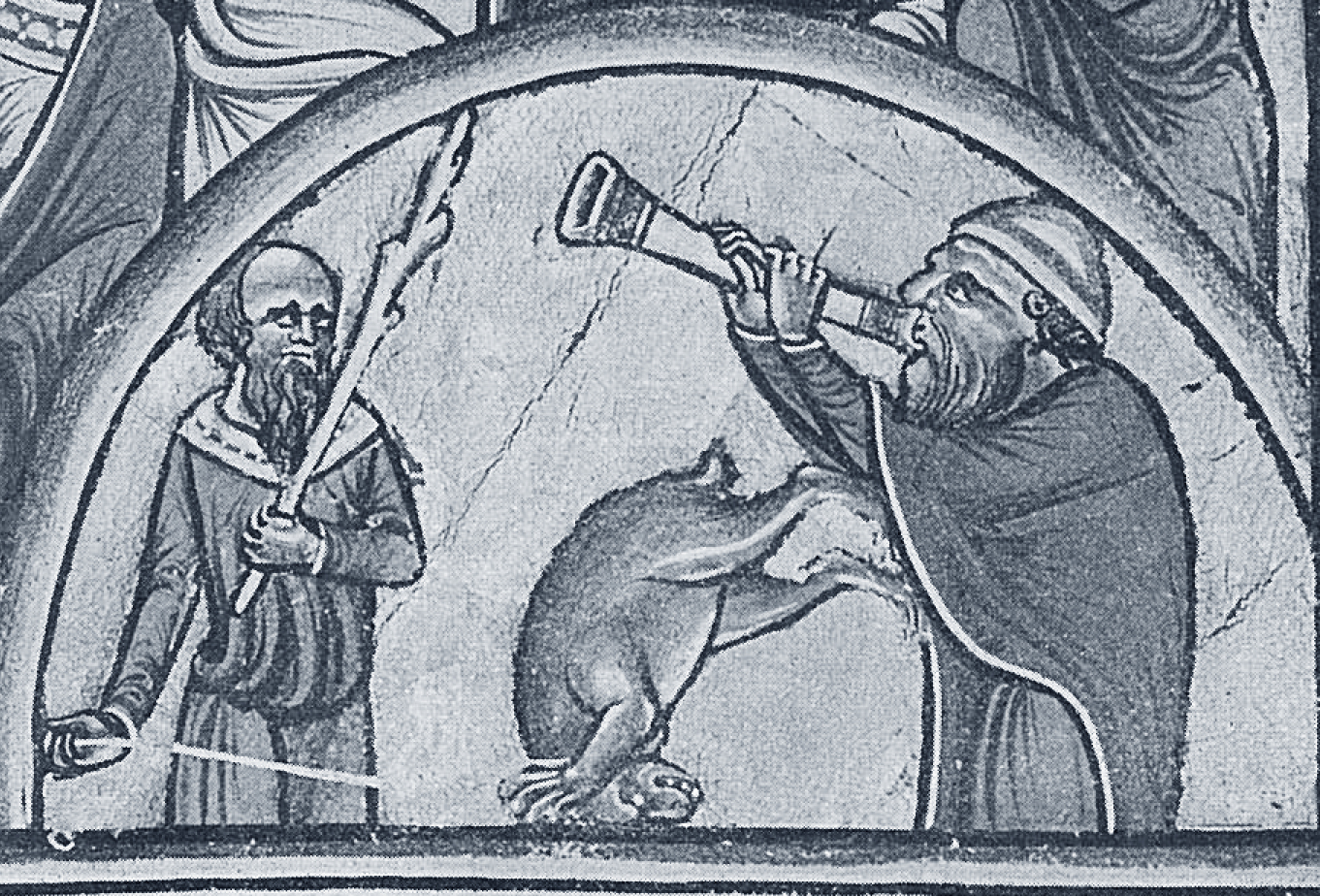
3. Training of animals. Musician’s lips are visible at the embouchure of the instrument. Function of hands undefined. 13...
3. Training of animals. Musician’s lips are visible at the embouchure of the instrument. Function of hands undefined. 13th cent. Paris, Bibl. nat., Cod. lat. 8846, fol. 50, psautier (manuscrit)
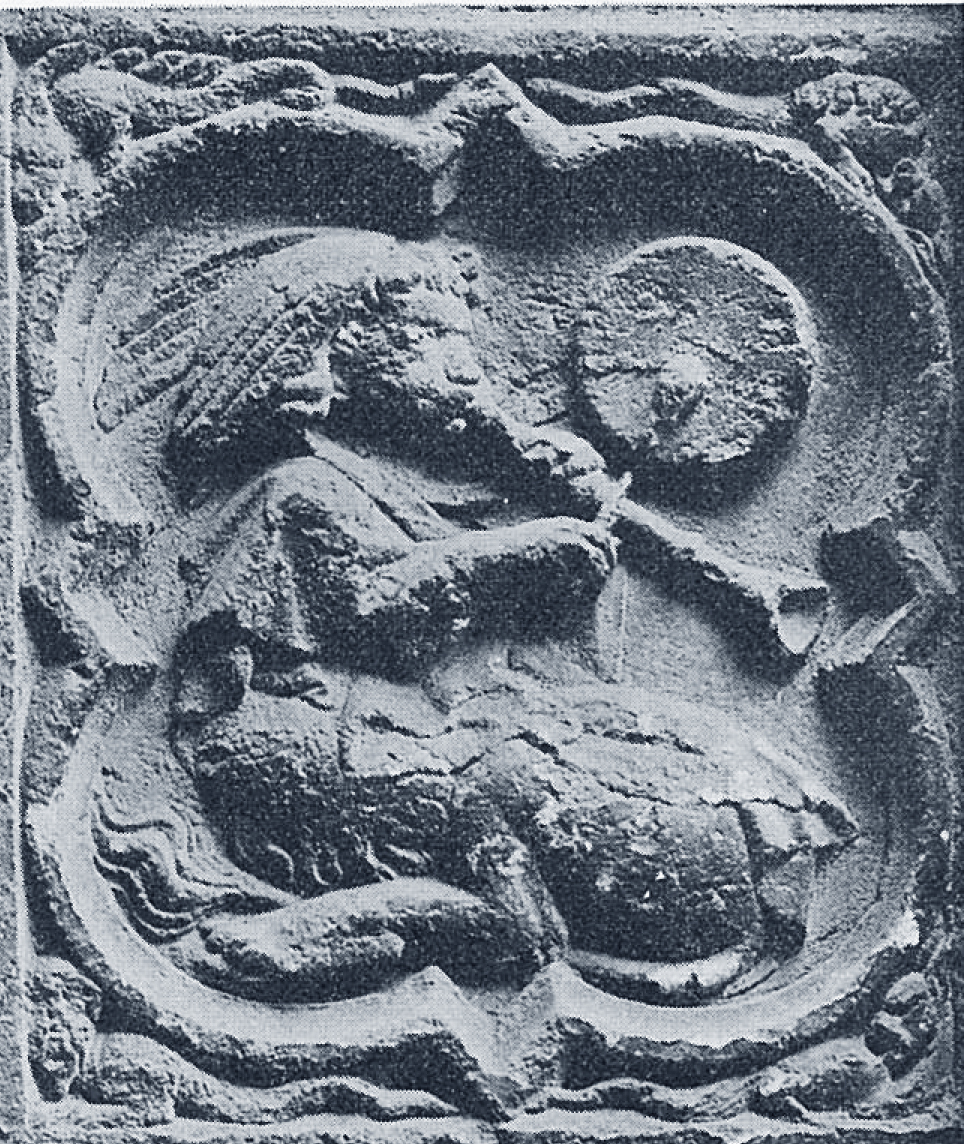
4. Fairy creature with winged helmet, playing a wind instrument and percussion crosswise. Around 1280. Rouen (Seine-Mari...
4. Fairy creature with winged helmet, playing a wind instrument and percussion crosswise. Around 1280. Rouen (Seine-Maritime), cathédrale, portail des Libraires. Drôlerie.
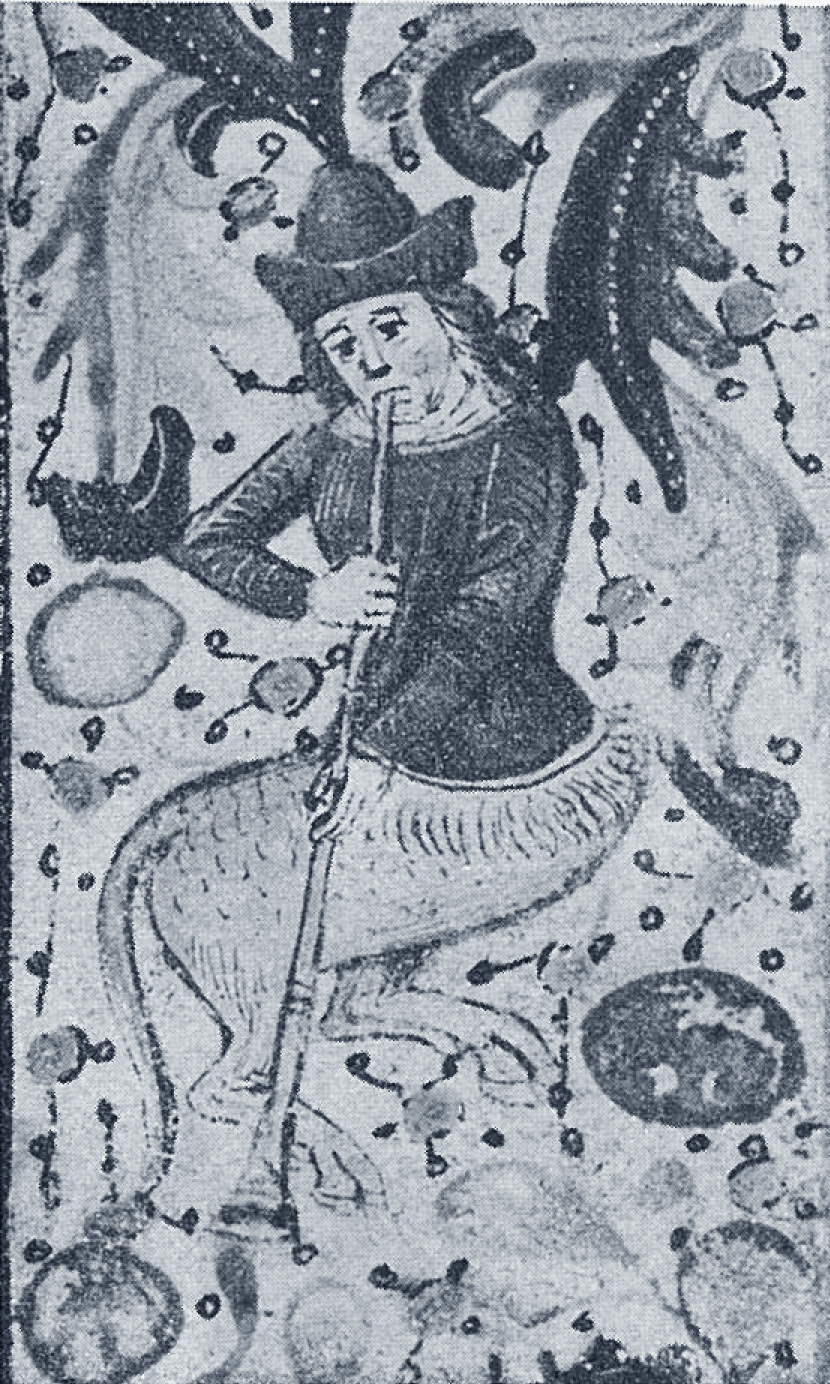
5. Centaur with straight trumpet. Around 1470. Darmstadt, LB, Hs. 1968; livre d'heures, Bruges, fol. 13, bordure.
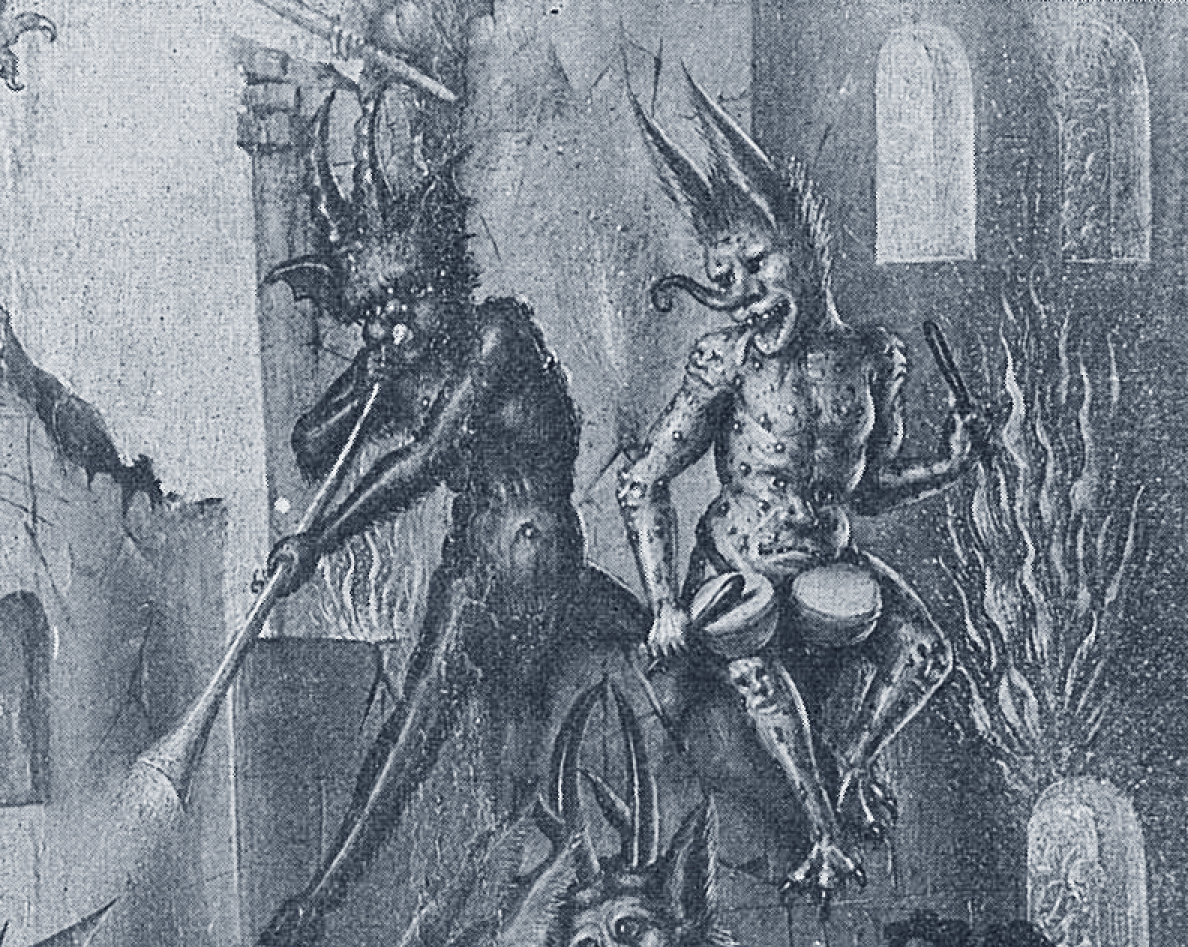
6. Two devils with a straight trumpet and small drums, beaten with clubs. Cutting from Stefan Lochner’s « World Judgment...
6. Two devils with a straight trumpet and small drums, beaten with clubs. Cutting from Stefan Lochner’s « World Judgment ». First half 15th cent. Cologne, Musée Wallraf-Richartz.
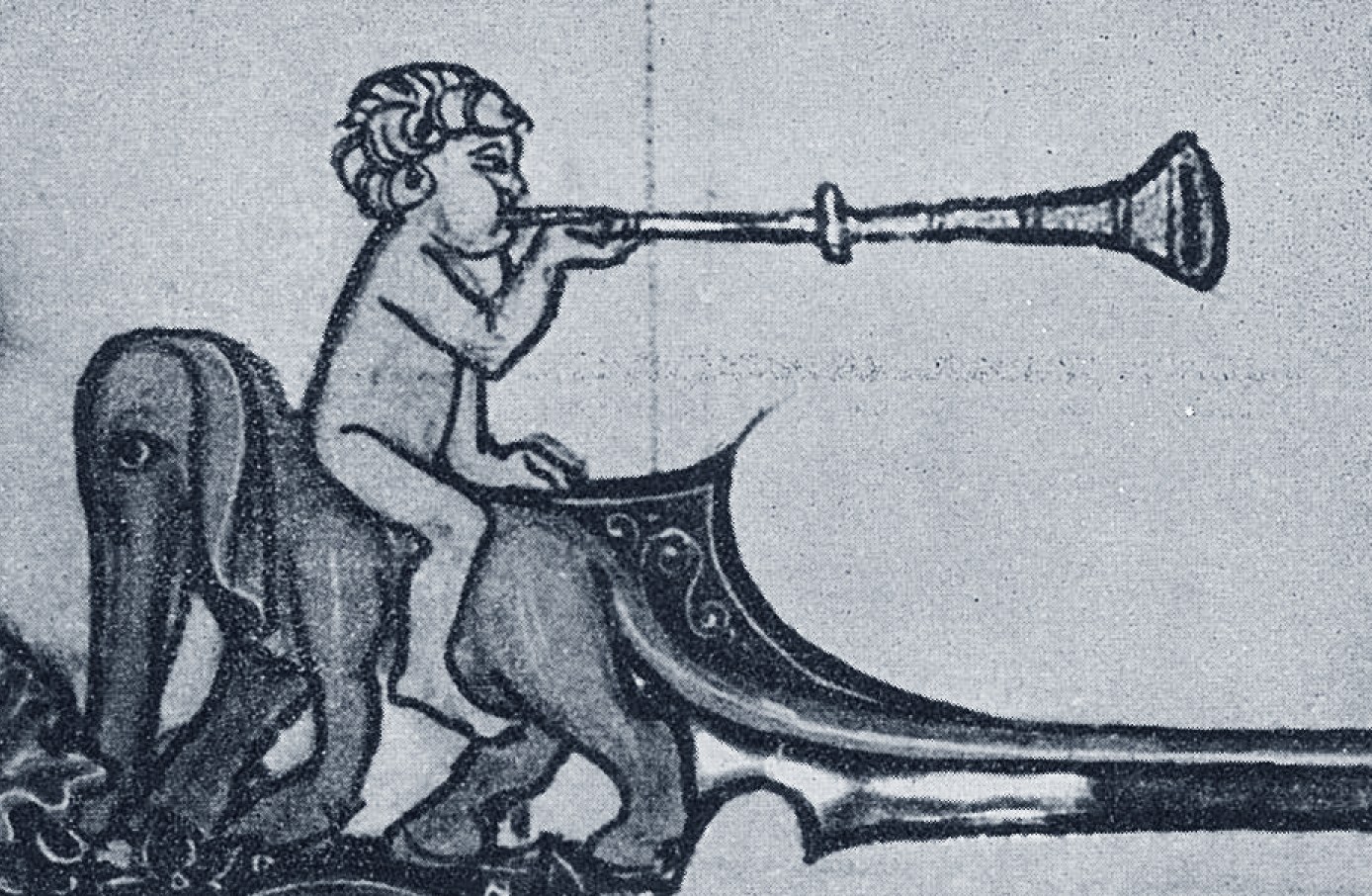
7. A droll figure with a straight trumpet riding a small elephant. End 13th cent. Paris, Bibl. nat., Cod. fr. 95, anthol...
7. A droll figure with a straight trumpet riding a small elephant. End 13th cent. Paris, Bibl. nat., Cod. fr. 95, anthologie ms. de romans français.
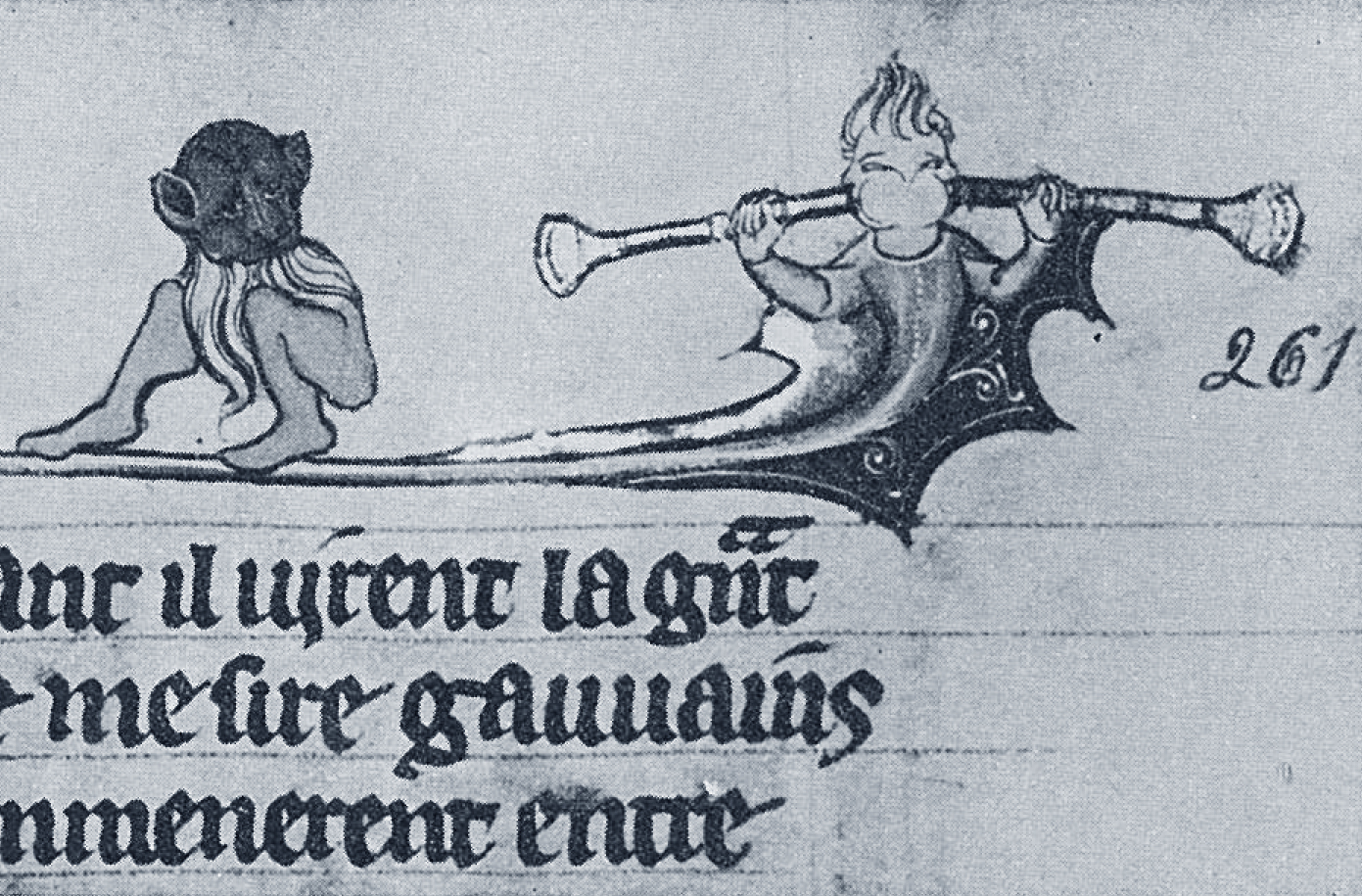
8. A droll picture of the human trunk whose head has two faces, each one blowing a trumpet. On the left a small fairy cr...
8. A droll picture of the human trunk whose head has two faces, each one blowing a trumpet. On the left a small fairy creature. End 13th cent. Paris, Bibl. nat., Cod. fr. 95, anthologie ms. de romans français, fol. 261r.
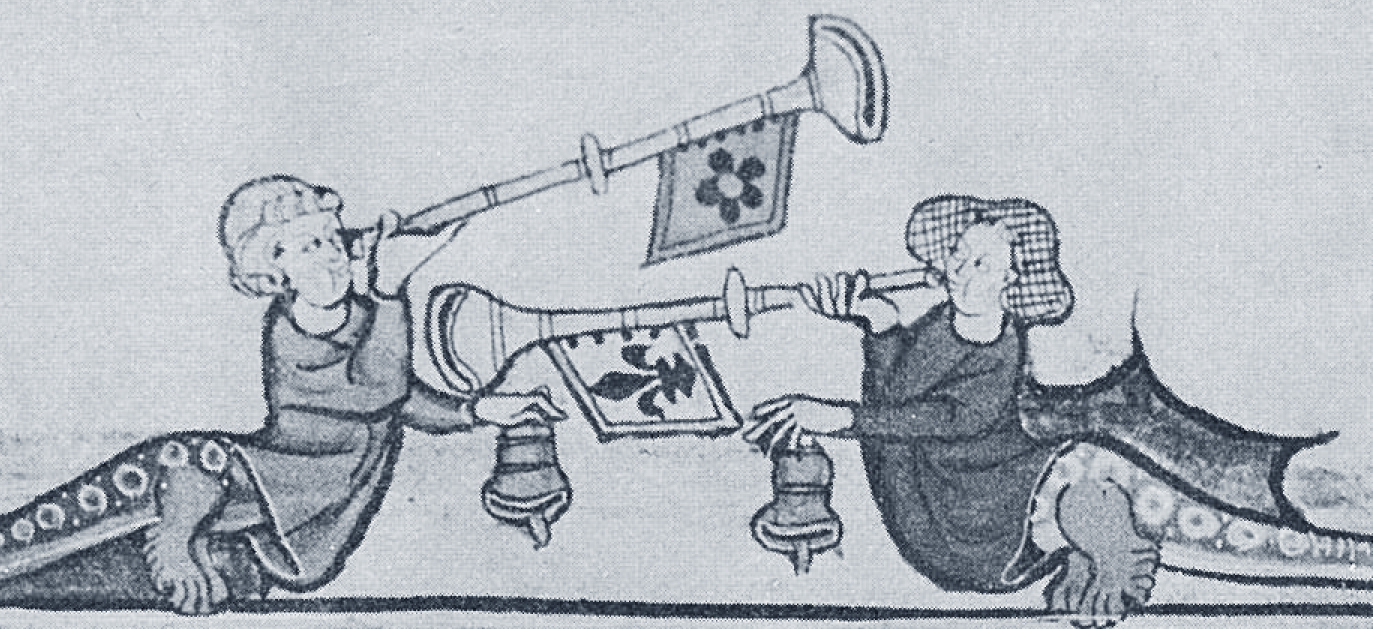
9. Two fairy creatures facing each other. They have human trunks and heads, but an animal’s feet. Both creatures carry a...
9. Two fairy creatures facing each other. They have human trunks and heads, but an animal’s feet. Both creatures carry a straight trumpet in one hand, a bell in the other. The bell joints of the trumpets and lower borders of the bells are drawn in a jocularly (?) deformed way. End 13th cent. Paris, Bibl. nat., Cod. fr. 95, fol. 52v
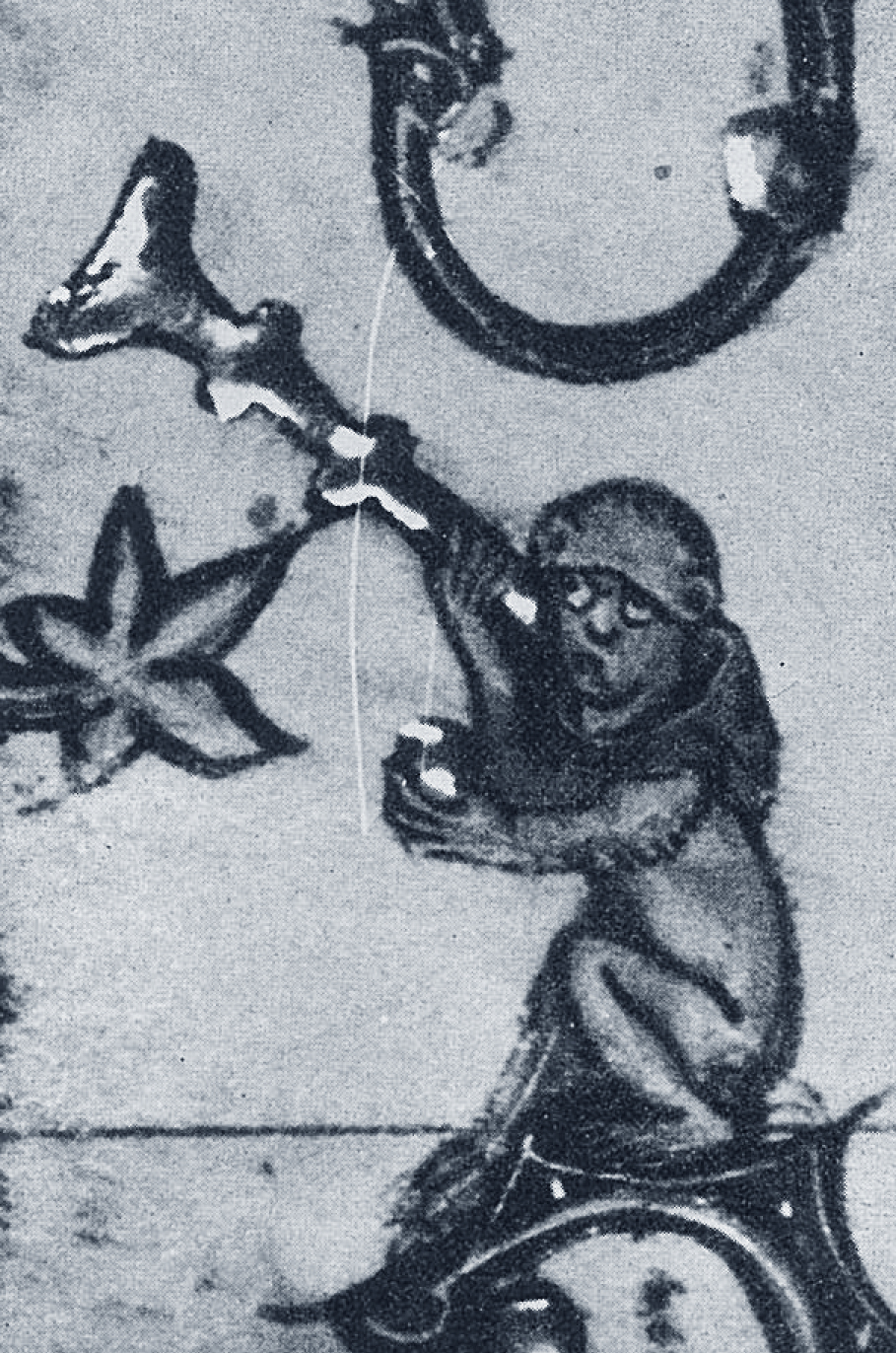
10. Small figure (monkey?) with spectacles holding a trumpet with two knobs to its ear as if it were an ear-trumpet. Mid...
10. Small figure (monkey?) with spectacles holding a trumpet with two knobs to its ear as if it were an ear-trumpet. Middle or end 13th cent. Paris, Bibl. nat., Cod. lat. 10435. Psautier de la Picardie, fol. 137.
Brass Bulletin 9, III / 1974 pagine 19–32

Tutti i contenuti sono protetti dal diritto d’autore © Brass Bulletin 1974–2026

Condividi questo articolo

Facebook LinkedIn
Loading…

Domande e risposte

Come funziona l’edizione digitale

Che cosa comprende l’edizione digitale?

L’edizione digitale riunisce gli articoli già digitalizzati sotto forma di testi leggibili e ricercabili online — non semplicemente come scansioni o file PDF — insieme alle illustrazioni originali, alle note, agli autori, alle informazioni sul numero della rivista e alle traduzioni disponibili. I suggerimenti di articoli correlati comprendono attualmente solo questo materiale digitalizzato.

Gli articoli digitali sono identici agli originali?

Conserviamo il più fedelmente possibile il testo originale, la lingua, le illustrazioni, le didascalie, le note e il contesto editoriale. La presentazione viene adattata per una lettura confortevole online e gli evidenti errori di trascrizione o scansione possono essere corretti. Il contenuto e il carattere dell’articolo pubblicato rimangono invariati.

Quali lingue sono disponibili?

Brass Bulletin è stato pubblicato in inglese, francese e tedesco nel corso di tutta la sua storia. Le traduzioni italiane e spagnole sono state aggiunte a partire dal numero 60. Sui siti italiano e spagnolo, gli articoli dei numeri da 1 a 59 vengono quindi mostrati in inglese per impostazione predefinita.

Con quale frequenza vengono aggiunti nuovi articoli?

Nuovi articoli vengono aggiunti quasi ogni giorno, con circa un numero completo digitalizzato ogni settimana. Il ritmo può variare in base al lavoro di preparazione, elaborazione delle immagini e verifica editoriale necessario.

Perché non tutti gli articoli sono disponibili in formato digitale?

La collezione completa di Brass Bulletin comprende 1.246 articoli pubblicati tra il 1971 e il 2003. L’indice completo è già disponibile online e consente di scoprire tutti gli articoli della collezione, compresi quelli il cui testo integrale non è ancora stato digitalizzato.

La digitalizzazione è iniziata nel febbraio 2026. Ogni articolo viene accuratamente preparato per la lettura online, verificato e collegato al relativo numero, agli autori, agli argomenti e alle illustrazioni. Al ritmo attuale di digitalizzazione, la collezione completa dovrebbe essere disponibile online entro febbraio 2028.

Perché alcuni riferimenti citano articoli che non sono ancora disponibili?

I riferimenti presenti negli articoli originali vengono conservati anche quando il materiale a cui rimandano non è ancora stato digitalizzato. In questo modo si preserva l’integrità storica ed editoriale della rivista. Man mano che nuovi numeri vengono aggiunti all’edizione digitale, un numero crescente di questi riferimenti condurrà ad articoli leggibili online.

Posso suggerire un articolo o segnalare un errore di trascrizione?

Sì. Se desiderate che un determinato articolo venga digitalizzato, oppure se notate un possibile errore di trascrizione o un’informazione mancante, contattateci. I riscontri dei lettori ci aiutano a migliorare l’edizione digitale e a stabilire priorità utili all’interno dell’archivio.

Come posso sostenere Brass Bulletin?

Il vostro sostegno contribuisce a finanziare la preparazione, la verifica e la pubblicazione online dell’intera collezione.

Abbonati all’Edizione digitale

Preferite sostenerci senza abbonarvi?

Fate una donazione

Come procede la digitalizzazione?

Stiamo rendendo Brass Bulletin disponibile online gradualmente, articolo per articolo. Potete leggere gli articoli appena digitalizzati non appena sono pronti, anche prima che un intero numero sia completato.

Consultate il nostro calendario di digitalizzazione per scoprire le ultime aggiunte e le date di disponibilità stimate dei prossimi numeri. Le stime si basano sul nostro ritmo recente e possono cambiare.

Cerca in Brass Bulletin.