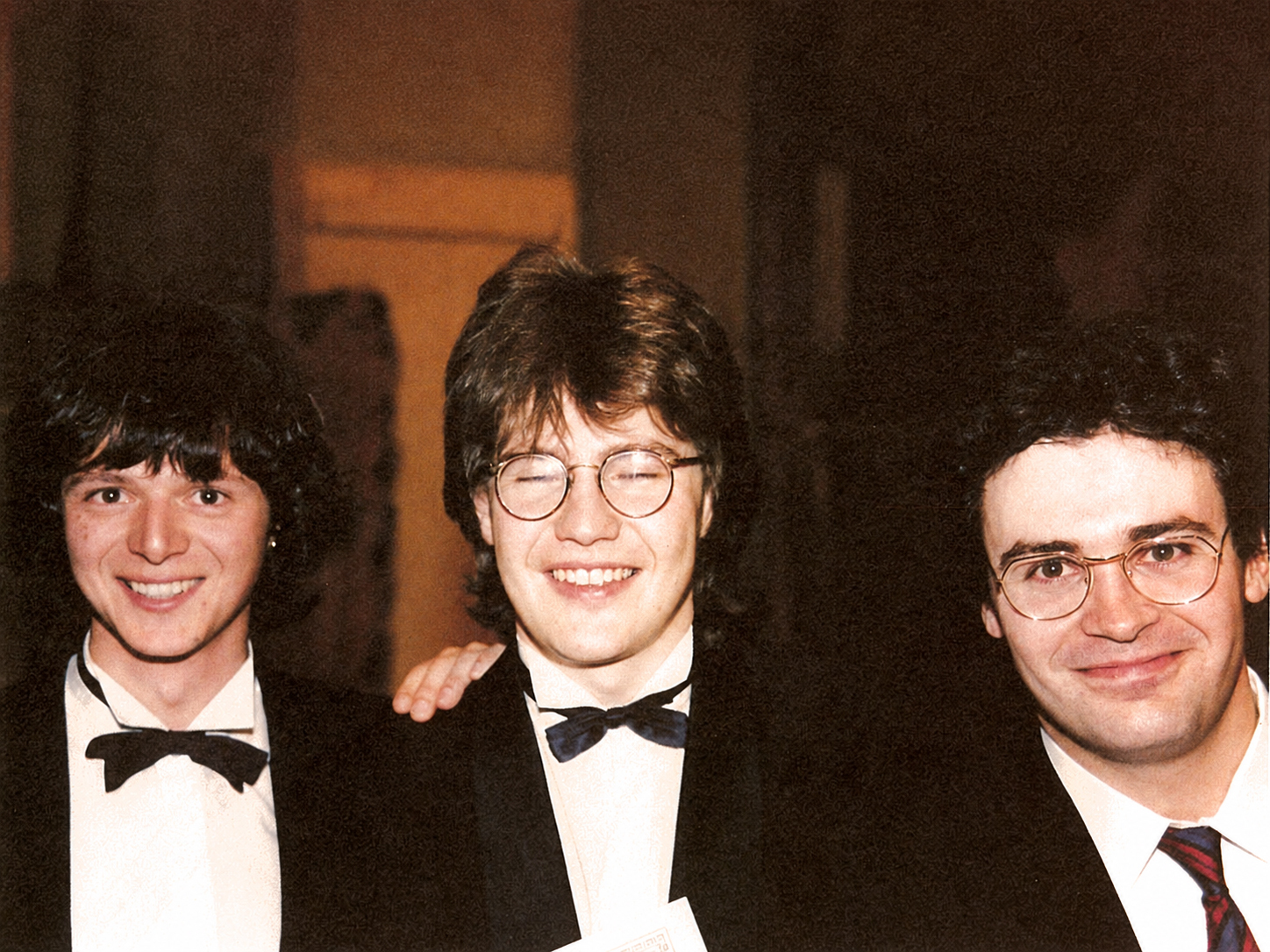
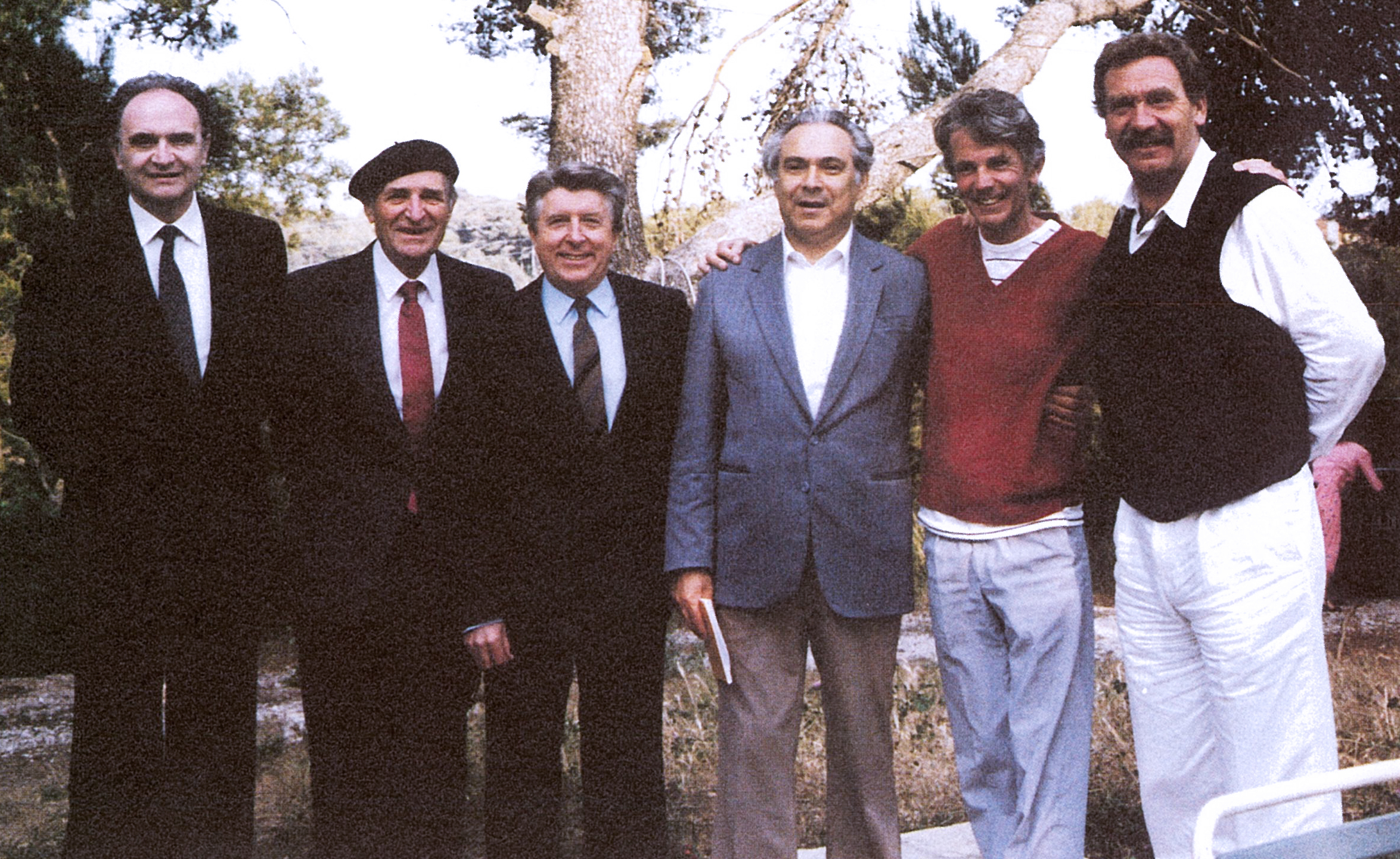
The jury. ➜ Carlo Arfinengo, Roger Voisin, Roger Delmotte, Timofei Dokschidser, Philip Jones, Jean-Pierre Mathez (X Edgar Cosma).
Can a jury be fair?
Every judge does not have the same scale of values. The average which the jury produces is therefore an artificial value which may seem unfair to some. (It would be interesting to see a parallel result from a “jury” consisting of candidates!) In any case the balance of a jury is proportional to the quality, personality, conscience and tolerance of each member.
Candidates and audience do not have the same criteria as the jury and often do not understand its decisions. For the judges, to enter this discussion is to enter a minefield. Since the decisions result from an average of a combined score, one judge speaking in his own name immediately resorts to his own subjective views. We must accept jury decisions — if we accept the principle of competitions in the first place — as having a certain degree of objectivity.
Discussion
After the Toulon competition BRASS BULLETIN had the opportunity of an interesting discussion with the judges:
Timofei Dokschidzer: I think competition programmes shouldn’t favour technicians, but should stimulate musicians who think and can demonstrate their musicality. We need works which lead to the joy of playing and listening.
Roger Delmotte: I only partly agree with that. How many 1st prize winners from Munich, Toulon, Geneva and so on really become soloists? It’s what is demanded in the orchestra that’s fundamental. That’s a job that demands mastery of all musical forms, old and new.
T. D.: That’s true! Competitions raise the standard of orchestral players. The exceptional soloist only turns up very rarely.
Philip Jones: I support Roger Delmotte as far as his competition repertoire is concerned. In my opinion he’s trying to get young musicians to understand and play all kinds of music. That’s an essential condition: if you want to play first in an orchestra, you have to know how to play classical, modern and avant-garde. What Timofey Dokshitser says about music is true but artistically the trend is irreversible and, eventually, universal. What Roger Delmotte is doing here in Toulon may be a little ahead of its time but it’s indispensable.
T. D.: My idea is not incompatible with that. I just think that in every area we need works of good quality, high standard — not circus music!
Roger Voisin: Personally I found the variety of programme and requirements excellent. In my view being a musician means being willing and able to adapt to all requirements. That’s professionalism! A competition like Toulon encourages all kinds of talents and monitors the candidates’ technical and musical resources.
Carlo Arfinengo: Generally I agree with what has been said but I still have some doubts. For example, is it right that those picked in the first round on the basis of Hummel and Sutermeister should still be in the running in the second round with two modern works? Personally I would have liked to hear them play a classical work again before inviting them to the final.
T. D.: I think these competitions are also very important for teachers. For example we in the Soviet Union should take more to do with western music and vice versa. (Our Soviet music is very romantic and good to play — Vasilenko, Vaynberg etc.) That would extend the range of our universal musical resources!
R. D.: What is an international competition for?
C. A.: Every musician thinks he’s at the centre of the world. A competition is a great international forum, for exchange and study. People can broaden their parochial outlook!
R. V.: It’s a place where talents confront one another, where you find the opportunity to compare, and to meet other nationalities. Culturally it’s very enriching and reminds us that music has no barriers, no frontiers.
T. D.: To listen and compare, to understand international playing standards or new interpretative tendencies. To discover new works and meet new challenges. A competition reveals the artistic horizon of every country in the world.
P. J.: A meeting like this should help you understand the different ways in which you can play the same music! And offer a non-nationalistic view of interpretation, force respect and stimulate a spirit of tolerance. What a competition should not be is the desire to play faster, higher and louder than anybody else!
Gentlemen, a summary of the Toulon competition 1987?
P. J.: The technical standard was higher than ever but I’m still looking for a corresponding degree of musicality. That’s the real job for the teachers who send their pupils here!
C. A.: Generally, sound quality and musicality were pushed into the background. You feel that the candidates prepared themselves mainly for the technical problems.
R. V.: I would like to emphasise that the accompanists should be of at least the same standard as the candidates. During this competition we heard some accompanists of a very uneven standard and some trumpeters undoubtedly suffered as a result! [The other judges agreed strongly and unanimously with this.]
T. D.: There’s still so much to do for these youngsters in terms of simple analysis of the musical text.
R. D.: The importance of this competition lies in offering young people from everywhere a place to challenge each other and to compare schools of playing. It’s not just giving marks and picking winners.
Would a competition be fairer if the candidates remained anonymous until the end?
P. J.: It would be interesting to preserve anonymity till the semifinal.
R. V.: Sure, even right to the end, as far as I’m concerned!
C. A.: I agree with Roger Voisin.
T. D.: I understand a player better if I can see him.
R. D.: This is a problem.
J.-P. M.: From the point of view of honesty I think that anonymity throughout the competition would be best!
One revelation from the competition:
The trumpet concerto which the French composer Edgar Cosma wrote as a set piece for the competition turned out to be a major work for the repertoire. Orchestration full of nuance and subtlety, very imaginative rhythms and a solo part of great quality. Jury, audience and candidates were unanimous: an exceptionally successful work!
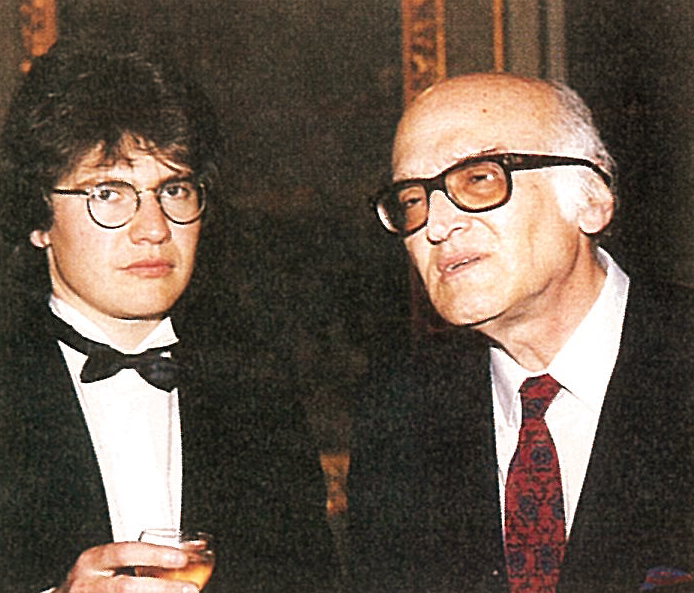
Urban Agnas — Edgar Cosma.
A few thoughts
Ruthless competition cannot lead to the fulfilment of the individual.
Young musicians need more time to live, discover, dream, think, practise. The times we live in have drastically shortened their days and nights!
It is a performer’s curiosity that leads him or her to discover the mysteries of interpretation.
Many of the candidates started out with a level of technical skill at the very limit of their capabilities and then lost half of it through nervousness. So why not devote half or more of one’s practice time to exercises in self-control and relaxation?
Questions about teaching?
Is progress through the repertoire too fast? Perhaps it is. Brass players should draw inspiration from singers rather than from other instrumentalists. And it takes full physical maturity to stand up to a heavy solo programme! Knowing how to plan one’s career with wisdom and perspicacity...
Are there too many influences?
The proliferation of masterclasses all over the world creates an enormous quantity of often divergent and confusing opinion. Pupils whose training has not yet stabilised can get lost in the middle of it all.
What is the right time to take part in an international competition?
When your intellect embraces both technique and musicality.
— When’s that?
— When you have climbed high enough and the horizon has receded far enough for you to have some open space around you.