14 min di lettura
The French Hunting horn, its history, its technique and its music
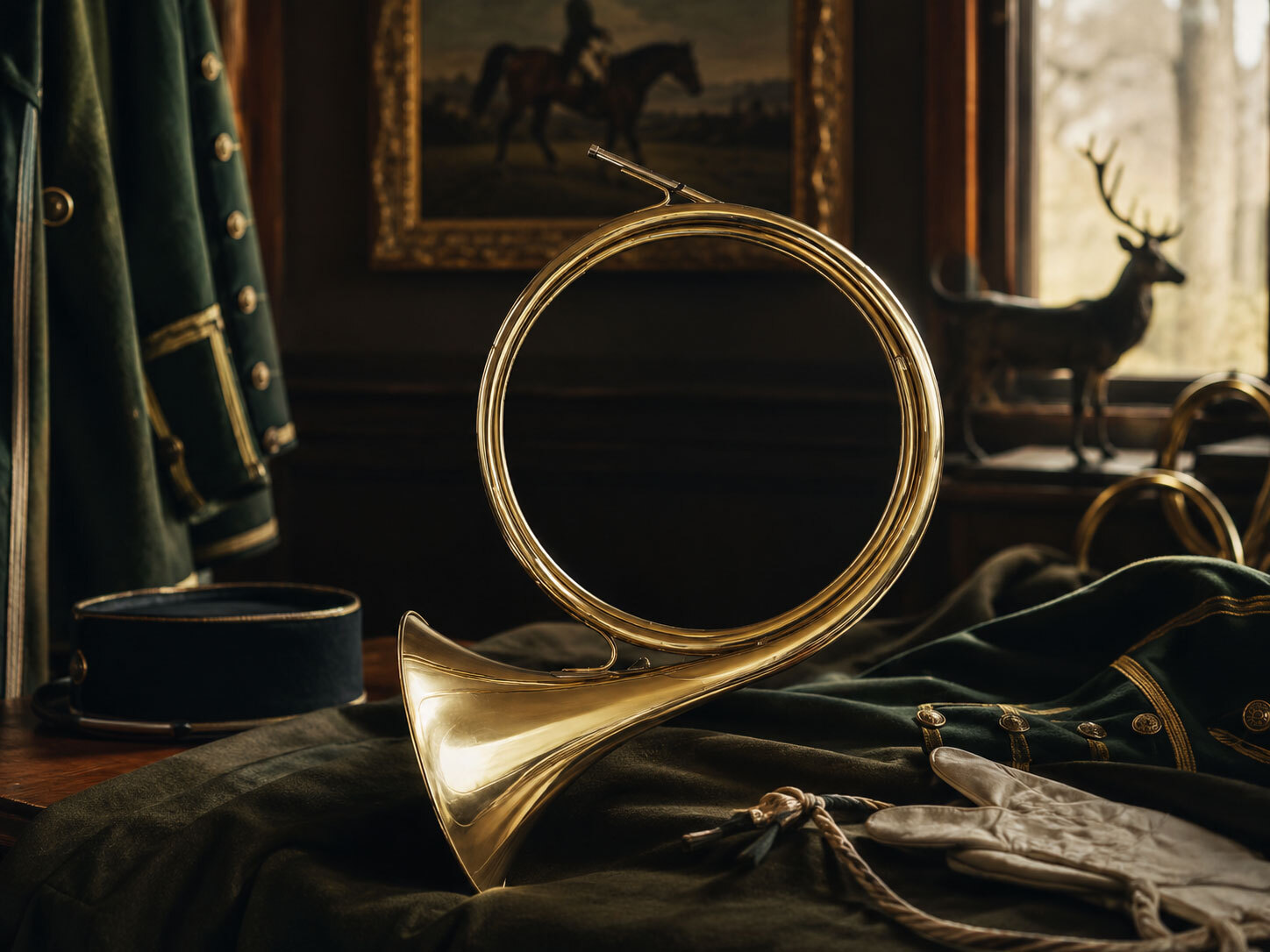
Since its birth classical music has evolved continuously and the major periods of its history have developed accordingly. It passed from Baroque to Romantic and from tonal to atonal, searching for itself and re-inventing itself continually. The music of the French hunt, of the chasse à courre, has taken a different course. Having undergone some early evolution, it became fixed in the 18th century. Nowadays it represents one of the finest and liveliest of the typically French traditions.
This tradition is linked to the history of France and in particular to that of her kings. They were all huntsmen and most sounded the horn, from Charlemagne, who acquired his title “the Great” after an act of bravery while hunting, as well as Louis IX who had his horn buried with him, François I who was regarded as the father of huntsmen, and Charles IX who, according to his surgeon Ambroise Paré, died at the age of twenty-four “having over-tired himself by sounding the horn”, right up to Louis XV who, along with the Marquis of Dampierre, experienced hunting at its zenith and was probably the last king to sound the horn.
The everyday French word for the horn is cor (from the Latin cornu and cognate with the English horn) and since the mid 18th century the terms cor de chasse and cor d’harmonie have been used to distinguish the hunting horn from the orchestral horn or Waldhorn. Those initiated into the ways of the French hunt, however, refer to their instrument as trompe (or trompe de chasse; confusingly, from Latin trumba, cognate with English trump, trumpet etc.) and to playing it as sonner de la trompe (rather than jouer du cor). The “two trumpets of silver” in the Lord’s instruction to Moses (Numbers 10,2) appear in the French Bible as “two silver trompes”.
The history of the French hunting horn and of its manufacture is known to us largely through pictures, engravings and tapestries, often the work of famous artists.
The horn was made originally from a cattle horn and later from metal. The engravings in Jacques du Fouilloux’s book La Vénerie show it in 1561 already wound into a coil. During the reign of François I the instrument became longer and two kinds of sound were produced from it, the ton gresle and the gros ton (literally “shrill sound” and “large sound”). Under Henri IV, around 1600, there appeared a horn 2.27 metres long and wound into six or eight coils, known as La Maricourt (this horn is still in use today for harecoursing). The year 1680 saw the appearance of a horn in C sounding an octave below the cavalry trumpet. It was wound in a single coil, measured 2.27 m. in length and had a bell 14 cm. in diameter. The only extant example is in the Senlis Hunt Museum near Compiègne. This is probably the type of horn which Count Sporck discovered while living at the court of Louis XIV at Versailles around 1680 and which he later introduced into Bohemia. In 1705, at the end of the reign of Louis XIV, a new horn appeared. It was in D like all later ones wound in one and a half coils, 4,545 m. long and had the very wide diameter of 73 cm. This was Dampierre’s horn and an example of it can be seen in the Paris Conservatoire museum. After 1729 an instrument maker called Lebrun wound this large horn into two and a half coils, bringing its diameter down to 55 cm. In honour of the birth of Louis XV’s first son (the dauphin) he called this horn “La Dauphine” and many examples of it survive.
Around 1830 Louis-Philippe’s son, the Duke of Orléans, had this horn wound into three and a half coils, further reducing the diameter to 45 cm. This horn was known first as demi-trompe, then trompe d’Orléans and finally trompe Périnet, the “Périnet horn”, after François Périnet, apprentice to the original maker Raoux.
This it the horn used today. As the horn was carried over the shoulder, changes to the way in which it was coiled were dictated by dress fashion and it is quite clear that the large diameter of the Dauphine horn was due to the wearing of the cocked hat. The firm of Périnet still exists today with hunting horns being made by Michel Bureau. There are several categories of instrument according to the thickness of the metal used, which influences the weight and thus the sonority of the instrument. The most common model is the trompe de Piqueux, weighing about 940 gm. and the trompe de Maître, weighing about 840. The age of a Périnet horn can be determined from the address inscribed on the bell garland. This one (Ill. 1) was made between 1870 and 1874.
Brass Bulletin 39, III / 1982 pagine 26–38
Tutti i contenuti sono protetti dal diritto d’autore © Brass Bulletin 1982–2026