Ofrezca Brass Bulletin en su universidad, conservatorio o biblioteca Descubra el acceso institucional

7 min de lectura

The contrabass trombone

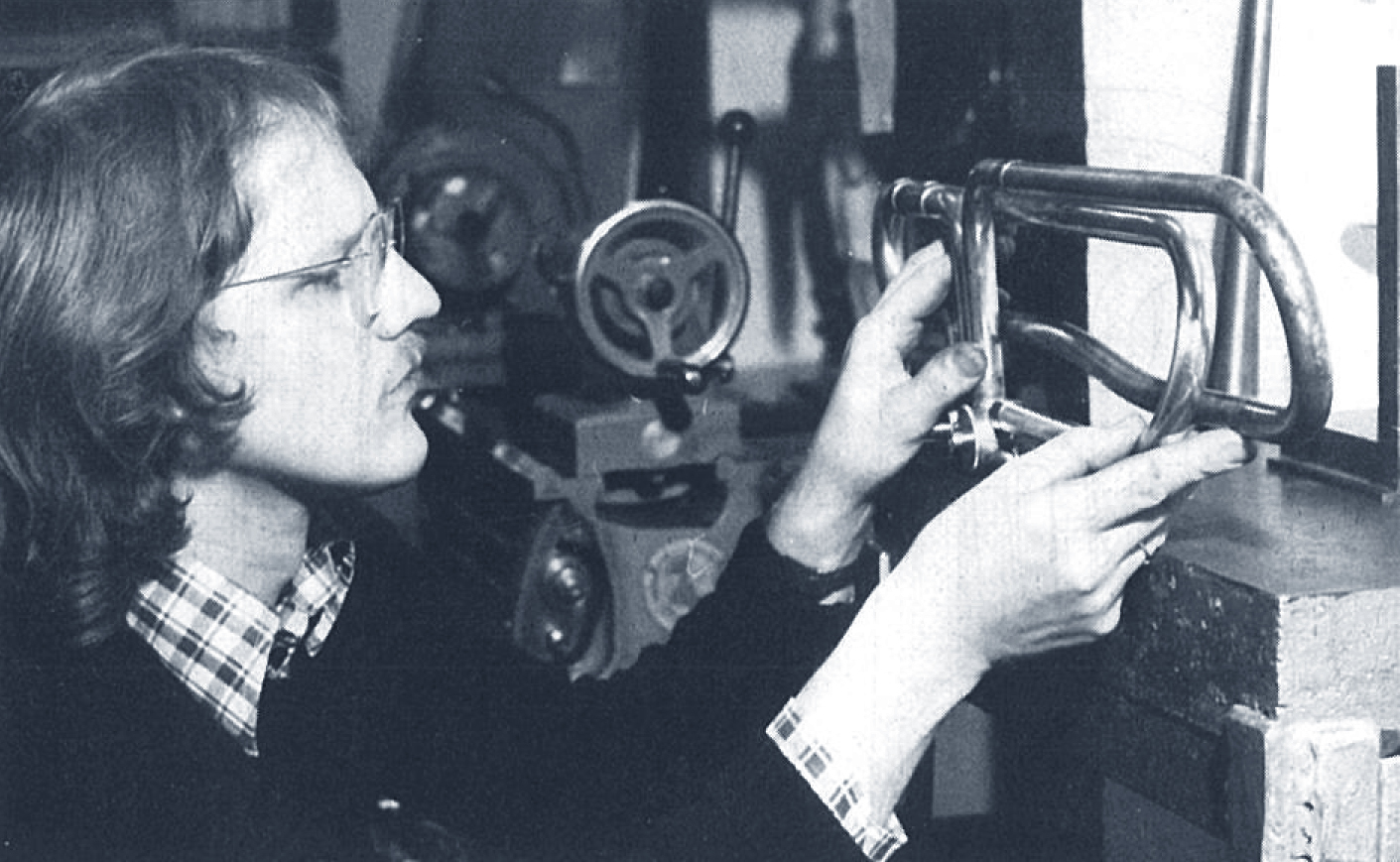
Picture and sketches, taking particularly into account the construction principles (1973)

Parte 2 – Fin

Por Heinrich Thein

Inside the workshop of innovation: Heinrich Thein reveals how rethinking every detail—from valves to bell—transforms the contrabass trombone into a modern orchestral instrument
The contrabass trombone

II. Constructional Aspects

2.1. Model construction

At the beginning of instrument manufacture there is first of all the drawing, whether it is the sketch of an idea as the preliminary stage to an individual design, or the hand or workshop design of an approved model.
The contrabass trombone dealt with here is a new construction design by the author, Heinrich Thein, based on an approved model.
This existing model is the contrabass trombone by Heinrich Kull, Witzenhausen.
His instruments are to be found in the European large symphony and opera orchestras and are praised especially for their good intonation (ill. 1).
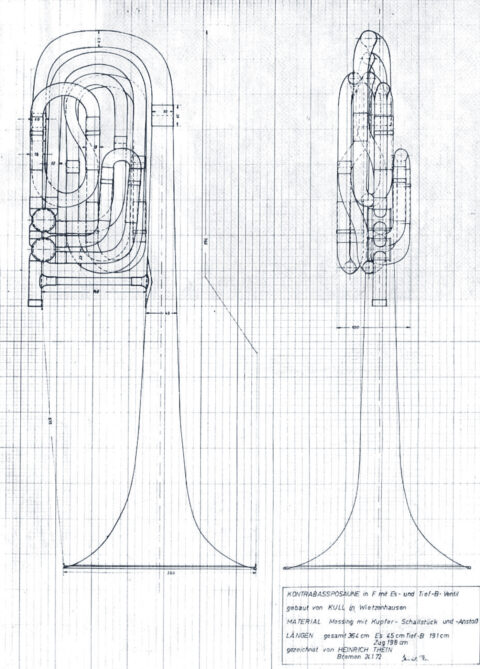
1. 

When examining the instrument and the drawing and in discussion with contrabass trombonists faults in the construction came to light: disadvantageous upright position of the valves, one above the other. Very long depression of thumb levers. The instrument spoke badly when valves were depressed and various slides which collected condensation were difficult to remove.

These faults in the model by Kull have all been corrected in the new design (ill. 2). The valves were put side by side and turned downwards. They are operated by a stable thumb valve mechanism which has a very short depression.
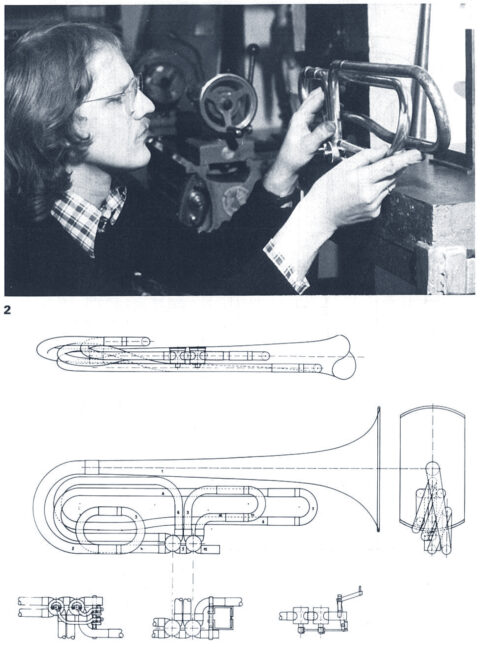
The tuning slide was positioned in such a way that it can be pulled out comfortably in the playing position, besides the condensation from the main tube collecting in it.

The shorter tube lengths are contained in as many straight sections and round bows as possible, so that the vibrating air column is unhindered by any narrow tubing. The rounded tubing creates an improvement in the way the instrument speaks, as has been proved. In consequence all the bows in this design have been built as rounded slides.

The "innards" (subsidiary coils) are positioned in such a way that all the condensation is collected in two easily accessible slides, which at the same time serve as fine tuners for the short sections. The inclusion of a bell stay was completely left out, and not only for reasons of weight. The bell section is unencumbered, which according to the latest knowledge acquired in instrumental constructional techniques contributes a great deal to improved response.

2.2. Basic pitch

The discussion about the basic pitch of the instrument finishes with the fixing of the main tube length and the individual tube sections for the "guts" (valve slides). The main tube length is 364 cm, of that 198 cm is allotted to the slide. The low Bb valve is 191 cm long, the Eb valve 45 cm. The present instrument is built in high orchestral pitch a' — 445 Hz.

2.3. The bell (complete)

2.3.1. The actual construction of the trombone begins with the preparation of the unfashioned bell section. This was ordered from the firm Meinl und Lauber, Geretsried, according to the construction design by H. Kull, Witzenhausen. The material is gold brass with French rim. The raw section is checked with respect to the bore, scoured, cut to length, smoothed off, ground and receives preliminary polishing (ill. 3).

Continue reading

Accede a la edición digital completa.

Brass Bulletin 23, III / 1978 páginas 55–64

Todo el contenido está protegido por derechos de autor © Brass Bulletin 1978–2026

Compartir este artículo

Facebook LinkedIn
Cargando…

Preguntas y respuestas

Cómo funciona la edición digital

¿Qué incluye la edición digital?

La edición digital reúne los artículos ya digitalizados como textos legibles y consultables en línea —no simplemente como escaneos o archivos PDF— junto con sus ilustraciones originales, notas, autoría, información del número y traducciones disponibles. Las sugerencias de artículos relacionados incluyen actualmente solo este material digitalizado.

¿Los artículos digitales son idénticos a los originales?

Conservamos con la mayor fidelidad posible el texto original, el idioma, las ilustraciones, los pies de imagen, las notas y el contexto editorial. La presentación se adapta para facilitar la lectura en línea y pueden corregirse errores evidentes de transcripción o escaneado. El contenido y el carácter del artículo publicado permanecen inalterados.

¿Qué idiomas están disponibles?

Brass Bulletin se publicó en inglés, francés y alemán a lo largo de toda su historia. Las traducciones al italiano y al español se añadieron a partir del número 60. Por este motivo, en los sitios italiano y español los artículos de los números 1 a 59 se muestran en inglés de forma predeterminada.

¿Con qué frecuencia se añaden nuevos artículos?

Se añaden nuevos artículos casi a diario, con aproximadamente un número completo digitalizado cada semana. El ritmo puede variar según el trabajo de preparación, tratamiento de imágenes y revisión editorial necesario.

¿Por qué no están disponibles todos los artículos en formato digital?

La colección completa de Brass Bulletin contiene 1.246 artículos publicados entre 1971 y 2003. El índice completo ya está disponible en línea y permite descubrir todos los artículos de la colección, incluidos aquellos cuyo texto íntegro todavía no ha sido digitalizado.

La digitalización comenzó en febrero de 2026. Cada artículo se prepara cuidadosamente para la lectura en línea, se revisa y se vincula con su número, sus autores, sus temas y sus ilustraciones. Al ritmo actual de digitalización, se prevé que la colección completa esté disponible en línea en febrero de 2028.

¿Por qué algunas referencias mencionan artículos que todavía no están disponibles?

Las referencias de los artículos originales se conservan aunque el material al que remiten aún no haya sido digitalizado. De este modo se mantiene intacto el contexto histórico y editorial. A medida que se incorporen más números a la edición digital, un número creciente de estas referencias conducirá a artículos que podrán leerse en línea.

¿Puedo sugerir un artículo o informar de un error de transcripción?

Sí. Si hay algún artículo que le gustaría especialmente ver digitalizado, o si detecta un posible error de transcripción o algún dato que falta, póngase en contacto con nosotros. Los comentarios de los lectores nos ayudan a mejorar la edición digital y a establecer prioridades útiles dentro del archivo.

¿Cómo puedo apoyar a Brass Bulletin?

Su apoyo ayuda a financiar la preparación, verificación y publicación en línea de la colección completa.

Suscríbase a la Edición Digital

¿Prefiere apoyarnos sin suscribirse?

Haga una donación

¿Cómo avanza la digitalización?

Estamos poniendo Brass Bulletin a disposición de los lectores en línea, artículo por artículo. Pueden leer los artículos recién digitalizados en cuanto estén listos, incluso antes de que se complete un número entero.

Consulten nuestro calendario de digitalización para descubrir las últimas novedades y las fechas estimadas de disponibilidad de los próximos números. Estas estimaciones se basan en nuestro ritmo reciente y pueden cambiar.

Busca en Brass Bulletin.