3 min di lettura
A brief survey of the history of the Finnish brass music
Di Simo Kanerva
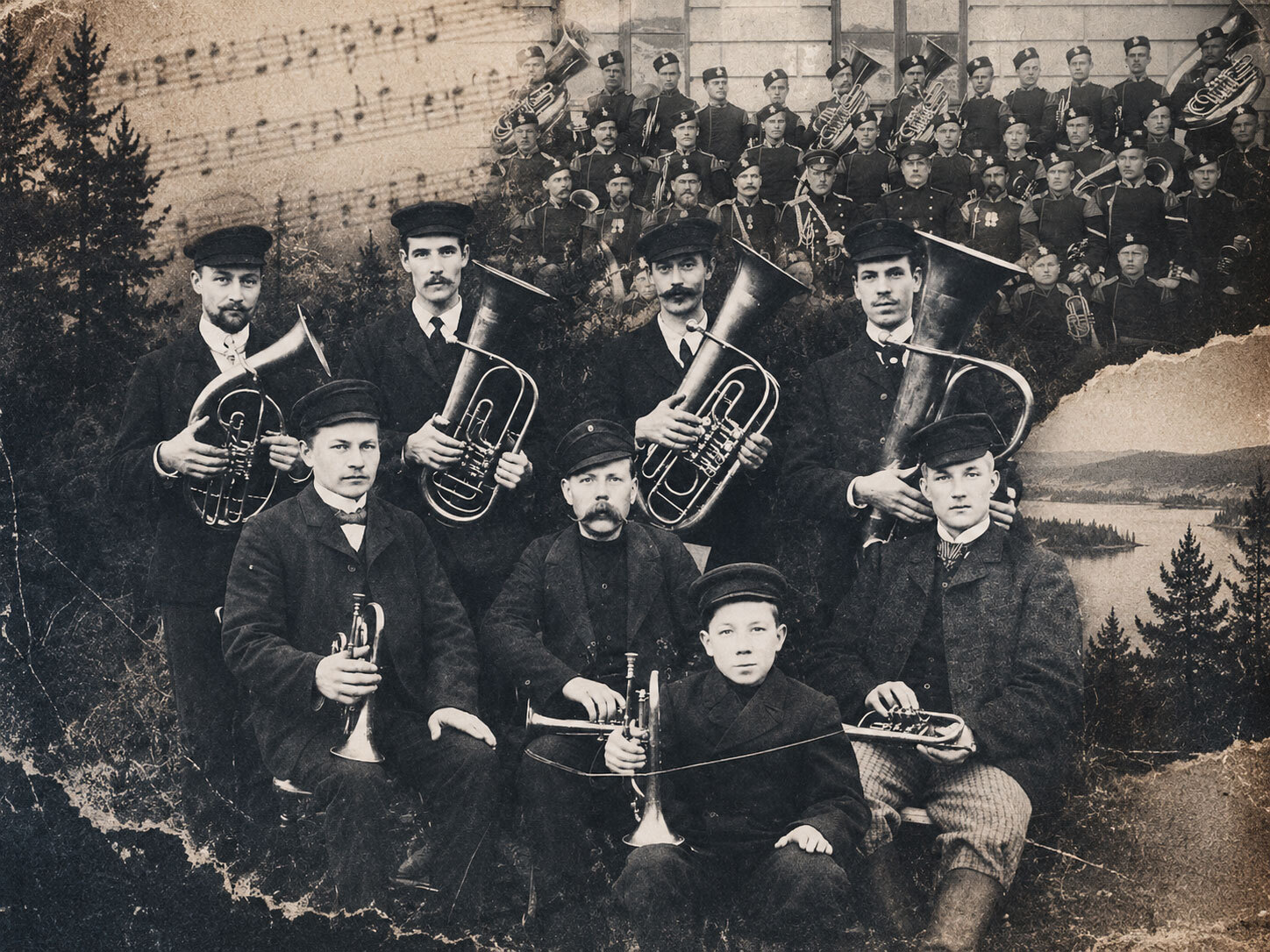
For geopolitical reasons the roots of the Finnish brass tradition can be found in two different places — the east and the west.
Eastern influence
The instrumentation of the Finnish military band reached us from the east during the Russian occupation, as did the “horn septet”¹, now a characteristic brass grouping in Finland.
The defence forces of that time, as also various civilian organisations, workers’ and sportsmen’s clubs, voluntary fire brigades etc., adopted the horn septet. The repertoire consisted mainly of contemporary dance music — polkas, schottisches, waltzes, tangos and foxtrots — but sometimes “overtures” or other “more serious” art music was wanted at the beginning of a function.
A quite special style
Soon this combination developed a quite special style of playing. The modern septet has little in common with its Russian — or any Slav — ancestor: only one element of its repertoire, plaintive waltzes or romances, often performed as baritone solos. Apart from that the “east” is hardly to be heard, so much have repertoire and playing style changed over the years.
Today the horn septet can be considered a Finnish combination, probably not to be found anywhere else. Its “golden age” was of course before the Second World War, when there were no amplifiers. It is no exaggeration to say that the horn septet was a significant element of Finnish popular culture, despised by adherents of art music as much as dance bands in restaurants are today.
Audience’s taste change
The septet’s popularity began to wane after the Second War. The audience’s taste changed, amplifiers brought new line-ups, defence organisations were disbanded, workers’, sportsmen’s and firemen’s celebrations were not so popular; the septet had less and less opportunity to play.
With time the art of playing the E♭ cornet was almost lost; it was often replaced by the clarinet, and the tenor horn by the trombone, to achieve a more modern sound.
Revival
Yet the septet proved very durable. Professional players in symphony orchestras did their bit to protect the tradition, playing “something lighter” for relaxation.
The two best groups were: Solistiseitsikko Otava, which consisted of the brass from the Helsinki City Orchestra, and Solistiyhtye Imperial, a modern group consisting of members of the Finnish Radio Symphony Orchestra. The latter is still very popular and its conductor and arranger Erkki Karjalainen is one of the instructors at Lieksa Brass Week.
The old septet tradition is now experiencing a revival and the first septet contest will take place this summer. In addition to the traditional septet music the set pieces include arrangements of classical music. And so the septet, still with its own instrumentation of course, is becoming familiar with modern brass ensemble music.
Brass Bulletin 53, I / 1986 pagine 52–55
Tutti i contenuti sono protetti dal diritto d’autore © Brass Bulletin 1986–2026