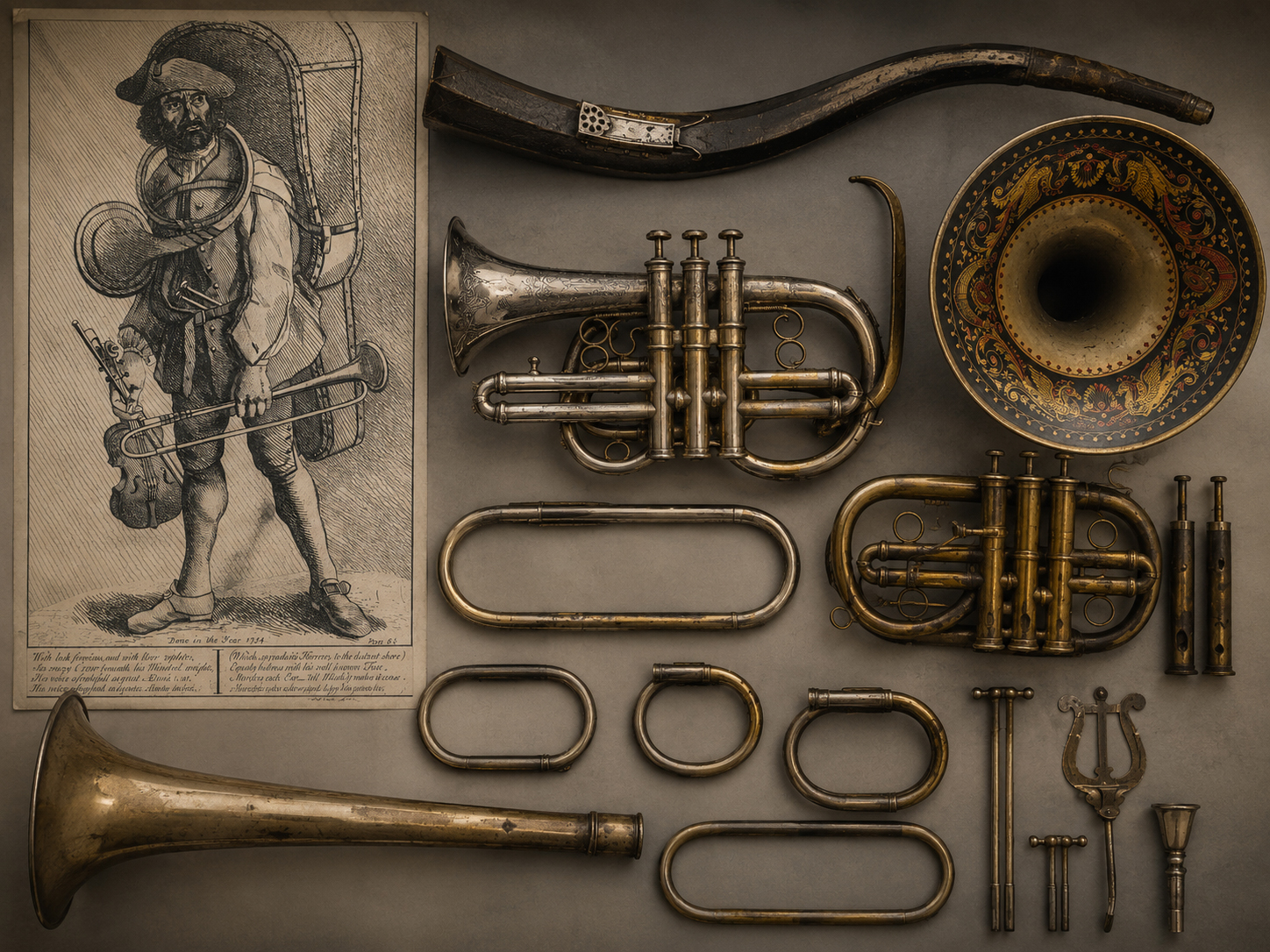
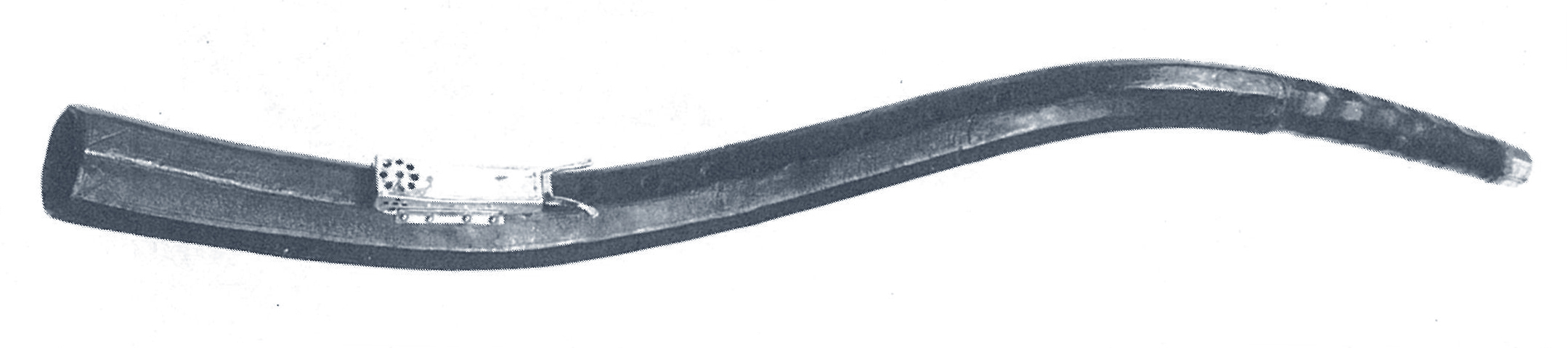
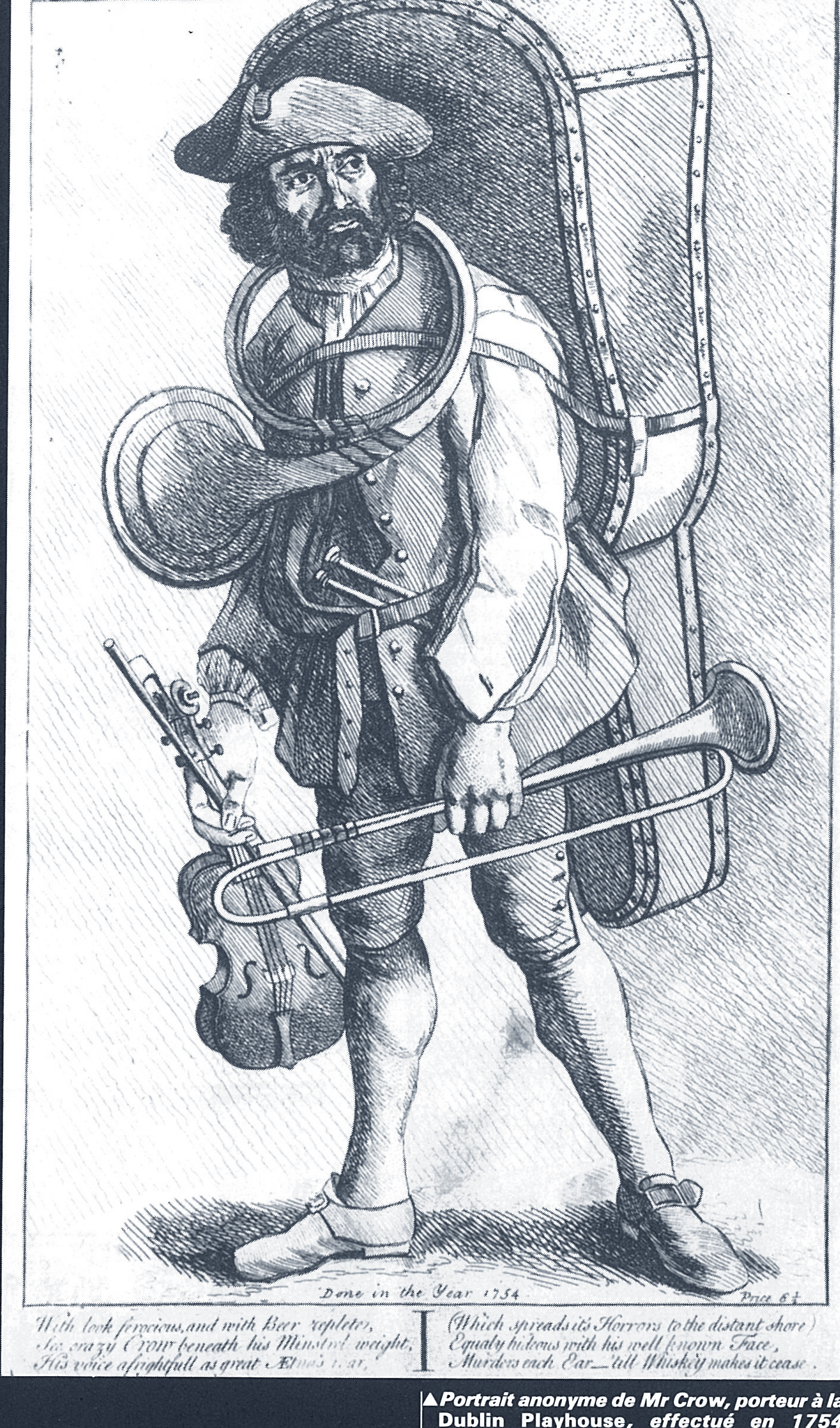
Anonymous, Portrait of Mr. Crow, Porter to the Dublin Playhouse, “Done in the Year 1754”.
But no-one else was doing what he was doing and there were plenty of instruments available, often quite cheaply. From the Portobello Road he moved to the King’s Road, the highway of the swinging ’sixties, then to the West End and finally, six or seven years ago, to Hampstead. From there he travels around the world visiting auctions and following up leads given him by his contacts.
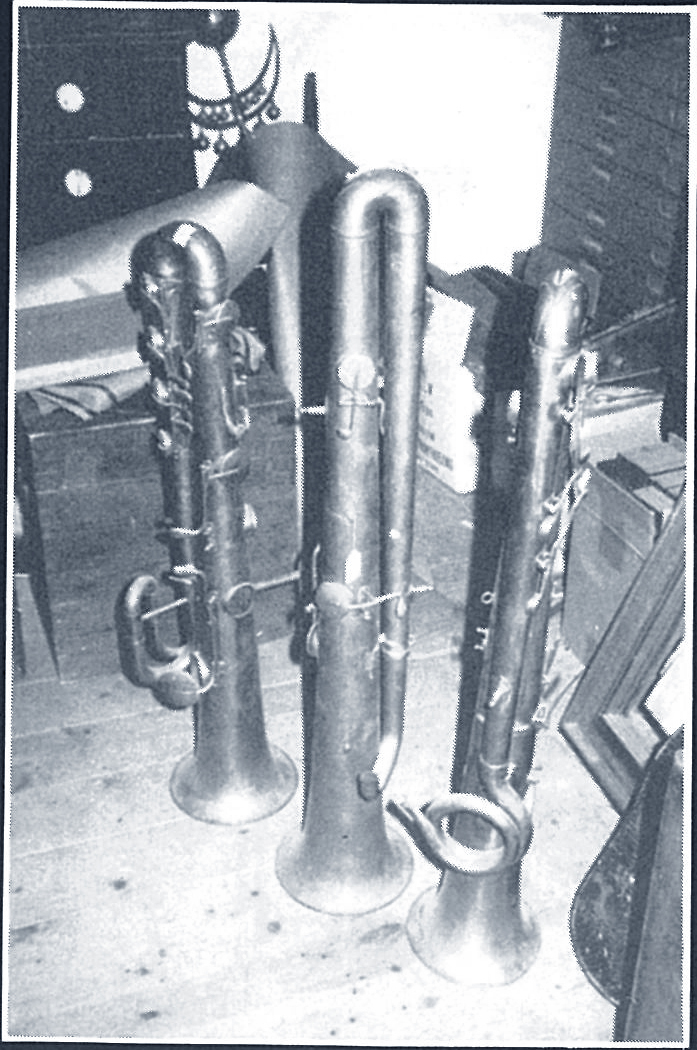
Three ophicleides await restoration.
“I’m interested in more or less everything. Of a certain age. I don’t really deal in what I call modern second-hand instruments. There’s no really solid cut-off date, but 1900 is a sort of rule of thumb. I don’t refuse to buy anything made later, but it’s not what I’m looking for.”
He doesn’t buy violins. “There are too many violin dealers as it is and it’s very specialised.” That exception aside he is interested in all western European orchestral or art music instruments, although he does have also several African and oriental things.
If necessary he will send an instrument to one of a number of restorers who do work for him, carefully matching the craftsman to the work needing to be done. “Most things I sell are playable. I wouldn’t necessarily recommend playing a 200 years old instrument eight hours a day, seven days a week. It would wear out.”
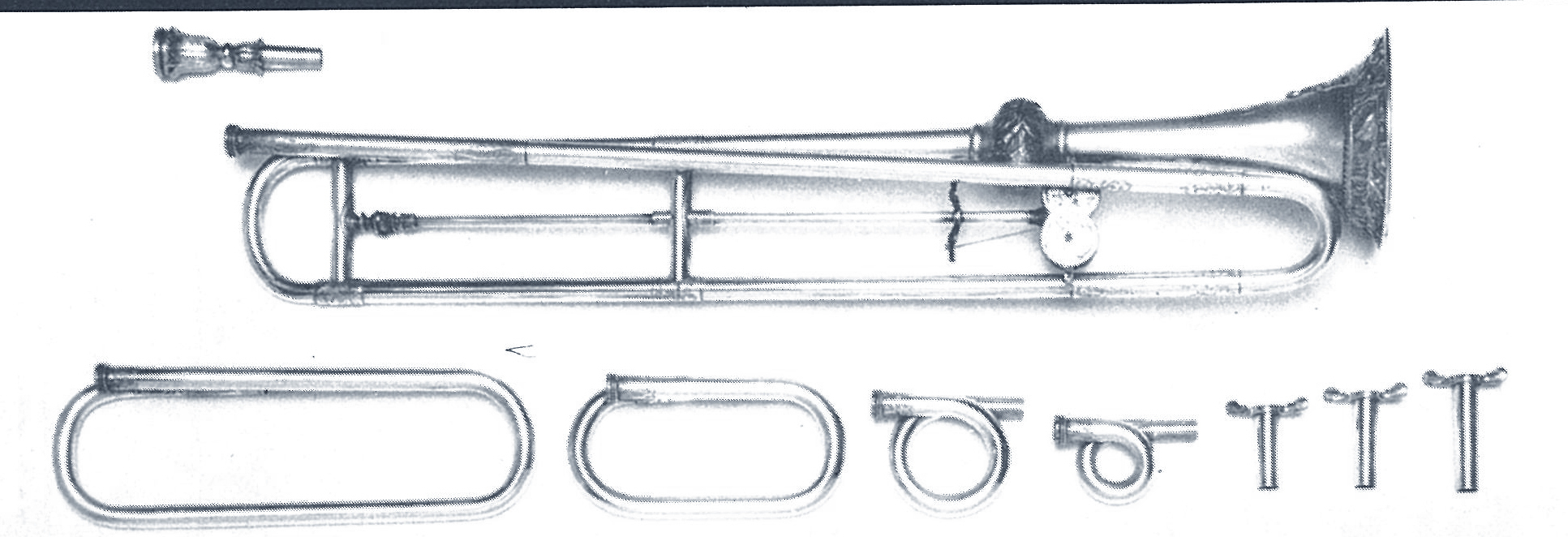
Presentation slide trumpet in sterling silver, signed, inside the bell, “ROBINSON BUSSEL & CO/7, Westmorland st Dublin”. Made c. 1840. Bell diameter 11,3 cm. Length 59,3 cm. Engraved, in a panel on the bell garland, “PRESENTED BY/Lieut. Col. Jackson K.H./& the Officers of the Carabineers/TO TRUMPET MAJOR WM COWEN/ as a mark of their approbation of his/most exemplary conduct during/a service of 37 Years in the Regt./NOVR 1840.”
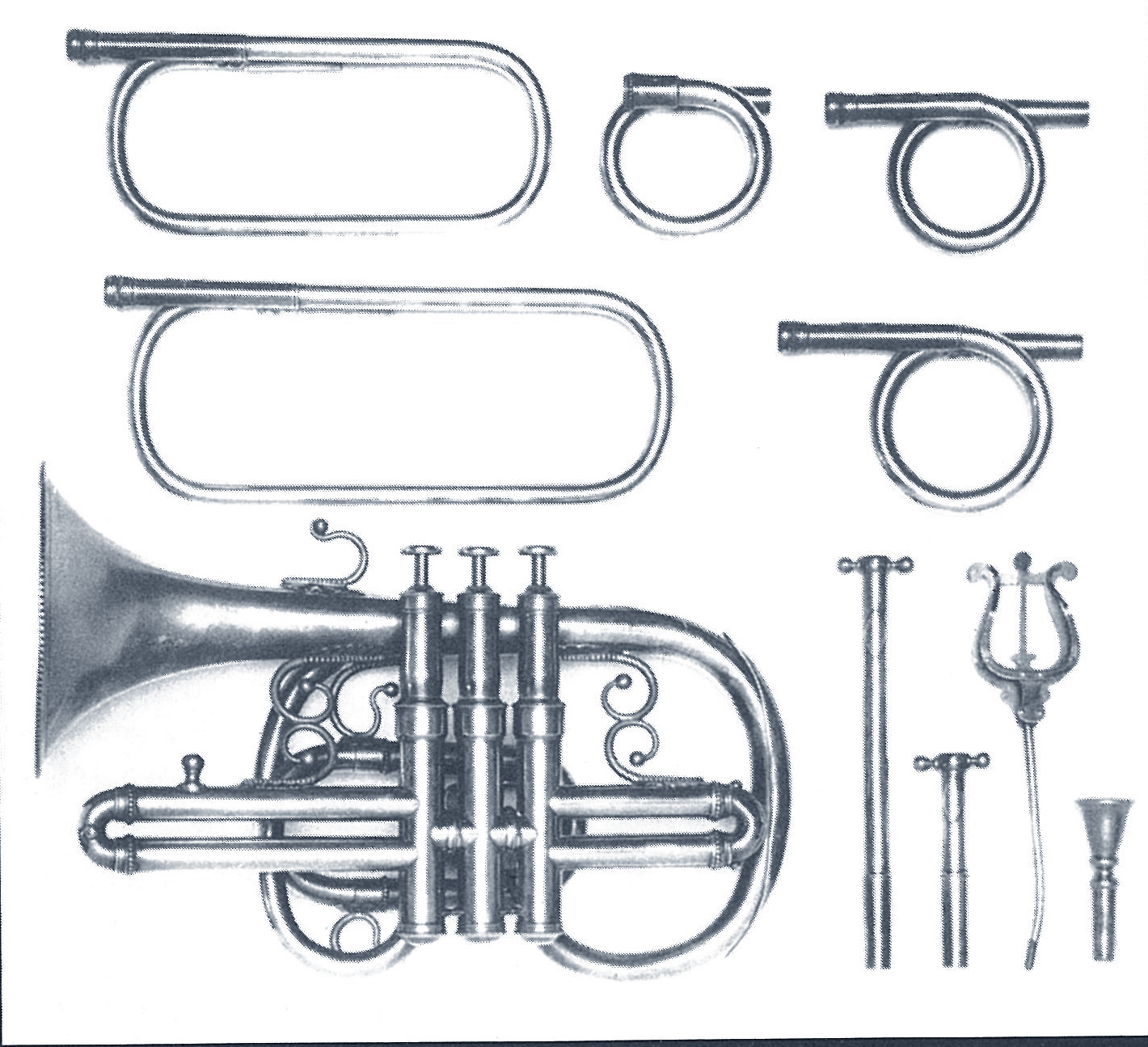
Cornet in brass with three piston valves (Perinet type), with ornate garland & fittings. Signed: “E. COURTOIS JNE RUE BICHAT 8 BIS PARIS.” Made c. 1850.
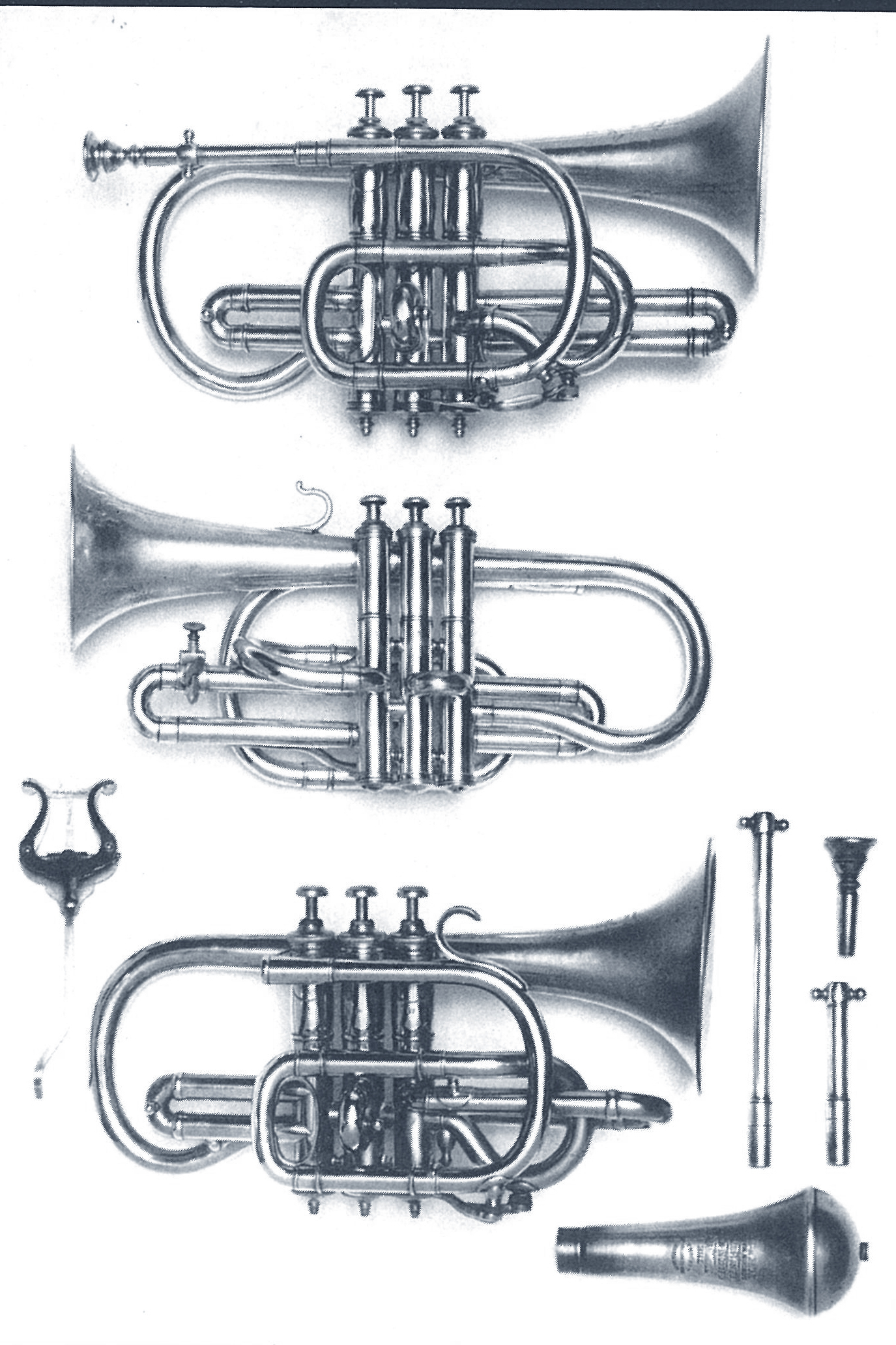
Cornet in brass with three piston valves (Perinet type). Signed “DISTIN & CO’S/Patent Light Valve/CORNET/APPROVED BY/Levy/MANUFACTORY 9 & 10 GRT NEWPORT ST/LONDON/6401”. Made c. 1865.
Cornet in silver plated brass with three piston valves (David’s patent). Signed: “David Brevete à Paris”; also engraved with a ‘MD’ monogram. Made c. 1866.
Cornet in brass with three piston valves (Perinet type). Signed “HENRY KEAT & SONS/ 105 & 103/ MATTHIAS RD/ STOKE NEWINGTON GN/ LONDON/N”. Made c. 1890.
“If people are going to make their living playing old music on original instruments, then in many ways I’m in favour of them playing accurate modern copies. Then the originals will survive as a point of reference. But I think it’s important that they can be taken off the wall or out of the cabinet and played occasionally. In America, for instance, there’s something called the Smithsonian Social Orchestra and Quadrille Band which plays late nineteenth century brass band dance music on original instruments — but they only perform about six times a year.”
Sometimes, of course, an original instrument — an ophicleide, say — will be cheaper to buy than any possible copy.
In any case, arriving at a price for an instrument is always difficult. “It has a lot to do with what I paid for it, and something to do with what I sold the last one for. Obviously one sometimes has to pay an enormous amount just to get something and you make a very small profit on it.”
Tony likes to think that the service he offers is virtually unique. Some of his very few competitors operate in countries where they have lots of problems with customs, whereas he is not much troubled that way. And he tries to acquire as much expertise as possible, researching the instruments to find out things about them that are not in the books. He makes a firm claim: “I’m reliable. People can buy things from me without seeing them and be sure of what they’re getting.”
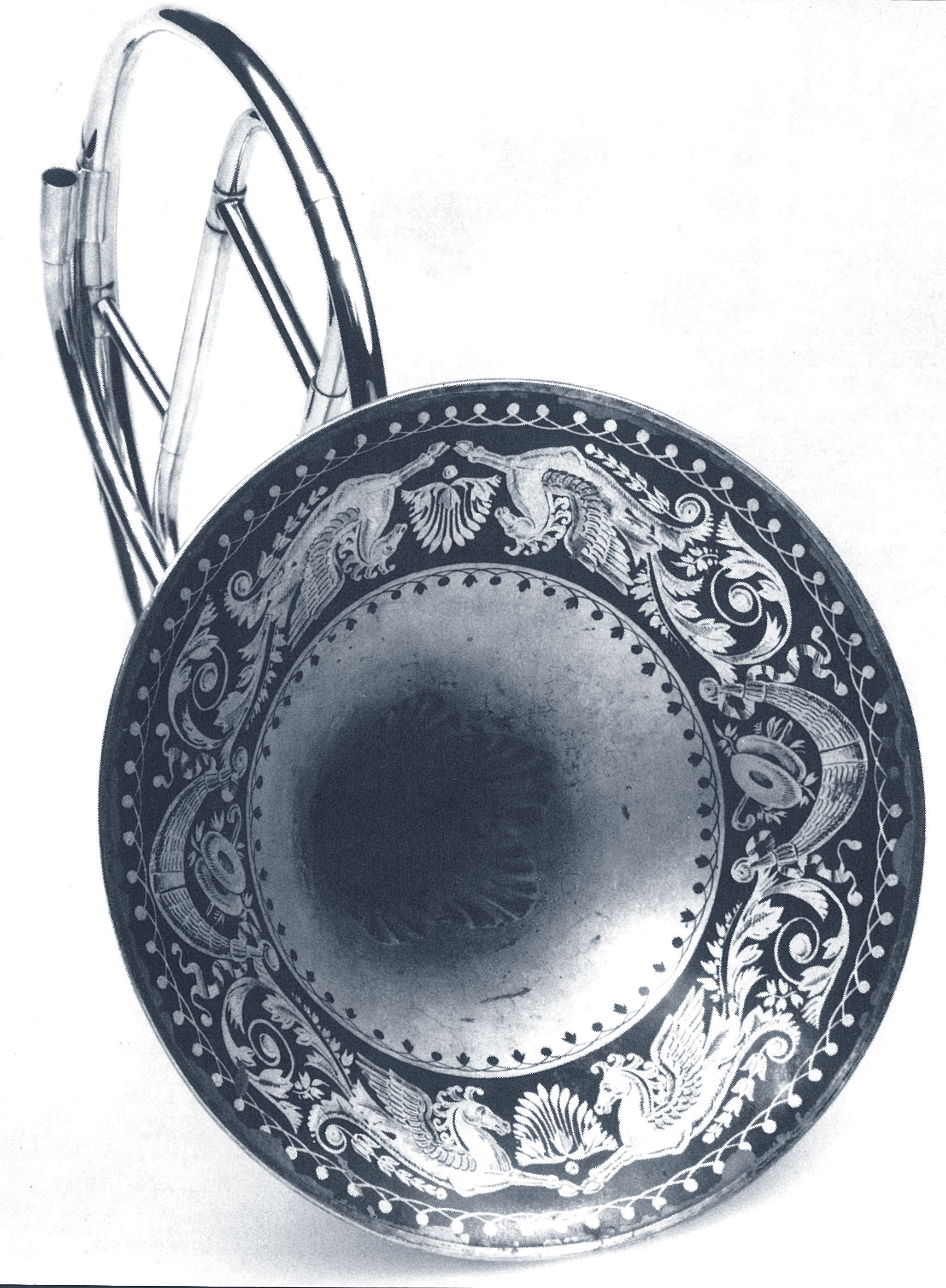
Natural horn in brass, painted inside the bell, signed, on the bell garland, “COURTOIS FRERE RUE DU CAIRE A PARIS”. Made c. 1815.
He has recently produced for his brass customers a fully illustrated and very informative catalogue which reduces the degree to which distant purchasers need buy “sight unseen”. The 36 page booklet has photographs and full written descriptions and histories of 45 instruments, and reproductions of interesting engravings of brass players, mainly from the sixteenth century. (He has his own collection of engravings and, like any good collector, sells his duplicates.) The oldest, and by a very long way the most expensive (£ 14 500 plus) instrument in the catalogue is a tenor cornett in leather-covered wood with silver mount, silver key & cover, made in Germany in the seventeenth century. Another instrument which arouses his particular enthusiasm is a presentation slide trumpet in sterling silver made in Dublin c. 1840, in its original case.
He also deals in reference works on the instruments he sells and tries to keep everything that’s in-print on his shelves. He has some out-of-print books but they are hard to find and tend to be expensive.
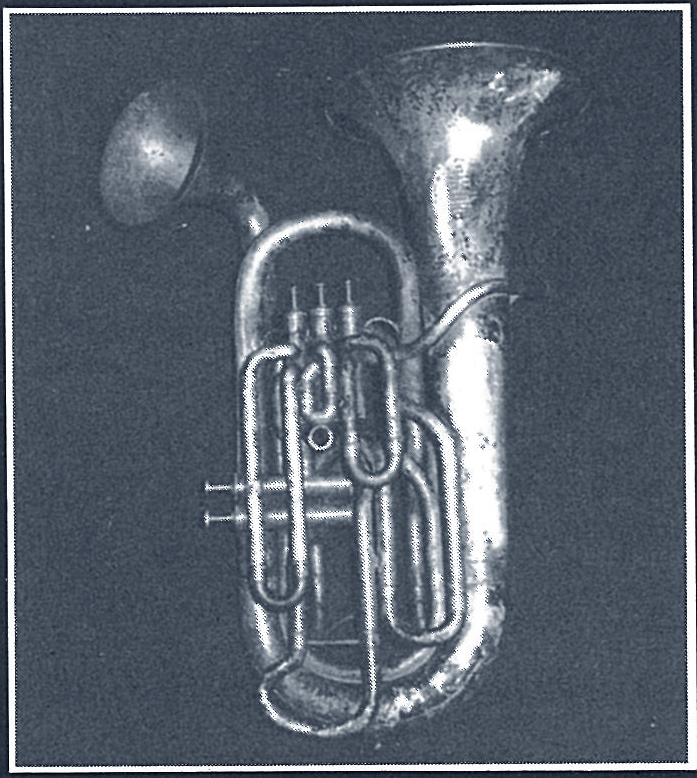
The Distin double-belled euphonium.
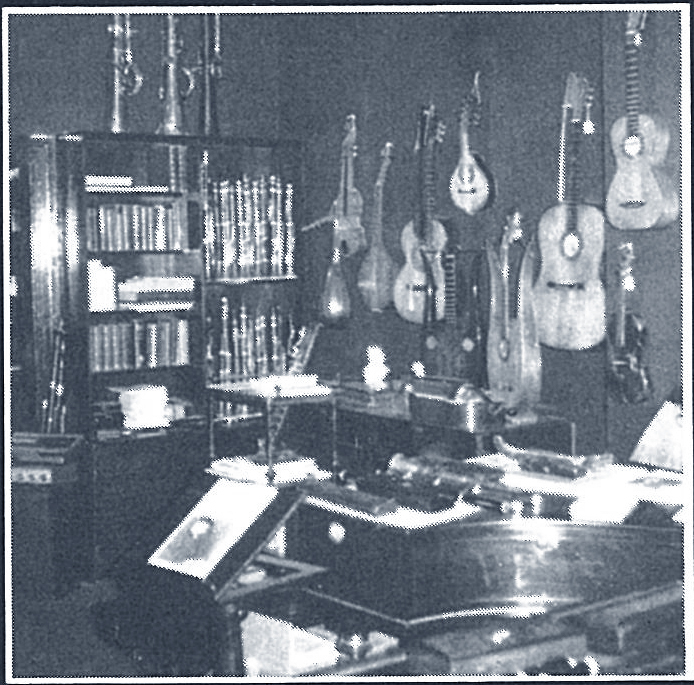
General view of the showroom.
When I leave, picking my way between the cornets and the corni da caccia, the harps and the harpsichords, Tony is turning his attention to a purchase which has already taken him abroad once this week and will do so again. Another rare old item for Aladdin’s cave.