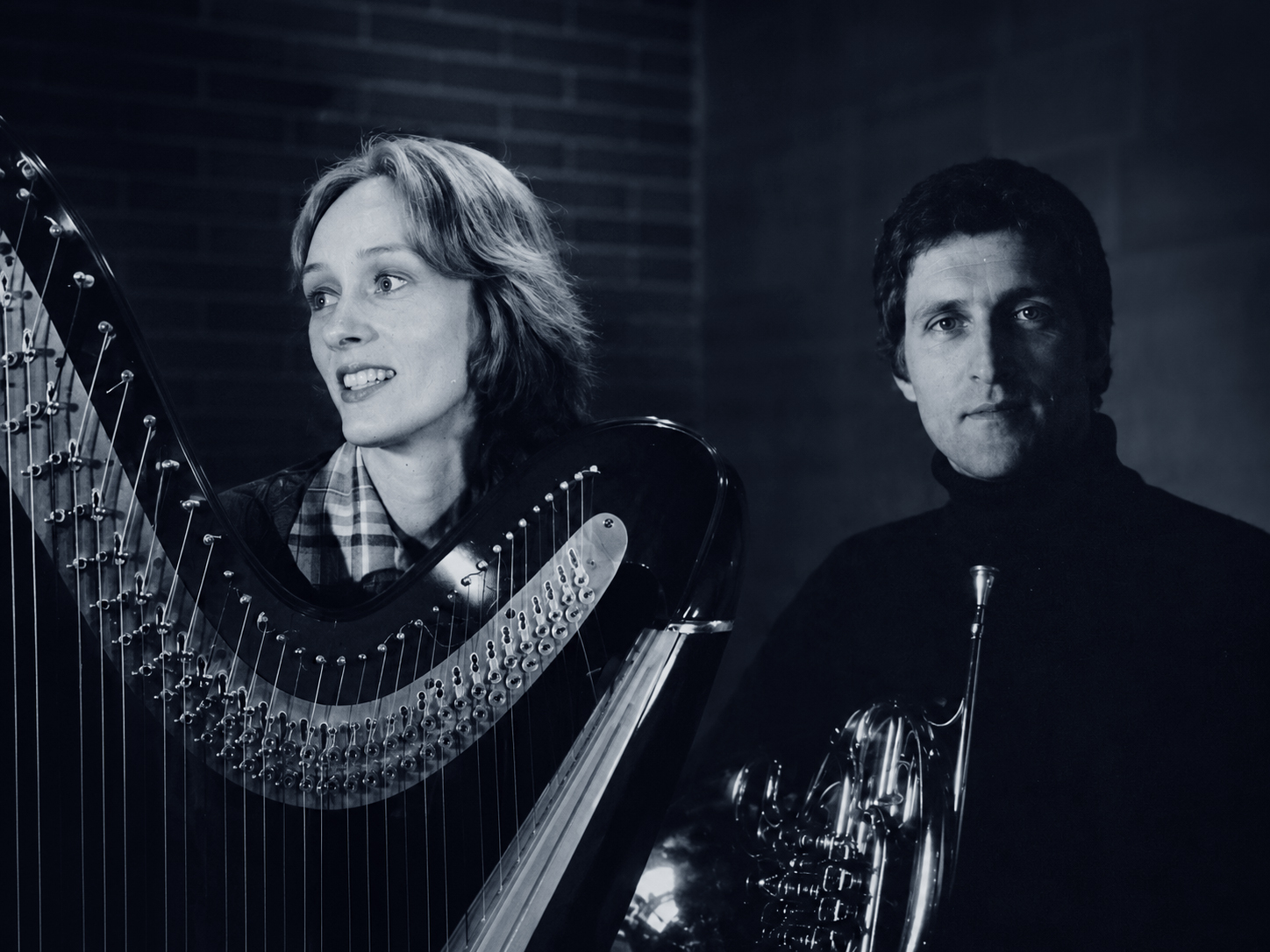
A duet by the French harp virtuoso Robert Nicolas Charles Bochsa (1789-1856) for horn (clarinet) and harp in F major op. 93 turned out to be a grateful piece for both instruments. Bochsa, descended on his father’s side from a Czech musical family, wrote numerous operas as well as a harp tutor which is still known today. He was a court musician in turn to Napoleon and Louis XVIII and had an adventurous time on his wide-ranging concert tours. Naturally enough, the harp has the lion’s share of the first movement, Allegro brillante (the word brillante is missing from the horn part). In the second movement, Siciliano, however, it assumes the role of accompanist, allowing the horn a pleasing cantilena towards the conclusion. A fiery Polonaise with a quite evenly balanced dialogue between both instruments forms the Finale. Guillaume Pierre Antoine Gatayes (1774-1846) was also a harp (and guitar) virtuoso. He was the oldest member of a French musical family and had a versatile talent, appearing also as a singer and a composer. He was originally to have become a clergyman but kicked over the traces and opted instead for the life of a musician. Manfred Maurischat also found his duet for harp and horn in F major op. 22 in the Bibliothèque Nationale. The opening movement, a Maestoso, showing traces of the Baroque ceremonial overture style in the manner of Lully, displays an alternation between harmonic and rhythmic sections for both instruments and virtuoso passagework for the harp. The subsequent Pastorale (Andante) contains grateful melodies for the horn.
The sonata for horn and harp (or piano) in F major by Louis François Dauprat (1781-1868) is available in a modern edition by Edmond Leloir (Choudens, Paris 1972). Dauprat was a horn player and his compositions constitute a valuable addition to the repertoire. Dauprat’s Belgian contemporary, the lexicographer Fétis, praised the fine sound and elegant phrasing of this virtuoso who played and taught only on the natural (valveless) horn. His horn can be seen today in the museum of the Paris Conservatoire. In the substantial Allegro moderato of its opening movement Dauprat’s sonata shows all the characteristics of a real concerto, retaining the classical sonata form: the harp starts with the exposition and after the appropriate interval the horn enters, almost like soloist, ten bars later; a subsidiary theme and virtuoso passagework follows. In the Andante and Variations the horn can display all the versatility of its technical and sonorous capabilities with runs, leaps, the drawing of melodic lines and a quasi-cadenza in recitative form. The final movement is again cast in concerto-like virtuoso style.
The repertoire of these two artists also includes L’Arbero sonore, written in 1942 by the Swiss Benno Ammann (born 1904). This piece by Ammann, who studied in Leipzig and Paris (where his teachers were Roussel, Honegger and Milhaud), is harmonically and melodically colourful and is notable, in addition to its technical and virtuoso details, for the key part played by the element of tonal colour in the combination of the two instruments.
Manfred Maurischat studied with Gustav Neudecker at the North-West German Academy of Music in Detmold and then became solo horn at the Basle Orchestral Society and a member of the South-West Radio, Hessian Radio and Bamberg symphony orchestras in turn. Brigitte Langnickel-Köhler also studied in Detmold, then in The Hague and with Helga Storck. In addition to their solo and chamber music work in radio and television recordings both artists are uniting in their search for original works for their instruments, whether modern or older music. Both live in Westphalia (FRG).